
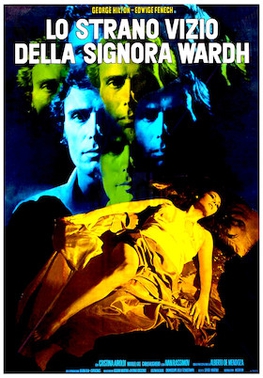
Lo strano vizio della Signora Wardh, known in English as The Strange Vice of Mrs. Wardh and also sold as Blade of the Ripper, is a 1971 Italian giallo directed by Sergio Martino and starring Edwige Fenech, George Hilton, and Ivan Rassimov. It is not a romance about negotiated power exchange. It braids an old sadomasochistic memory into a standard Italian thriller: fear, stalking, and violence. For adult viewers who know BDSM or fetish culture, the interest is not a worked-out D/s agreement. It is the pressure of a past that will not stay past.
Julie Wardh is a diplomat’s wife. She and her husband Neil come back to Vienna after living in New York. She married Neil partly to get away from Jean, a former lover. What began as sadomasochism between them turned into plain abuse. On her first night home she gets flowers from Jean and a sinister note. A straight-razor killer is also murdering women in the city. Sex and the fear of death sit on top of each other.
At a society party Julie meets George, cousin of her friend Carol. Carol and George are the only heirs of a rich dead uncle. George flirts. Julie is unhappy in a cold marriage. Outside, Jean confronts her about the past and offers her a ride. Neil arrives and slaps him. Jean laughs and leaves. After a lunch Carol arranges, Julie and George start an affair even though she does not want it at first. A blackmailer calls and threatens to expose them. Julie suspects Jean. Carol insists on meeting the blackmailer in Julie’s place. In the park at Schönbrunn Palace, Carol is killed with a straight razor.
Julie points the police at Jean. He has a solid alibi. A razor-wielding figure then attacks Julie in her building’s parking garage. She gets away. Neil takes a weapon and forces her to Jean’s home. They find Jean dead in a bloody bathtub. Julie slips out of Vienna with George and goes to Spain. Back in Vienna, one of the razor killer’s intended victims kills him in self-defense. Julie thinks the danger is over, because the dead man is a stranger. Notes signed “Jean” still show up at the Spanish house, and she breaks down. While George is out fetching a doctor, Jean — who had faked his death — ambushes her and stages the kitchen as a carbon-monoxide suicide. George and the doctor break in, pull her out, and call an ambulance.
At the police station George and Neil are told Julie is dead and that the death is suicide. Neil accuses George of murder even though the doctor has an alibi. George drives to a remote meeting with Jean, the man he hired to kill Julie. Jean wants his pay and a fake passport to Rio. George shoots him and stages a suicide so Jean cannot testify.
George and Neil then meet and lay out the conspiracy. With Carol dead, George is the sole heir. With Julie dead, Neil collects a large insurance payout and avoids bankruptcy. To alibi each other and to blame the razor killer, Neil killed Carol in the park, George attacked Julie in the garage, and after the real killer died they hired Jean. Neil sees Julie alive at the roadside. Police chase the two men off a cliff. The doctor had saved Julie. The police used a fake death to force George and Neil into the same place. Julie is driven away, comforted in the car. She has outlived the sadistic ex-lover and seen through the plot between her husband and her lover.
Just before release, an Italian woman named Mrs. Ward threatened to sue, saying the original title could harm her reputation, so an “h” was added to Ward. U.S. release titles include Blade of the Ripper. Other names include Next! and The Next Victim. Edwige Fenech plays Julie, Ivan Rassimov plays Jean, and George Hilton plays George. This is Martino’s first giallo. AllMovie wrote that “Sergio Martino’s first entry into Italy’s giallo genre delivers everything this style of thriller requires and then some,” and called it “a skillful example of how the giallo can be a head-spinning experience in style over substance.” That fits the genre’s taste for a gloved killer, a glamorous victim, and baroque murder set pieces.
On a BDSM film map the movie is an awkward neighbor. It does not show community-negotiated dominance. It shows the “strange vice” between Julie and Jean as something that already turned into harm. Razor murders, a faked death, and a staged carbon-monoxide scene are criminal horror in a fiction film, not play. The film stays in adult-movie history because an old SM history is what Julie is afraid of: marriage as the escape, flowers and notes as stalking, the staged death as the end of the plot. Watch it for Vienna, the Schönbrunn murder, and the unmasking at the cliff. It is not a lesson in how to exchange power.
![[Norio Sugiura] Another Bondage Gallery On-Set Video Elly Akira (Yuka Osawa)](https://bdsmwild.com/wp-content/uploads/2026/09/Another-Kinbaku-Gallery-Akira-Eri.jpg)