
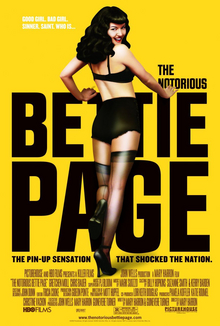
The Notorious Bettie Page, released as a 2005 American biographical drama, was directed by Mary Harron. Harron and co-writer Guinevere Turner put the 1950s pin-up and bondage model Bettie Page at the center, played by Gretchen Mol. For adult viewers who know kink film and fetish history, it is a mainstream arthouse attempt to show how a devout Southern Christian became the face of underground leather, whips, and restraint photography. Her image outlived the men who tried to burn the negatives. The leather corsets, whips, and restraints on screen are a recreation of 1950s fetish photography, not a demonstration of how to do BDSM. The burning of the negatives is a plot turn about dodging prosecution, not a method.
Page is drawn as ambitious, naïve, and deeply Christian. She leaves Nashville to get away from childhood sexual abuse, a failed wartime marriage, and a gang rape. In 1949 she goes to New York and enrolls in acting class. On the beach at Coney Island, amateur photographer Jerry Tibbs notices her and suggests the bangs that become her trademark. She quickly becomes a favorite of nature photographers, including Bunny Yeager, who poses her with two leopards. When a camera asks, she strips without hesitation. Those early reels build the paradox that made her an icon: total comfort with nudity and fetish costume, and a personal innocence about how underground consumers would use the pictures. Images of the shapely brunette reach the brother-and-sister entrepreneurs Paula and Irving Klaw. Their public business is movie stills and memorabilia. The side business is fetish photos, magazines, and 8mm and 16mm films.
Top model Maxie brings Bettie in. Soon she is posing for photographer John Willie, often at the request of Little John, a mild-mannered attorney with unusual tastes. She wears leather corsets and thigh-high boots and holds whips and chains. The film keeps stressing her innocence. She does not fully grasp the sexual charge her bondage stills carry for aficionados, even as those pictures make her a star in the underground world of restraint and discipline fantasy. For adult viewers mapping fetish media, this is kink commerce before the internet: the Klaw mail-order model, specialty film loops, and the uneasy line between the “pin-up” and a full bondage product.
In 1955 Bettie is summoned to testify at a hearing chaired by Senator Estes Kefauver, investigating pornography’s effects on American youth. She waits patiently for twelve hours. Kefauver refuses to call her and dismisses her with no explanation. Casting directors then seem more hungry for her notoriety than for any acting craft. She drifts to Miami Beach. Work thins out. Her social life nearly vanishes. She stumbles into a small evangelical church, answers the altar call, and embraces Jesus Christ. She insists she is not ashamed of what she has done, and she looks glad to leave the pin-up past. She preaches on street corners and goes back to her spiritual roots. The movie refuses a simple “repentance equals shame.” It shows a woman who can claim both the bondage stills and the gospel megaphone, and it does not deliver a tidy culture-war sermon.
Back in New York, Irving Klaw is under heavy stress and sick. He decides that he and Paula must burn their vast collection of erotic photos and film footage to dodge prosecution. Paula reluctantly does it, but she secretly saves negatives of many of Bettie’s pictures and films from the fire, so the work survives. That beat is the film’s quiet argument for fetish archivists. State panic and self-censorship nearly erase a core archive of bondage images. One sister’s disobedience keeps Bettie Page’s work alive into the late-twentieth-century revival of her icon status.
On the DVD feature, producer Pamela Koffler and writer-director Mary Harron explain why most of the film is black-and-white. Monochrome caught period nostalgia and hit the audience psychologically. Harron planned the Miami sequences in color, to contrast Bettie’s professional life with the spiritual escape she eventually chooses. Cinematographer W. Mott Hupfel III used old color stock to approach the bright Technicolor of 1950s movies. Co-writer Guinevere Turner was originally slated to star. Funding trouble and casting decisions moved the role to Gretchen Mol. Harron called Mol her first choice: emotionally right, with a natural decorum, not the vamp caricature so many auditions fell into. Mol carries both the outer Bettie, the bangs, the silhouette, the nude and leather tableaux, and the inner Bettie Harron wanted, decorous and emotionally exact rather than a vamp. A woman directed, and six of the seven producers were women. That is part of why Mol felt free enough to play nude and fetish-coded material without the usual Hollywood male-gaze machinery.
The film premiered at the 2005 Toronto International Film Festival, then played the Berlin International Film Festival and South by Southwest, before a limited U.S. release on 14 April 2006. It opened on twenty screens and took $143,131 its first weekend. The domestic total was about $1,415,082. Foreign markets added about $362,924. Worldwide box office was near $1,778,006. The U.S. DVD arrived on 26 September 2006. Those numbers fit an arthouse biopic about a bondage icon, not a wide sexploitation cash-in.
On Rotten Tomatoes the film sits at about 58 percent from 134 reviews, average near 6/10. The complaint is that it only skims the surface of Bettie Page’s life and leaves her a cipher, without placing her iconic status in a full historical context. Metacritic scores it 64/100 from 38 critics, generally favorable. That split is the film’s permanent critical problem. Viewers admire Mol’s body and her presence, and they are frustrated that Harron and Turner refuse a loud thesis about what Bettie “meant.” Manohla Dargis in The New York Times wrote that Mol plays the role with “the carefree expressivity you tend to see only in young children who have learned the joys of nudity,” and that when she strips, “Bettie soars.” Roger Ebert found the tone subdued and reflective, a “subdued nostalgia for a more innocent time” around 1950s fetish product, and a sadness that most of the women and the men they inflamed are dead: “their lust is like an old forgotten song.” Mick LaSalle in the San Francisco Chronicle said the movie “floats on the charm and the labors” of Mol, who “single-handedly makes the picture worth seeing,” and that she gives a near-cipher innocence, mischief, wit, and feeling. He argued that Harron and Turner tell the story in a curiously uninflected way and impose little meaning. That is far from a recipe for high drama, he wrote, but it has “the integrity of accuracy.” Peter Travers in Rolling Stone gave three stars out of four, called Mol “hot stuff in every sense,” and said she delivered the first actress performance of that year that “deserves serious Oscar consideration.” Todd McCarthy in Variety was colder: a superficial look researched from press clippings, Harron curiously uninvolved, a strangely placid, unchallenging picture with no blood in its veins. Mol is splendid to behold dressed or undressed, but the script offers no clues to what is going on in her head and heart, and a compliant Bettie becomes a heroine with no ambition or goal, of limited dramatic interest.
Mol was nominated for the Satellite Award for Best Actress in a motion picture drama, and lost to Helen Mirren in The Queen. Viewers chasing more Page mythology often set this biopic next to other screen treatments, including Bettie Page: Dark Angel, and next to the primary Klaw and John Willie image history. Michael Sicinski’s note in the Fall 2006 issue of Cineaste is one scholarly-adjacent reference for the production credits and the reception. The film will not satisfy every fetishist who wants a full documentary, or every historian who wants a deep account of 1950s obscenity law. What it does deliver is a careful, often black-and-white recreation of how bondage pin-ups were made, sold, panicked over, nearly burned, and accidentally preserved: leather corsets, thigh boots, whips, John Willie’s camera, Klaw mail-order, the Kefauver moral panic, and a woman who could preach Christ after posing in chains.