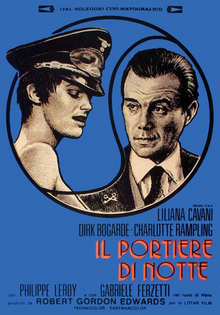
The Night Porter (Italian: Il portiere di notte) is a 1974 Italian psychological war film, co-written and directed by Liliana Cavani. Dirk Bogarde and Charlotte Rampling lead, with Philippe Leroy, Gabriele Ferzetti, and Isa Miranda in support. Since release, people have called it brave art, “romantic pornography,” or Nazi sexploitation. In 2018 it was selected for the Venice Classics section of the 75th Venice International Film Festival, and the argument was still going. For viewers who know BDSM and fetish culture, it is not a safe, sane, and consensual romance. It is trauma-bonded captivity, staged against historical atrocity, ending with the two of them dead together.
Vienna, 1957
The two timelines meet in Vienna in 1957. During the war, Nazi SS officer Maximilian Theo Aldorfer (Max) poses as a doctor in a concentration camp, takes sensational photographs, and builds a sadomasochistic tie with the prisoner Lucia. He torments her and also acts as her protector. She is interned because of her father’s socialist politics. In the flashbacks she is a young prisoner. By the 1957 reunion the character is married, an adult woman. Charlotte Rampling, who plays her, is an adult actress. The flashbacks are not erotica about a minor.
In 1957 Lucia is married to an American orchestra conductor. She runs into Max by chance in Vienna. He works as night porter at a hotel and belongs, reluctantly, to a circle of former SS men who destroy documents and get rid of witnesses. His old comrade Hans Vogler accuses him of wanting to live hidden away like a church mouse. Max prefers the shadows, but he still says he supports the cover-up. The reunion wakes what was unfinished between them. He tells hotel guest Countess Stein that he has found his “little girl” again.
The Salome flashback
Flashbacks keep driving the camp’s violence into the present. In one memory Lucia, wearing pieces of an SS uniform, sings Marlene Dietrich’s “Wenn ich mir was wünschen dürfte” to the guards. Max “rewards” her with the severed head of a male inmate who had been bullying her, a grotesque Salome echo. Chains, and later starvation, are injuries in the plot, not a safe way to play. The killing is plot, not a method.
Lucia is a threat because she could testify. To keep the secret and keep her, Max finds Mario, a former collaborator who knows she is alive, and kills him offscreen. That removes a witness and ties the two of them tighter. Max tells Countess Stein that they are both “in the same boat.” She thinks he is insane.
The apartment siege
The former SS men are furious that Max is hiding a key witness. Vogler sets Adolph, a young man at the hotel, to watch him. The police question Max about Mario’s murder. Max spends days with Lucia, chains her to the wall so “they can’t take her away,” and barely sleeps. Vogler tries to talk Lucia into staying and testifying, with a murkier long-term interest in her. She insists she is with Max of her own free will.
Max refuses the coming mock trial and calls it a farce. He says he works nights because he is ashamed in daylight. He quits the hotel and stays with her. The former SS cut off food from a nearby grocery. Vogler shoots and wounds Max on an outdoor terrace. The two of them barricade the apartment and ration what they have. Max phones an old hotel acquaintance and a neighbor. Both refuse. The neighbor is harboring Adolph.
Malnutrition pulls Lucia toward unconsciousness. After the electricity is cut, Max puts on his Nazi uniform and Lucia puts on a negligee, the kind he gave her in the camp. They leave the building and drive to a bridge. At dawn they walk the rail, with a car of old colleagues behind them. Two shots. Both fall dead.
How it was made, and how it was received
Exteriors were shot mainly in Vienna, including the Volksoper and the Central Cemetery. Interiors were shot at Cinecittà in Rome. The camp scenes were done in Rome’s Tuscolano district. Costumes are by Piero Tosi, a five-time Oscar nominee. When the Italian distributor’s budget ran out, producer Robert Gordon Edwards had editor Franco Arcalli rough-cut the strongest scenes and used that cut to persuade a colleague at the French arm of United Artists to fund the Vienna exteriors in exchange for French distribution rights.
Romy Schneider turned down Lucia. Mia Farrow and Dominique Sanda were considered before Charlotte Rampling. Rampling’s son was four months old when she started shooting. She and Bogarde rewrote and ad-libbed a lot of the dialogue. Bogarde also brought in Anthony Forwood for uncredited script help. After the shoot Bogarde seriously thought about retiring; he felt the part had used him up. Philippe Leroy, Gabriele Ferzetti, and other actors were dubbed by other voices.
Rotten Tomatoes lists about 67% from 33 reviews. The consensus is that the film’s salaciousness leaves a bitter taste on its look at historical trauma. Roger Ebert gave it one star and attacked it for exploiting memories of suffering. In The New York Times, Nora Sayre warned that people who do not love pain will not find it erotic, and that people who do may already be tired of Nazi decadence. Vincent Canby, in the same paper, called it “romantic pornography” and junk. The German magazine Filmdienst filed it as “political pornography,” which did not stop a German gross of more than $1.3 million. Michel Foucault, in Cahiers du Cinéma, criticized the sexualized picture of Nazism. In a 2000 essay Annette Insdorf called it provocative and problematic, a vision of characters doomed by their World War II past. Scholar Mikel J. Koven has called it Nazi sexploitation and put it on the same disputed shelf as other films of that kind. It is not a model of healthy kink. It puts erotic domination, uniform fetish, and chains inside a genocide and leaves that picture on screen.
![[Art Video] 1988 Slave Correspondence No.12 Nozomi Uchida Hikaru Shiina](https://bdsmwild.com/wp-content/uploads/2026/08/Art-Video-1988.jpg)
![CN-318 Immoral Fallen Angel Rinka Yaguchi [Exclusive]](https://bdsmwild.com/wp-content/uploads/2026/07/CN-318-Exclusive.jpg)