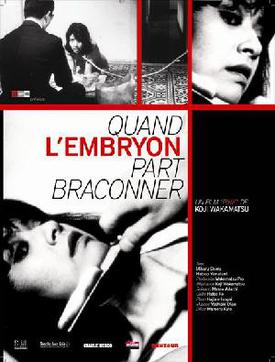
The Embryo Hunts in Secret, Japanese title 胎児が密猟する時, romanized Taiji ga Mitsuryō Suru Toki, opened in July 1966. It is the first film Kōji Wakamatsu made independently of any studio, months after he left Nikkatsu and founded Wakamatsu Productions. He was quoted at the time: “For me, violence, the body and sex are an integral part of life.” That line sits on the plot of captivity, bondage, and revenge. As early independent Japanese softcore, it has a particular place in pink-film and BDSM-media history: no studio behind it, a private torture room, rope, a razor, forced nudity, and a woman who finally turns the situation around.
The story is a small sealed apartment. A mentally unstable man keeps his girlfriend there and tortures her. He wants her naked. She is put through bondage, whipping, and razor cuts. He also brushes her hair and puts makeup on her. Care and cruelty trade places in the same tight room while his mind comes apart, and the film tracks that breakdown as closely as it tracks the abuse. The structure is a power-exchange nightmare with no negotiation. Captivity is the relationship. Grooming is control. Breaking free and taking revenge is the only “aftercare.” For kink viewers used to SSC, this is not a lesson and not a romanticized fantasy. The apartment is a dungeon he built himself. The razor is the line between eroticized violence and a murderous collapse. The bondage, the whipping, and the razor are horror plot, not a set of practices and not a model of consent.
Hatsuo Yamaya (山谷初男) and Miharu Shima (志摩みはる) lead a small cast. Two bodies, one room, no studio resources to soften it. That economy is how early Wakamatsu Productions could work on its own, and it is also where the brutality of the image comes from.
Film history often cites The Embryo Hunts in Secret as an early “stalker film,” decades before that label became a Western genre marketing term. Jack Hunter’s Eros In Hell: Sex, Blood And Violence In Japanese Cinema (1998) places it in the run of Japanese cinema about sex, blood, and violence. For BDSM-media readers the weight is not a lifestyle endorsement. It is a founding independent pink film in which bondage and razor torture are the grammar of a private power crime, and the ending is revenge, not reconciliation. Wakamatsu’s line about violence, the body, and sex as part of life is the blunt epigraph for the political softcore and underground extremity he kept pushing after the 1966 break with Nikkatsu.