
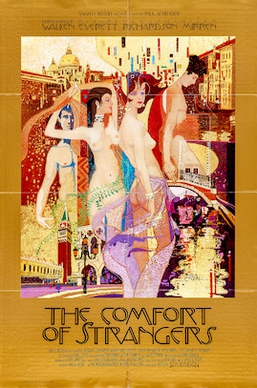
In 1990, The Comfort of Strangers played out of competition at Cannes. Paul Schrader directed it. Harold Pinter wrote the screenplay from Ian McEwan’s 1981 novel. For adult viewers who track BDSM and fetish psychology on screen, the film is a particular specimen. An English couple on holiday in Venice are pulled into the life of a glamorous local pair whose marriage runs on stalking, sadism, and murder. It is not a picture of a workable BDSM life. Power, perversion, and predation are dressed as hospitality. There is no safeword. What follows is the film’s plot, not a template and not a set of instructions.
Unmarried Colin and Mary are in Venice for the second time. While they drift among the landmarks, a stranger photographs them without consent. After dinner they get lost in the streets and meet Robert, an elegant British-Italian man, who steers them to his bar. Several bottles in, he lays out a bizarre intimate autobiography: a sadistic father who was an Italian diplomat, cruel childhood pranks by his younger sisters, and how he met his wife Caroline, the daughter of a Canadian diplomat. Colin and Mary try to get back to their hotel and get lost again. They sleep rough. At dawn they wake in a café on the square at St Mark’s Basilica, and Mary wants to cut the holiday short. Robert reappears, apologizes when he learns they slept on the street, and invites them home for a meal. A water taxi takes them to his spacious Moorish apartment. They meet Caroline. She feeds Mary, admits she looked in on them while they napped, and remarks on their beauty. Mary notices that Caroline seems to have a back injury.
Robert returns and continues the family anecdotes. In the library Colin insults him, and Robert punches Colin in the stomach. Colin does not tell Mary. After dinner the English couple go back to their hotel and have intense sex. Mary dreams, wakes, and admits she saw a photograph of Colin in Robert and Caroline’s apartment. On the beach Colin finally admits the punch. He suggests they marry when they return to England. Mary is now hesitant. Walking the city, they stumble on the residence by chance. Caroline, on a balcony, calls them up. The hosts say they leave the next day for Canada to visit Caroline’s family. Robert insists Colin come with him on a short trip to the bar. Colin agrees. Caroline stays with Mary. The house is mostly packed. Caroline says they plan to sell it when they return. Over tea she says the back injury comes from years of sadomasochistic sex with Robert.
Meanwhile Robert tells Colin he is selling the bar. Colin asks why Robert photographed him. Robert steers the talk back to family stories. Mary gets vertigo and suspects she has been drugged. Caroline takes her into a bedroom whose walls are covered with photographs of Colin taken across the vacation. Caroline explains: Robert has been stalking him since the day they arrived, after passing the couple on the street. Robert and Colin return. Colin finds Mary unable to speak and tries to get a doctor called. Robert and Caroline cut his throat with a razor while Mary watches and cannot help him. As Colin bleeds out, the hosts embrace. Later the Italian police question Mary, and she views Colin’s body. Robert and Caroline are interrogated. As soon as the detectives start with Robert, he launches the same story about his father. The compulsion and the performance do not stop under arrest.
The cast is built for that trap. Christopher Walken’s Robert is decadent without extra gesture. Helen Mirren’s Caroline is beauty, injury, and complicity. Rupert Everett’s Colin and Natasha Richardson’s Mary are intelligent enough to feel that something is wrong, and still too polite, too desiring, and too curious to leave in time. Reviews on release were generally mixed. Vincent Canby in The New York Times was positive about Schrader’s rigor and discipline: a movie “fascinated by the baroque behavior it observes, but without imitating it.” Roger Ebert gave it 2.5 out of 4. He admired the literate eroticism, McEwan’s perversity, Pinter’s terror under polite speech, and Walken’s understated danger, and he also found the characters left as ciphers and the story arbitrary and unfinished. Peter Travers in Rolling Stone called Schrader an astute guide through the byways of sexual manipulation, with “intelligent pleasures as well as gruesome chills.” Slant Magazine later gave it four stars out of five and called it underrated. The Criterion Collection issued a home-video edition in 2020 and put the title on the prestige-thriller shelf for another generation.
Caroline’s confession is the film’s explicit kink marker: years of sadomasochistic sex with Robert wrecked her back. Everything around that confession is predation without consent. Secret photographs, walls of stalking images, drugging, and murder as the couple’s climax. A real power exchange is negotiated. Robert and Caroline’s marriage is a closed system that feeds on outsiders. The hotel sex after violence and unease is thriller eroticism, danger used as an aphrodisiac, not a model of a scene. A razor is not aftercare. The film is worth reading as culture. It is not a scene template.
Venice is not postcard filler. Alleys that double back, and water taxis that deliver you to the wrong kind of palace, make the couple’s loss of agency physical. Pinter’s specialty is terror under small talk. Robert’s endless father stories are both the seduction and the trap. They fill the air until a refusal would sound rude. Schrader’s camera stays disciplined rather than baroque for its own sake, which is why Canby praised the rigor and why later reappraisals, including Slant and the Criterion essay context, treat the film as controlled erotic dread rather than messy exploitation. The Criterion-related commentary fits: the English pair think they are the protagonists of a holiday romance, and Robert and Caroline know they are writing the ending. For kink-literate viewers that authorship is the horror version of topping without consent. The script is imposed, a safeword is impossible, and the audience is made to watch the throat cut. The comfort in the title is the strangers’ comfort in each other and in the kill, not the guests’.