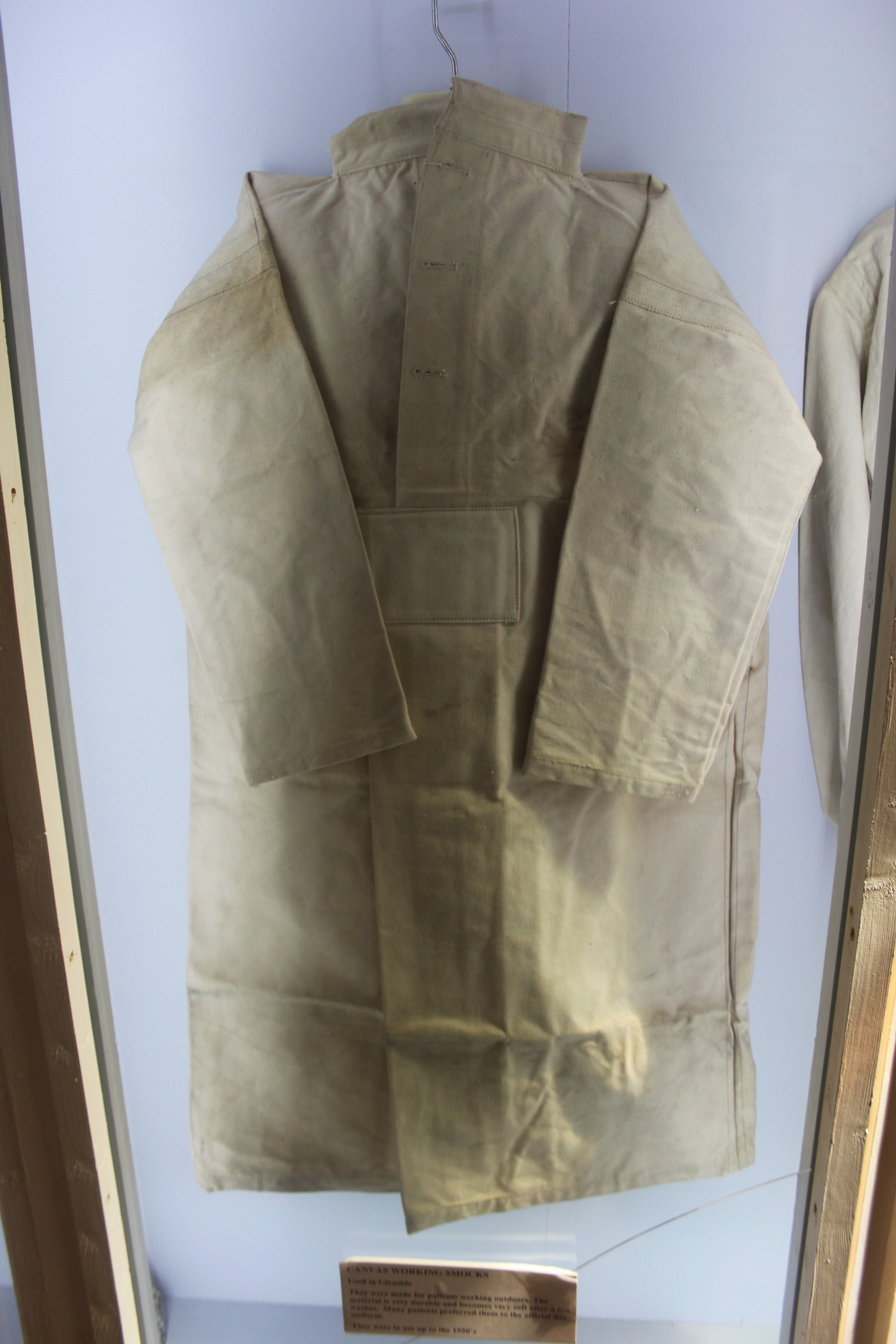
A straitjacket is a jacket with sleeves long enough to pass the fingertips. In institutions its classic job was to restrain people who might harm themselves or others. The arms go into the sleeves, the sleeves cross the chest, and the ends are tied or buckled behind the back so the arms stay pinned and can barely move. “Strait” means confinement. For BDSM and bondage players the same silhouette is fetish gear, a predicament prop, and an escape-play classic: institutional looks, a forced embrace, and the weight of being packaged as a patient or a prisoner. Stage magic turned it into a public spectacle. Dungeons and session rooms took it back as negotiated restraint between adults. The garment still carries a real history of medical trauma. A scene can be wanted and erotic, and the object was still a routine psychiatric treatment that is now widely judged cruel.
From a 1772 medical book to a lawsuit
The straitjacket is in print at least as early as 1772, in a book by the Irish physician David Macbride. French tradition also credits an upholsterer named Guilleret with a form made around 1790 for Bicêtre Hospital, the camisole de force. Before psychiatric drugs and modern talking therapies, clinics had little for schizophrenia, depression, and severe anxiety. Treatments now called cruel were ordinary. The jacket was one of them. At the height of its medical fashion, doctors often preferred it to ropes or chains. It did less damage to clothing and furniture, it cut injury to the wearer and to other people, and by the standards of the day it looked humane.
Before the American Civil War, people with serious mental illness whose families could not cope often landed in poorhouses, workhouses, or prisons and were treated as criminals. Mid-nineteenth-century reform wanted specialized asylums. Between 1825 and 1865 the number of U.S. asylums went from nine to sixty-two. More buildings did not mean better science. Physicians still guessed at causes — religious excitement, sunstroke, even novel-reading — and believed patients had lost a moral self-control that only strict discipline could restore. The jacket fit that view. Restraint was therapy and it was order. Assessors such as Marie Ragone and Diane Fenex defended it as gentler than prison chains: fewer skin abrasions, and more mobility than a person strapped to a bed or a chair. Some nursing specialists even recommended outdoor walks while restrained, control plus fresh air. Understaffed asylums were darker. Poorly trained attendants used the jacket to keep order when care was impossible. In the late nineteenth and early twentieth centuries some prisons used it as punishment or torture. Part of its modern legal meaning comes from a Canadian class action won in 2015 over misuse of a suit branded Argentino, made by PSP Argentino Inc. When the protocol fails, restraint can be litigated as abuse.
How the garment holds, and why size is the restraint
The common closure puts both arms in the sleeves, crosses them over the chest, and fastens the ends at the back. Many designs close the sleeve tips completely, so the hands cannot grip a buckle. Some anchor the sleeve ends so that struggling rotates the knot or buckle farther from the hands. Variants force the arms behind the back and hold them stricter. Most serious jackets add a crotch strap so the wearer cannot shrug the garment off upward. Loops at the front and the sides force the sleeves through fixed paths and block the classic arms-over-the-head escape. Institutional straps often use friction buckles on webbing, hard to open without free hands. Stage-magic jackets that have been gimmicked leave the loops off, use easier buckles, or hide openings in the sleeves, so the escape looks impossible and is not. Security tracks fit. Too much room at the chest and the armpits lets a person walk their arms out of the sleeves. A close fit there is the base of a real restraint. Choosing a size is the difference between a costume and bondage, not a fashion choice.
What long wear does, and the floor for play
Long wear has the same body costs in an institution and in a scene. Blood pools at the elbows and the arms swell. Hands go numb when circulation is compromised. Shoulders and upper arms stiffen and ache. The person thrashes to stretch. Institutions answer that with monitoring rules. A scene partner has to answer it with checks, a time limit, and an emergency plan. A straitjacket is not something you put on and forget. Lost circulation, compressed nerves, panic, overheating, and the inability to break a fall with the hands are real. A jacket with a crotch strap, sleeve loops, and the arms crossed is a full bondage situation. The floor for kink use, between consenting adults, is sobriety, a safeword or a non-verbal signal, shears or cutters that can get through the straps, and one free person in the room. Solo self-bondage in a serious jacket is a known high-risk category, because getting out is hard once something goes wrong. Inversion or suspension multiplies blood pressure, load on the shoulders, and the chance of a fall. A hood, a gag, or earplugs multiplies sensory control and the duty to watch. Impact or temperature play on a jacketed body has to account for a person who cannot brace or protect themselves. Afterward means unbuckling slowly, letting blood return, stretching the shoulders, warmth, and a debrief. Institutional gear can trigger a trauma response even when the scene was wanted.
The dislocation rumor, and the timed stunts
Popular myth says you must dislocate a shoulder to escape a full jacket with back straps and a crotch strap. Harry Houdini and his brother Hardeen encouraged that rumor to thin the competition. Houdini later published technical handling in a newspaper. In practice, slack can be taken without injuring the joint: elbows held out while the straps go on, the arms pulled back inside the sleeves during fastening, or a deep breath let out so the chest shrinks. Jacketing a willing volunteer can be a one-person job. A struggling person generally needs at least two restrainers. On a jacket with no front strap, the path that gets described is to work the arms up and over the head, free the crotch strap, then the neck strap, and peel the garment upward. That is a fact from the stage. It is not a template for unsupervised play, and it is not a procedure for escaping lawful restraint. Houdini is who made the straitjacket escape famous, first behind a curtain where the audience heard the thumps, then in full view once he saw that visible struggle sold, and later hung from cranes or sealed in milk cans. Those are stage facts.
The record list is entertainment under controlled conditions. In the 1980s Steve “Mr. Escape” Baker escaped two jackets while hanging upside down on Live Wednesday. On Mindfreak, Criss Angel escaped two jackets at once while suspended from a crane over Bourbon Street in New Orleans. In 2007 Cliff Gerstman did a zero-gravity escape in about forty seconds aboard a Zero G aircraft. In 2010 Alexanderia the Great got out of a regulation jacket secured with fifty feet of chain and ten padlocks in 2:37. In 2013 she did an underwater escape in a tank. The official fastest escape from a regulated Posey straitjacket is 2.84 seconds, set by Danilo Audiello on 11 August 2014 at Studio Fleming Medicina Generale in Foggia, Italy.
Buying one, keeping it, using it
In kink the jacket is institutional bondage made erotic. Goals vary: a helplessness headspace, a predicament such as standing only or kneeling only, sensation on exposed skin, forced oral while the arms are useless, photographs, medical role-play, or an escape challenge that was actually negotiated. Players use canvas Posey-style medical models, heavier leather builds, and custom pieces with D-rings, locks, and display collars. Measure chest, arm length, and torso. Ask about buckle type, strap material, the crotch design, and whether the hardware is load-bearing. Medical-surplus jackets need a real cleaning. Leather needs conditioner and dry storage, and honesty about body fluids on secondhand pieces. Metal hardware should move freely. Store the jacket fully unbuckled and loosely folded. A magician’s escape jacket belongs in the performance bag, not in the dungeon drawer, unless both people know exactly which gimmicks are in it.
Asylums that used these jackets at scale developed protocols: who could order one, how long it stayed on, how often staff checked, and where punishment started. Modern psychiatric and corrections settings tightened the rules because of that history of misuse. Kink players can take the useful half — a time limit, a free person, circulation checks — and drop the coercive half. No surprise jacketing. No medical-play script that was never negotiated. Session houses and professional dominants who offer the scene often keep several sizes, log the condition of the buckles, and refuse clients who are drunk. That discipline is a model for private play. Treat the garment as high-consequence bondage even when the look is playful. A jacket that photographed well at a convention is not automatically fit for a three-hour scene at home if a buckle sticks or the only free adult in the house falls asleep.