
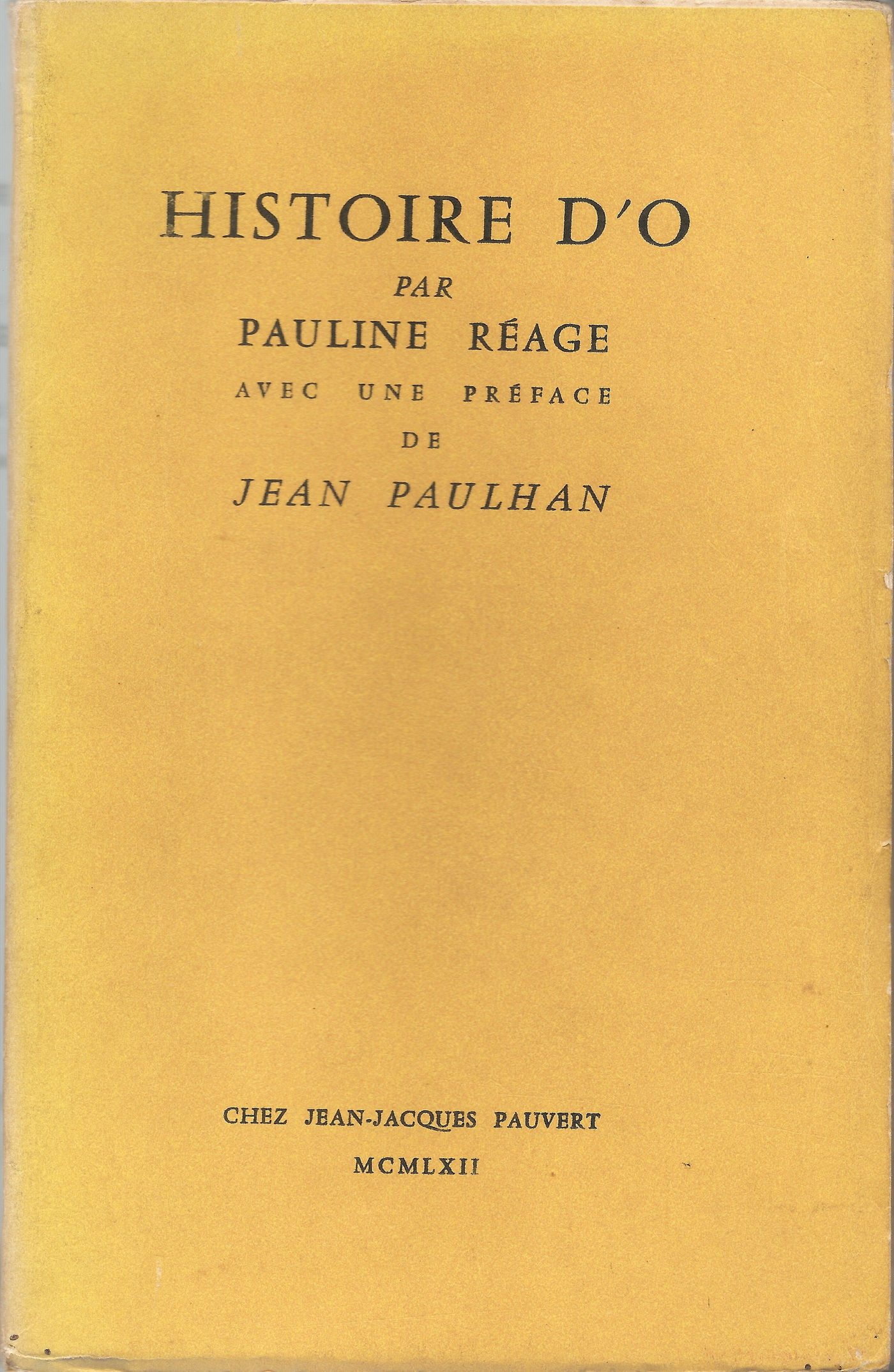
Story of O (French: Histoire d’O) is the 1954 erotic novel that still sits under half the consensual-slavery fantasies in Western BDSM. Jean-Jacques Pauvert issued the original French text. The author on the title page was Pauline Réage. The woman behind that name, Anne Desclos (also known for decades as Dominique Aury), did not claim the book until 1994, forty years later. She said she wrote it as a series of love letters to her lover Jean Paulhan, who admired the Marquis de Sade and had doubted a woman could write in that key. Love, dominance, and submission are the shared ground with Sade. The difference is the tone: O’s degradation is offered as devotion, not only as libertine catalog.
If you play with collars, houses, brands, or the erotic of being handed to a friend, you are already downstream of this novel whether you have finished it or not. That is not a compliment the book always deserves, and it is not a reason to treat a 1954 literary sadomasochism as a consent manual. It is why the page exists on a porn-and-kink site instead of only in a French-lit seminar.
Plot: Roissy, Sir Stephen, Samois, the Brand
O is a beautiful Parisian fashion photographer. Her lover René delivers her to a château at Roissy, where a secret society of men trains her to be constantly available—mouth, vagina, anus—to any male who belongs. She is stripped, blindfolded, chained, whipped. Her anus is opened with plugs that get larger. A labium is pierced. The buttocks are marked for ownership. The novel’s erotic engine is not a single implement. It is the rule that her body has become a facility.
After the first training, René gives her to his elder stepbrother Sir Stephen, a colder master, as a demonstration of bond and generosity. René wants her to serve a man she does not love and who does not love her. She falls in love with Sir Stephen anyway and believes the feeling is returned. In summer he sends her to an old house at Samois inhabited only by women, for advanced training and the body modifications that will advertise her status. There she agrees to permanent marks of Sir Stephen’s ownership: a brand, and a steel tag hanging from the labia piercing.
Meanwhile René pushes her to seduce Jacqueline, a vain fashion model, and steer her toward Roissy. Jacqueline is disgusted when she sees O’s chains and scars. O is proud of them. Jacqueline’s younger half-sister, by contrast, becomes infatuated with O and begs to be taken to the château. The climax is a party at which O is presented as a slave and almost nothing else: nude except for an owl-like mask and a leash clipped to the piercing, offered to guests who use her as an object. Afterward she is shared by Sir Stephen and a man known only as the Commander.
Some early editions added variant epilogues in which Sir Stephen later abandons her. In one version O is so wrecked by the threat of being left that she asks permission to kill herself and is granted it. Whether Desclos meant any of those tails as the real ending has been argued ever since. Paulhan himself said he was surprised by the death-wish close and did not believe it was “the real end,” or that “in reality (so to speak)” the heroine talks Sir Stephen into consenting to her death. The debate is literary. The image that stuck in leather culture is not the suicide permission. It is the château, the brand, the tag, and the woman who wants the marks.
Hidden Names: Desclos, Aury, Réage, d’Estrée
Anne Desclos wrote under a pen name, then lived for decades under another public literary name, and only near the end of her life let the last mask drop. Paulhan’s preface is written as if he does not know the author. According to Geraldine Bedell, writing in 2004, many readers were sure a man had to have written the book. The identity became public about ten years before Bedell’s piece, when British journalist John de St. Jorre interviewed an impeccably dressed 86-year-old intellectual, Dominique Aury, who said the castles, masks, and debauchery were hers. Other sources are careful about the name stack: Dominique Aury was itself a pseudonym of Anne Desclos, born 23 September 1907 in Rochefort-sur-Mer, died 26 April 1998 in Paris at ninety.
The U.S. Grove Press edition of 1965 was translated by editor Richard Seaver, who had lived for years in France, under the further mask Sabine d’Estrée. So the English book that American leather people actually read is a French woman pretending to be Pauline Réage, rendered by an American man pretending to be a French woman. That hall of mirrors is not a cute publishing anecdote. It is the novel’s gender argument leaking into the colophon. If a woman “could not” have written Sade, then a man “had to” have translated her, and everyone got a costume.
Desclos’s own account of the origin is domestic and sharp. Paulhan loved de Sade and told her a woman could not write like that. She took it as a dare and wrote Histoire d’O. He was impressed enough to send it to a publisher. The love-letter frame matters. This is not a committee novel and not a commercial spanking book. It is one specific erotic intelligence trying to hold a specific man by proving she could go further into his canon than he thought a woman could go.
Paulhan’s Preface: “Happiness in Slavery”
Jean Paulhan’s introduction, “Happiness in Slavery,” performs ignorance of the author and then talks to her anyway. He says the book is managed like a feat more than like a gush; more speech than effusion; more letter than secret diary. Then he asks the obvious question: to whom is the letter addressed? Whom is the speech trying to convince? “I don’t even know who you are. That you are a woman I have little doubt.” Read next to the real relationship, the preface is not only criticism. It is another turn in the couple’s conversation, printed at the front of the book she wrote to keep him.
Paulhan also uses the preface to state his own theory of women, which later critics have called sexist without much strain. He treats the book’s themes as if they revealed a female nature rather than a fantasy written to a particular lover. In interview he described O’s hunger as religious: a wish to lose responsibility for body and mind, the way some religious women seek to surrender to God. In both cases, he said, the joy is destruction. He was also quoted: “To be killed by someone you love strikes me as the epitome of ecstasy.” That sentence is why the disputed suicide ending feels, to some readers, like Paulhan’s temperature more than Desclos’s.
One critic has placed the essay with the rest of Paulhan’s work: the interest in erotica, the “mystification” of love and sexual relationships, a view of women that is at least arguably sexist. You do not have to settle the literary quarrel to see why leather readers still trip over the preface. It blesses the novel’s slavery as metaphysical truth. Consensual M/s that came after—contracts, safewords, aftercare, the lesbian Samois generation—had to work around that blessing and against it at the same time.
Publication, the Deux Magots Prize, and the Ban That Wasn’t Quite a Ban
In February 1955 the book won the Prix des Deux Magots, a serious French literary prize, not a dirty-book ribbon. The state still brought obscenity charges against Pauvert. The courts rejected the charges, then imposed a publicity ban that lasted years: you could have the novel, you just were not supposed to advertise it. That is a very French solution, and it helped make the book legendary rather than merely available.
Olympia Press published the first English edition in 1965. Eliot Fremont-Smith, in The New York Times, called the appearance “a significant event.” Grove’s American edition the same year put Réage next to the other dirty classics the house was fighting into the respectable dirty canon. From that point the château stopped being only a Parisian rumor. English-language SM, including the gay and lesbian leather worlds that would build clubs in the 1970s, could assign O as homework.
Object, Orifice, Gestapo: How the Book Was Attacked
The harshest critical line is that the novel is about, and gets its heat from, the total objectification of a woman. The heroine’s name is as short as a name can be. It shortens Odile, but it also reads as object, as orifice, as a letter that is already a hole. Many feminists said the book glorified the abuse of women. Susan Griffin, in a piece that appears in Against Sadomasochism: A Radical Feminist Analysis (reprinted from her Pornography and Silence), argued that Story of O shows “how a pornographic society turns a woman’s heart against herself.”
When Just Jaeckin’s film opened, L’Express ran a feature on the novel and the adaptation. Feminists from the Mouvement de libération des femmes picketed the magazine. Journalist François Chalais said the book glorified violence and accused it of “bringing the Gestapo into the boudoir.” That comparison has followed O ever since: the château as camp, the brand as political terror cosplay, the love-letter origin as no excuse. People who actually do branded-slave scenes in 2020s dungeons have to live with that smear in the room. The honest response is not “Réage was only joking.” It is that a literary fantasy written to impress a Sade scholar is not a governance model, and that later leather ethics were built in part by people who loved the heat and refused the Gestapo reading as a life plan.
Sequel, Samois, and the Awards That Took Her Name
A sequel, Retour à Roissy (Return to Roissy, often sold in English as Return to the Chateau, Continuing the Story of O), appeared in 1969 from Pauvert again and in English from Grove in 1971. It is not settled whether Desclos wrote it. Treat the sequel as a commercial aftershock unless you like living in attribution fog.
Emmanuelle Arsan said Story of O pushed her to write Emmanuelle (1967)—another French erotic brand that escaped into film and into the idea of the sexually available heroine as travelogue. Closer to this site’s map is the place name. The town of Samois-sur-Seine is where the novel puts Anne-Marie’s house of women. In 1978 a lesbian-feminist BDSM organization in San Francisco took the name Samois. It lasted until 1983 and is credited as the first lesbian BDSM group in the United States. Patrick Califia’s cohort did not pick a neutral noun. They picked O’s finishing school. That is how a 1954 heterosexual literary slave novel became the namesake of leatherdyke organizing.
In 2007 the National Leather Association International created awards for SM, fetish, and leather writing. The fiction-novel prize is the Pauline Réage Award—using the pen name, which is the name the books still wear. In 2020 Anne Desclos was inducted into the Leather Hall of Fame under the life name. The community that spent decades arguing whether O was a map or a poison still put both names on the wall.
Film, Comics, Radio, Documentary
Kenneth Anger made a 20-minute experimental short, L’Histoire d’O, in 1961. Henri-Georges Clouzot wanted a feature for years and never got it. Just Jaeckin did, in 1975: Histoire d’O (Story of O), produced by Eric Rochat and Gérard Lorin, starring Corinne Cléry and Udo Kier. The film is the version most non-readers think they have read. It was received as thinner than the novel. The British Board of Film Classification refused it a certificate; it did not pass in the United Kingdom until February 2000.
Also in 1975, Gerard Damiano—already famous for Deep Throat (1972) and The Devil in Miss Jones (1973)—made The Story of Joanna, which lifts motifs from a chapter of O and from Sartre’s No Exit. In 1979 Lars von Trier, still early, shot the short Menthe – la bienheureuse as an homage. His 2005 film Manderlay also draws on the book, especially on Paulhan’s introduction. In 1984 Sandra Wey played O in Story of O: Chapter 2, written, directed, and produced by Rochat. In 1992 Rochat made a ten-episode Brazilian miniseries, A História de O, with Claudia Cepeda. In 2002 another feature, The Story of O: Untold Pleasures, cast Danielle Ciardi. The adaptations keep proving the same market fact: people want to see Roissy even when they do not want to sit with Réage’s sentences.
Guido Crepax adapted the novel as comics in 1975. In 2007 Charles Alverson and John Linton Roberson parodied both the book and the Crepax version. Documentary attention came later, once the author’s identity was a story of its own. Pola Rapaport’s 2004 Writer of O mixes interviews with reenactments and lets Dominique Aury talk about A Girl in Love, the book about how Story of O was written. BBC Radio 4 aired The Story of O: The Vice Française, presented by Rowan Pelling, then editor of the Erotic Review, on the history of the book and of Desclos. Maya Gallus’s 1997 documentary Erotica: A Journey into Female Sexuality, produced by Red Queen Productions, includes what is described as the final interview with ninety-year-old Aury; she tells the love story behind the novel and seems faintly amazed to have lived so long.
Afterlives: Songs, Sitcoms, and the Dungeon You Already Know
Damien Rice name-checks the book in “Amie,” on an album itself titled O: “read me the story of ‘O…’.” In season five, episode three of Frasier (“Halloween”), Roz comes to a literary-character party dressed as O. That is the afterlife in miniature: a sadomasochistic French novel reduced to a costume that a network sitcom audience is expected to get. The château became a reference. The piercing became a joke. The brand became a Halloween idea.
Leather culture kept the less funny parts. A house with rules. A woman—or, in later play, any gender—handed from a lover to a harsher friend. A period of training among women. A mark you cannot wash off. A party where you are furniture. Those tropes pre-exist Réage, including in Sade, but she gave them a modern professional heroine, a fashion-world surface, and a prose that made the surrender sound like mysticism rather than like a catalog of positions. That is why Samois could steal the place name and why NLA International could put Pauline Réage on a literary trophy.
Read it as a love letter that worked too well and became a genre. Read it as a problem feminists were right to picket. Read it as the ancestor of every “take me to the house” thread on a kink forum. Do not read it as a contract template. O does not negotiate. Sir Stephen does not aftercare. The owl mask is a climax, not a safety plan. The book’s gift to BDSM is the heat and the imagery. The book’s warning is that literary ecstasy will let you die at the end and call it love. Living players who want the château without the Gestapo comparison have spent seventy years writing the missing ethics around Réage’s hole-shaped initial. That unfinished rewrite is the actual sequel.
The literary neighborhood matters because O did not invent erotic slavery on the page. Sade is the dare Paulhan named. Venus in Furs is the other European ancestor people shelve beside Réage: a contract, a cruel woman, a man who wants to be ruined—different polarity, same nineteenth-century argument that desire can look like jurisprudence. Later explicit fairy-tale SM, including Anne Rice’s Sleeping Beauty novels under the A. N. Roquelaure name, sits in the same bookstore aisle: a heroine trained, marked, and displayed. Those books are not sequels. They are proof that the Roissy pattern—house, training, mark, public use—became a reusable machine. Fruits of Passion and the later “Chapter 2” films are what happens when the machine meets a camera and a budget.
Desclos died in 1998, four years after she allowed the mask to fall. The interview record from those last years is almost gentle: an old literary woman, still surprised the love letter had become a world. Leather put her in a hall of fame anyway. The novel remains in print in the Réage name, which is the honest cataloguing: the fantasy belongs to Pauline, the life to Anne, the public intellectual face to Dominique. If you only remember one plot object, remember the tag on the piercing. If you only remember one publishing fact, remember the 1955 prize plus the publicity ban. If you only remember one political fight, remember Griffin’s turned heart and Chalais’s Gestapo line. Between those three you have the reason the book will not leave BDSM alone, and the reason BDSM should not leave the book uncriticized.