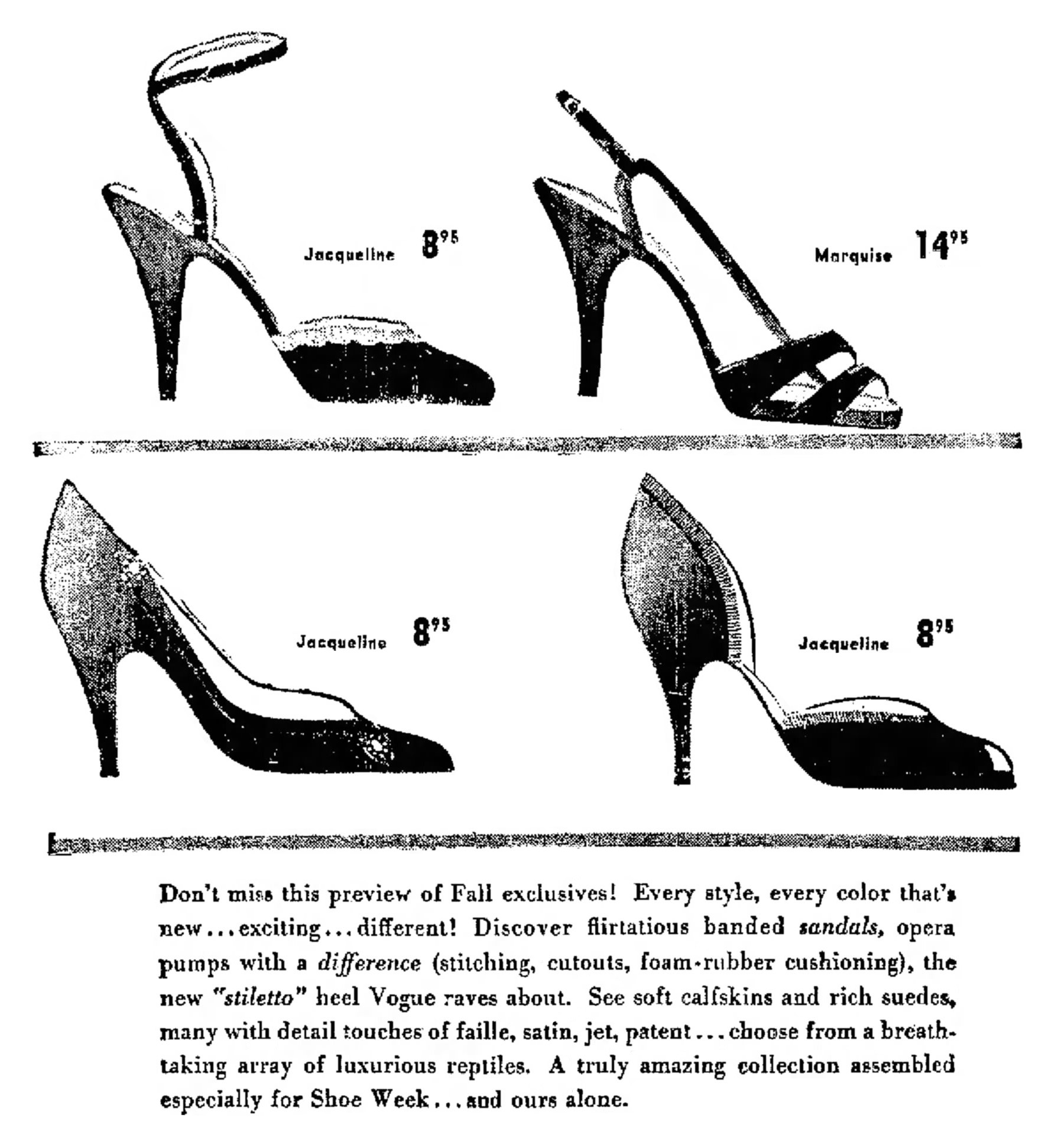
A stiletto heel, or just a stiletto, takes its name from the stiletto dagger. The heel is long, thin, and high. Some definitions require a ground-contact diameter under 1 centimeter. Heights run from about 2.5 centimeters (1 inch) to 25 centimeters (10 inches), and a platform can push them higher. A stiletto-shaped heel at 5 centimeters or shorter is a kitten heel. In BDSM and fetish culture it is a fashion object with a weapon silhouette. The spike gathers the body’s weight, changes the walk, and announces power by sight and by sound before the wearer says a word. The people in question are adults.
Before the French Revolution, high heels were court fashion for men and women. When they returned in the late nineteenth century, they were coded as female. A true stiletto depended on materials: a metal core or stem inside the heel, strong enough to stay thinner than wood or other cores that had to be bulky. Italian designer Salvatore Ferragamo’s steel arch made extreme thinness structurally possible. Some historians treat him as the inventor of the stiletto heel. Others name the French designer Charles Jourdan. In the 1950s Roger Vivier and André Perugia pushed the silhouette across Europe and the United States. By the early 1960s the toe was as sharp and long as the heel. After the Beatles, mainstream demand cooled. In 1974 Manolo Blahnik brought a version back under the name “Needle.” London’s Biba, Russell & Bromley, and smaller boutiques followed. Street stock and copies moved into punk and other subcultures. In the 1980s, offices wore rounder, thicker, sometimes cone-shaped semi-stilettos with power suits. Block heels took over in the 1990s. After 2000 the thin stiletto came back hard, used by young women for office clothes or with jeans. The cycle is the point: fetish object and fashion staple keep reoccupying each other.
Like other high heels, stilettos lengthen the look of the leg, shrink the look of the foot, and add height. They load the calves and push the bust and the buttocks into a more obvious line. Cultural coding ties them to the femme fatale: seductive, dangerous, controlled. Professional domination and fetish taste treat the shoe as equipment. The heel is a tool in trampling fantasy, and the click on a hard floor is authority you can hear.
Every high heel works against the foot’s natural mechanics. Too much wear is tied to skeletal and muscular problems, venous discomfort, and lower-limb venous hypertension. A stiletto tip concentrates force in one point. In popular physics comparisons, that pressure can exceed the pressure under an elephant’s foot, enough to scar carpet and flooring. Without a stopper to enlarge the contact patch, grass, sand, and mud are impractical, and some venues ban unprotected spikes. Dommes and performers who stay in them for hours keep mats, stoppers, backup flats, and foot-care tools. The shoe surviving in fashion does not make it practical. Demand rises and falls. The silhouette stays.
What the spike does in a scene
In power exchange the stiletto does several jobs. It is a status costume: a Domme, a switch, or a high-femme submissive puts the rank on before protocol starts. It is an object fetish: shoe worship, polishing, smelling, kissing the toe, with designer spikes budgeted as tribute. Heel pressure, and pressure adjacent to CBT, is high-risk play. It has to be negotiated. It depends on training, a soft surface, and sober judgment. It builds predicament and posture — standing orders, corner time — and turns the gait into a performance. The sound on a hard floor can become a conditioning cue. Taking the shoes off can be a reward or a way of showing vulnerability. Foot health, duration, and flooring all have to be on the table. A mall receipt does not make the shoe safe gear. The same spike can injure a partner or the person wearing it. After a long-heel scene, sitting down, rubbing the feet, and saying so about blisters and joint pain is how the glamour stays short of injury cosplay.
From Ferragamo’s steel arch, through Vivier’s 1950s glamour, Blahnik’s Needle, and the pairs punks picked up on the street, the stiletto stayed because it does three jobs at once: an engineered flex, a fashion signal, and an erotic threat. BDSM culture did not invent that charge. It refined it and turned it into ritual. For adult readers building a fetish wardrobe, stilettos sit with corsets, leather boots, and latex: clothing that changes the body and also works as equipment. Match the height to real mobility. Take floors and feet seriously. Trampling is edge play, not the default. The dagger-named heel is still the shortest picture of power, posture, and desire a person can strap under a sole. Fashion history, including Rachelle Bergstein’s writing on shoes and identity, treats heels as a class signal, a gender performance, and workplace armor. Fetish culture drops the pretense that the erotic charge is an accident. When a Domme picks a ten-inch platform stiletto for a session, she is using the metal stem Ferragamo made possible and the femme-fatale grammar Hollywood sold. When a shoe fetishist budgets for tribute pairs, the object is both commodity and sacrament. That double life — runway and dungeon, office and protocol — is why the stiletto stays on BDSM equipment lists even when mainstream fashion briefly prefers chunky soles.