
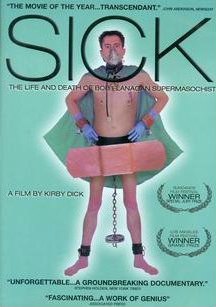
In 1997 Kirby Dick’s documentary Sick: The Life and Death of Bob Flanagan, Supermasochist premiered at Sundance and took a Special Jury Prize. It follows Bob Flanagan, a Los Angeles writer, poet, performance artist, and comic, and a public figure in BDSM. He lived with cystic fibrosis and died of it in 1996. For adult viewers who take masochism as art, as illness, and as a partnership, rather than as weekend costume, the film is a portrait that is hard to do without: a public supermasochist, and his longtime dominant partner, Sheree Rose.
Dick filmed Flanagan for several years, up to the end of his life. Interviews, personal footage, home movies, performance documentation, and video diaries cut together Flanagan, Rose, and the Flanagan family. The film also includes a passage of Flanagan in the Nine Inch Nails video for “Happiness in Slavery.” On camera he explains BDSM as sexual gratification and as a therapeutic technology. Cystic fibrosis was always punishing the body. He takes back control by choosing pain, and uses pain he volunteers for to answer pain he cannot refuse. His conceptual art, performance, and video work run pain, illness, medicine, and sexuality as one continuous subject.
The film also records his care work. He was a camp counselor for children with cystic fibrosis, and under Make-A-Wish arrangements he visited a young woman with the same disease. Those scenes are care, not sex. Do not read the camp or the visit as sexual, and do not quarantine his masochism away from that care. He agreed to be filmed on one condition: his death had to be in the finished film. That agreement is the ethics of the piece. The supermasochist authorizes the camera to stay through the last of it.
Sick was a surprise hit at Sundance in 1997, and it then took the Grand Prize at the Los Angeles Film Festival. That was a surprise for Dick too. He had planned to skip the ceremony. Critics largely accepted the balance between extremity and intimacy. Kevin Thomas in the Los Angeles Times and Roger Ebert in the Chicago Sun-Times praised the careful picture of Flanagan’s struggles and of his relationship with Rose. Edward Guthmann, in the San Francisco Chronicle, wrote that the film presents material that is extreme and sometimes revolting, and at the same time makes you like and admire Flanagan. He called him both a madman and an exhibitionist, and a gifted writer committed to taking risks, confronting death, and living on his own terms.
Mainstream coverage of SM often stops at lifestyle color or at crime panic. Sick stays on a harder case: lifelong medical suffering, formal art practice, the labor of a dominant and submissive marriage, and a death that is on the record. The cock-and-ball torture in the film, the CBT in his work, is part of that art, not a sideshow. The nickname Supermasochist is not a marketing line inside this frame. It is a public identity tested against time in hospital. Sheree Rose is not a sidekick. She is co-author of the life the camera records. Set beside the history of sadomasochism, extreme performance art, and that CBT, Dick’s film is funny, harsh, and tender. It is finished only when the ending Flanagan bargained for is on the screen. For an adult building a serious SM film library, it belongs in the stack.


![[Taiyo Tosho] 605631 Memories of Sex Slaves Yuki Tazaki](https://bdsmwild.com/wp-content/uploads/2026/08/605631-slave-1.jpg)