
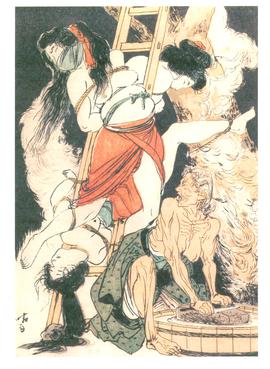
Seiu Ito (伊藤晴雨, Itō Seiu; also romanised Seiyu Itoh; 3 March 1882 – 28 January 1961) is widely called the father of modern kinbaku. Long before rope became an international BDSM export, he treated bondage and torture imagery as a serious subject for painting and for ethnography: bind the model, photograph the pose, then paint from it. Those images still hang over Japanese SM aesthetics. His life later became the subject of Noboru Tanaka’s 1977 Nikkatsu Roman porno Beauty’s Exotic Dance: Torture!, the closing film of Tanaka’s Showa Era trilogy.
He was born Hajime Ito (伊藤一, Itō Hajime) in Tokyo’s Asakusa district. By 1890 he had started studying painting. His father was a metalworker. Ito also trained in ivory carving and later worked in sculpture. At thirteen he took the art name Seiu, the Sino-Japanese reading of the characters for “clear” and “rain.” Around 1907 he began newspaper work. In 1919 he hired a young art-school model, Kise Sahara. After she became pregnant she was his second wife, and she posed for him willingly. Censors targeted him in 1930 and drained his money. The Great Tokyo Air Raid later destroyed works. In 1960 the Japan Artists Association (日本美術家連盟, Nihon Bijutsuka Renmei) gave him an award. He died in 1961. The death line in the local archive notes Truro.
Ito was obsessed with kabuki and with Edo-period manners. After the Great Kanto Earthquake he published 江戸と東京風俗野史 (Edo to Tōkyō Fūzoku Yashi), rendered in English as An History of Edo and Tokyo Manners. His method for depicting period torture was hands-on. He bound the model in historically suggestive ways, photographed the setup, and painted from the pictures. The most notorious example suspended his pregnant wife Kise upside down so he could imitate Yoshitoshi’s ukiyo-e The Lonely House on Adachi Moor in Michinoku Province. That case still gets retold whenever people argue about art, consent, and what “authenticity” costs a living body. Upside-down suspension involves blood, breathing, and fall risk. That is a historical fact, not a technique to copy. For a reader now, the people in question are understood as adults who have agreed. Whether Kise’s consent at the time was enough is a dispute the record itself leaves open.
Modern nawashi and kinbaku photographers inherit Ito’s double legacy. Rope is part of Japanese historical visual culture, and it is also an erotic spectacle. Tanaka’s biopic fixed that myth for pink-film audiences. From Yoshitoshi’s torture prints, through Nikkatsu’s SM queens, to the lineages of kinbaku photography, Seiu Ito is the hinge between ukiyo-e cruelty and the rope culture shot and sold worldwide now. He is claimed as the founder of the aesthetic. The same story is also a warning about how far an artist will go for one image.

![Legend of Shima 108 Shima Legend 108 Document SM Suspension Wild Dance Saori Nishi -Shima Shikou- [Shima Planning] SS-0313](https://bdsmwild.com/wp-content/uploads/2026/07/Legend-of-Shima-108-SS-0313.jpg)