
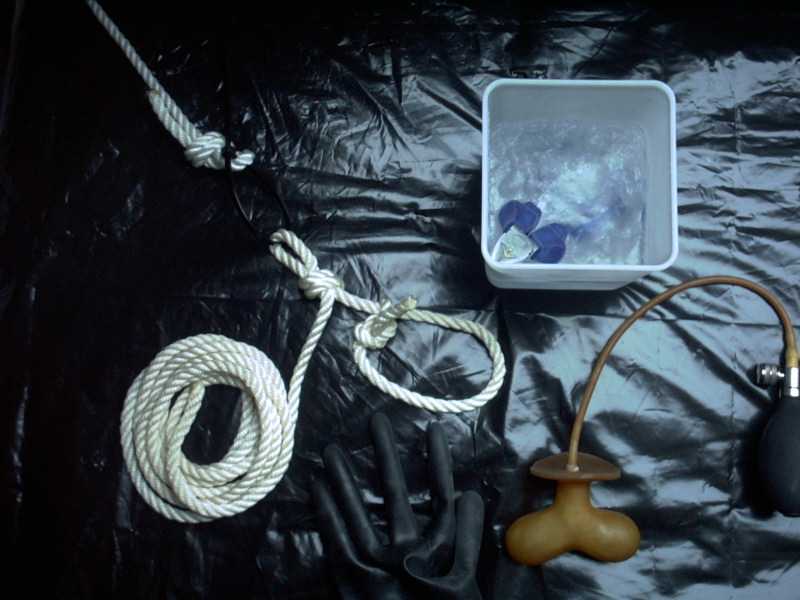
Self-bondage is the solo branch of adult restraint. You cuff, rope, tape, or device yourself because you want immobility, helplessness, and a timed way out. What pulls people is the engineering problem and the higher risk. How do you lock the last restraint when your hands are about to go out of play? If something goes wrong, there is no partner there to cut you free. Many players treat the puzzle as part of the turn-on, so the culture travels with backup keys, ice locks, and erotic fiction full of solo traps. This is for adults who have agreed to it. It does not belong in the same session as suspension-style asphyxia or breath restriction.
Partnered bondage has a second brain in the room. Self-bondage does not. Players often build in layers, putting on a gag, a blindfold, and leg irons before the final hand restraint. Each layer narrows movement, so the plan has to be finished before the last lock closes. For a lot of solo players, “how do I get out later?” is not a flaw. It is the point. That is why community educators insist on redundant releases and strongly argue against combining self-bondage with autoerotic asphyxia or breath restriction. That combination is a known way people die. The 1994 death of Stephen Milligan, the British Conservative MP for Eastleigh, is a frequently cited case of autoerotic asphyxia together with self-bondage. What follows names the risks and the kinds of release. It is not a tying recipe.
Sensual, Strict, and the Cost of Getting Out
Two modes cover most of it. Sensual self-bondage keeps escape easy and immediate: keys within reach, knots tied loose, cuffs that open without a puzzle. The aim is the erotic feeling of being restricted, not true captivity. If you are bored, hurting, or scared, you stop. Strict self-bondage withholds escape until a timed release fires. The delay can deepen the helplessness. It also deepens the harm if there is a fire, a medical emergency, or gear that fails early. People who choose strict setups should have more than one independent way out, and they should do the risk thinking sober.
A common compromise is a backup key you can always reach, but that costs you something to use. The classic version drops a spare key into a bucket of paint, or into some other mess that will ruin a carpet. If a limb is dying or the house is on fire, you take the property damage and fish the key out. If you are merely uncomfortable or impatient, the cleanup tax pushes you to wait for the main timer. Another design is a social penalty: you have to call someone and explain what is happening before you get help. The embarrassment is enough to block a casual early exit, and the call can still save you. The backup has to work while you are panicking. If fire is one of the emergencies in the plan, do not replace non-flammable paint with a flammable liquid.
Timers and Locks People Actually Use
Solo players invent and trade release systems, trading off cost, reliability, timing, and complexity. The working rule is redundancy: several independent mechanisms, so one failure is not a death sentence.
Ice and ice locks. A key frozen in ice comes free as the ice melts. Simple and reliable, and the minute-count is not precise. An ice lock can freeze parts together so they hold tension or keep someone fixed until the melt weakens the bond. For some people the uncertain timing is the appeal. For others it is the defect.
Salt or sugar locks. A water-soluble material blocks the lock. You influence the speed by how you add water. Chemistry and temperature still throw the timing off.
Combination locks. Two patterns show up. One resets the lock to an unknown combination and forces trial and error. A three-digit lock has a thousand possibilities; if you are efficient, about one try a second, that is roughly under seventeen minutes. Four digits stretches toward a couple of hours. The other pattern is darkness: you know the combination, but you cannot read the dials until daylight or a timer-switched lamp comes back. That means you have to get into the bondage in bad light. Actively cracking the lock also pulls attention off circulation and breathing.
Electronics and electromagnets. A microcontroller or a computer can time the release. On power loss these often fail open: the key drops early. Annoying, and safer than failing closed. Build quality matters if the electronics sit near water or metal.
Heat cutting. A timer drives a soldering iron to melt through nylon cord. The fire risk is real. Hot metal has to stay off bedding and skin.
Delivery and mail. You mail the key to yourself and stay bound until it arrives. That depends on the courier. If nobody else can reach you, this plan is a bad one.
Emergencies, and What the Rope Does Alone
Separate from the main timer, strict players keep a break-glass option for real danger. One version is the unpleasant drink: the key releases only after you swallow something foul. Community lore sometimes names urine. The point is to make an early exit psychologically expensive. Rescue plans include telling a friend when to check after the planned end, or placing a phone where you can still work it while bound. Humiliation is an acceptable cost. Death is not.
Getting rope on alone is awkward. A common arrangement uses a tightening slip loop with a coil around the wrists, so struggling pulls the wrists tighter, and a knife or safety shears is often the realistic way off. Hardware that tightens only one way — handcuffs, zip ties, ratcheting pulleys — maps onto self-bondage because you can add restraint after your hands lose fine control. Zip ties in particular need cutters in the plan. They are not romantic knots you work free after a cramp.
A Short Safety List for Adult Solo Players
Most self-bondage still runs on ordinary hardware and furniture. That do-it-yourself ethic is part of the subculture, and a commercial specialty toy does not replace physical redundancy. If you are new, start with sensual play you can exit, stay under thirty minutes, and practice putting cuffs on and taking them off until the motion is memory. One beginner frame: soft cuffs on the ankles, a blindfold, a vibrator you can still reach, keys on a tray, an unlocked phone beside you, a roommate or partner due home at a known time, no gag, no neck rope, no alcohol. Do the on-and-off practice twice before you add the erotic charge. If you later want a strict timer, tell someone you trust when to check, and do not play drunk. Strict self-bondage is an advanced specialty, not a badge of being real. The solo scene that counts is the one you walk away from on purpose. A plan with one key and no human check-in is a hazard, not a scene.
![[Taiyo Tosho] 605515 The Scandal 15 Young Wife Love Slave Room of Pleasure and Abuse Mayfa [Exclusive]](https://bdsmwild.com/wp-content/uploads/2026/09/605515-Exclusive.jpg)