
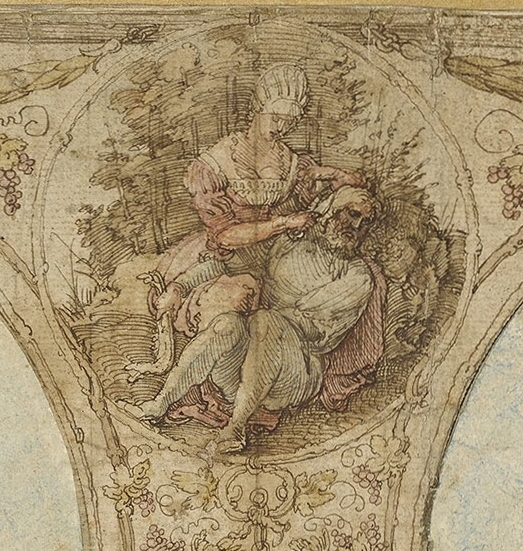
For centuries, medieval Europe told a story about seduction and overthrow. It is a moral warning, and it is a core piece of the “Power of Women” motif. The figures are legendary adults: Aristotle, the philosopher treated as the highest male intellect, and Phyllis. She is the king’s mistress. That king is Alexander’s father, not Alexander himself. The tale is not classical biography. It is a fiction about feminine charm overturning male reason at its peak. From the twelfth century on, the scene was carved in church stone, cut in ivory, woven into tapestry, and later painted and engraved. It became a standard European image of dominance and submission.
The spine of the story stays put even when details move. Aristotle warns his pupil Alexander to stay away from his father’s mistress, Phyllis, because her charm could fog the wisest man. The philosopher does not escape it. Phyllis offers a bargain: she will grant him her favor if she may ride him. The man who stood above everyone else is bridled, down on all fours, carrying Phyllis like a beast of burden. She has already told Alexander. The pupil watches his tutor conquered. In some versions Phyllis is Alexander’s own wife or mistress. The picture does not change. Reason bends to desire, the teacher becomes the mount, and the woman is the one in charge.
An early telling is the French poem Lai d’Aristote, from about 1220, which scholars attribute to Henri d’Andeli or Henri de Valenciennes. In the thirteenth century Jacques de Vitry, in a German context, also recorded the story. In 1386 the English poet John Gower retold the episode in English in Confessio Amantis. Gower’s joke is that logic and the syllogism do nothing for Aristotle: the queen of Greece bridles him and turns him into a living “Silogime,” so he forgets all his logic and obeys entirely for love. In the same period the Dominican John Herold wrote a Latin version. A fifteenth-century German comedy, Ain Spil van Maister Aristotiles (A Play of Master Aristotle), put the story in front of a public audience.
The visual tradition is specific. Medieval makers cast the pair as a brass aquamanile, a water jug, so a diner poured from Phyllis as she rode Aristotle. Stone, ivory, textile, and print carried the motif into churches, courts, and houses. Clergy could preach that lust conquers wisdom. Secular viewers got an erotic reversal: Aristotle in a harness, Phyllis astride, reason turned into a body someone can ride.
Into the Renaissance, famous hands kept using the theme. Hans Baldung, Albrecht Dürer, Lucas Cranach the Elder, and Bartholomeus Spranger all depicted Phyllis and Aristotle. Later, Alessandro Turchi swapped the woman for Campaspe, Alexander’s historical mistress, and folded that classical name into the same pose. The scene settled into Europe’s visual dictionary of erotic and moral images: a staged, theatrical threat to patriarchal order. Later artists also painted Phyllis fully nude, her sexual authority as the dominatrix of the picture.
The fantasy lasted into modern art. Julio Ruelas and Oskar Kokoschka, the latter in 1913, reworked the motif. An intellectual man broken by a woman’s sexual authority stayed desirable to painters. Long before the word “dominatrix” was ordinary English, Phyllis was an early European icon of fictional femdom: saddle, bridle, public humiliation of a high-status man, and an erotic lesson for the pupil watching, Alexander.
The story is not a modern consent manual. It is a cultural fossil of power exchange. Desire finds a way through even a system that thinks of itself as pure reason. For people who read leather culture and fetish imagery now, Aristotle on all fours is a medieval picture that is still legible. “Reason” gets recast, in fantasy, as something a skilled top can ride. Churches and print shops passed that image around for centuries. It stayed alarming and pleasurable at the same time.


![[Art Video] 2124 Women Who Climb to the Peak of [Algolagnia] Algolagnia Sensuality (9) [Exclusive]](https://bdsmwild.com/wp-content/uploads/2026/08/Art-Video-2124-Exclusive.jpg)