
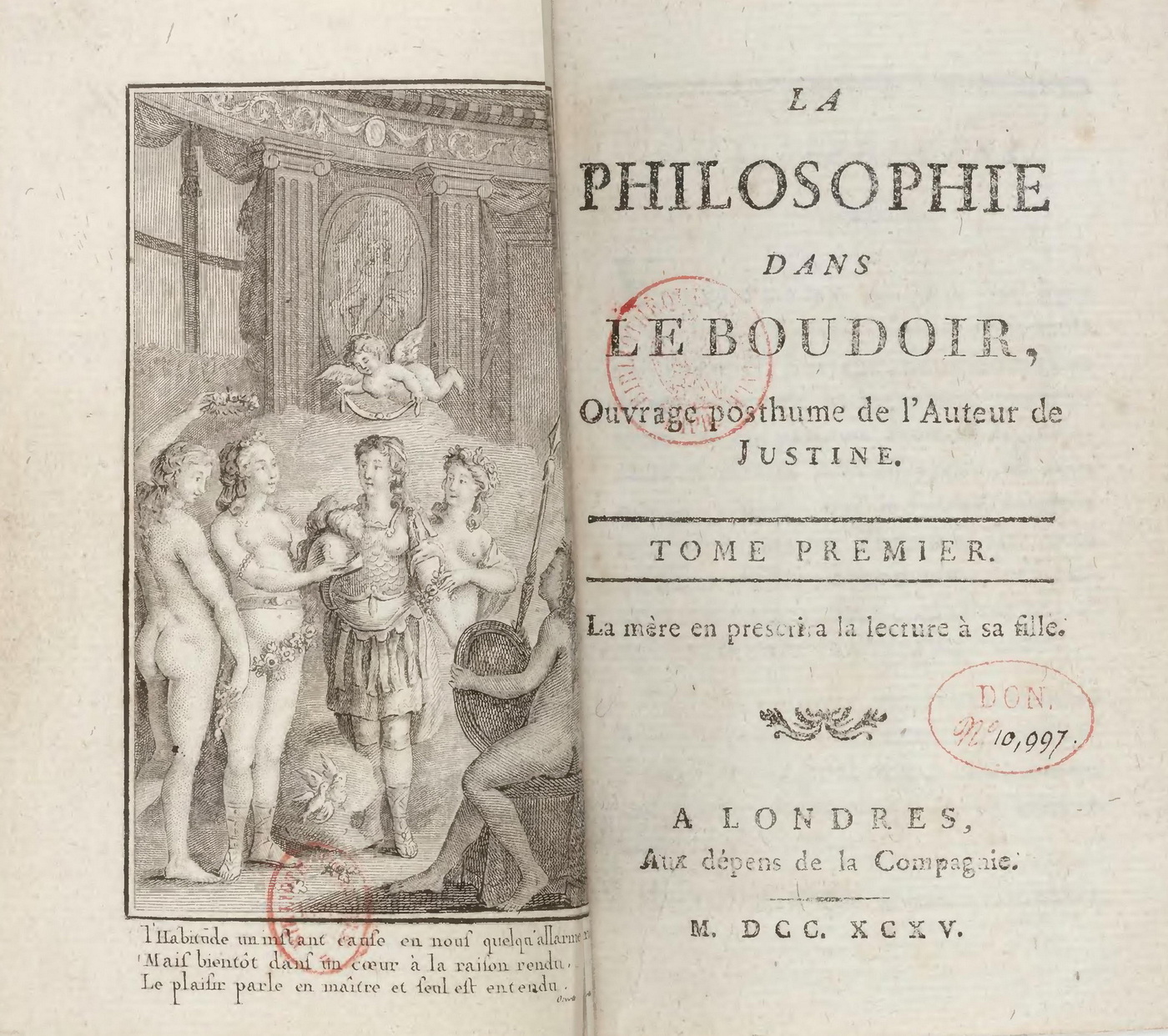
Philosophy in the Boudoir (French: La philosophie dans le boudoir), often mistranslated as Philosophy in the Bedroom, is a 1795 book by the Marquis de Sade written as a dramatic dialogue. Inside a boudoir, the lead libertines argue that the only moral system fit to reinforce the recent French political revolution is libertinism—and that if France fails to adopt it, monarchy will return. In the “Fifth Dialogue,” the character Chevalier reads a long philosophical pamphlet, “Frenchmen, Some More Effort If You Wish to Become Republicans,” which channels Sade’s views on religion and morality: the program he wants the new republic to write into law. Across the text Sade urges atheism, rejects conventional teachings about pleasure and pain, and claims that crimes committed in pursuit of pleasure cannot be condemned.
Characters
- Eugénie — fifteen, virgin and sexually naïve at the start; raised by her mother to be modest, decent, and obedient.
- Madame de Saint-Ange — twenty-six, libertine owner of the house and bedroom; hosts Eugénie for a two-day course in libertinage.
- Le Chevalier de Mirval — Saint-Ange’s twenty-year-old brother; assists his sister and Dolmancé in “educating” Eugénie.
- Dolmancé — thirty-six, atheist and bisexual with a strong preference for men; Eugénie’s principal teacher and the dialogue’s dominant voice.
- Madame de Mistival — Eugénie’s provincial, self-righteous mother.
- Augustin — Saint-Ange’s gardener, about eighteen to twenty; summoned for sexual assistance in the fifth dialogue.
Sade’s Direct Address to the Reader
In the introduction Sade exhorts readers to indulge the play’s activities. He dedicates the work to “voluptuaries of all ages, of every sex” and urges imitation. “Lewd women” should model themselves on voluptuous Saint-Ange and ignore anything that contradicts pleasure’s “divine laws.” “Young maidens” should copy Eugénie and spurn the “ridiculous precepts” of “imbecile parents.” Male readers should study “cynical Dolmancé” and practice selfishness aimed only at personal enjoyment. The book is less a closed drama than a recruiting pamphlet for libertine ethics wrapped in explicit sex.
Plot: Sex Education as Ideological Conversion
Dolmancé dominates the conversation. He tells Eugénie that morality, compassion, religion, and modesty are absurd barriers to human existence’s sole aim: pleasure. Like much of Sade’s corpus, the dialogue is thick with sex and libertine argument. It features torture, yet—unlike many Sadean works—contains no actual murder on the page. Dolmancé and Madame de Saint-Ange begin with their brand of sex education: biological facts first, then the claim that physical pleasure outranks reproduction as motive. Both insist Eugénie cannot know “true pleasure” without pain. Practical lessons follow; Le Chevalier joins in the fourth act and helps take her virginity. Eugénie learns rapidly across a menu of practices.
As usual in Sade, characters are bisexual; sodomy is the preferred act, especially for Dolmancé, who prefers male partners and will have only anal intercourse with women. Madame de Saint-Ange and her brother also have sex and boast of regular incest. Dolmancé justifies incest, sodomy, adultery, homosexuality, and other taboos with energetic rhetoric that collapses to “if it feels good, do it.” Sade’s ultimate legal claim is that even murder done under desire for pleasure should escape legal punishment. Context matters: sodomy remained a capital crime in France until 1791 (last execution 1750)—only four years before this dialogue—and Sade himself had been convicted of sodomy in 1772.
Eugénie’s corruption is requested by her father, who sends her to Saint-Ange specifically to strip away the virtue her mother taught. The work divides into seven “dialogues” and was originally illustrated by Sade. Embedded in the fifth dialogue is the long pamphlet “Yet Another Effort, Frenchmen, If You Would Become Republicans,” arguing that after abolishing monarchy the French must also abolish religion to secure liberty. Sade warns that royal tyranny and religious superstition are linked shackles; leave one intact and the other returns. A republican’s only gods, he writes, must be courage and liberty—Rome fell when Christianity rose, and France is doomed if she keeps revering it.
Climax: The Mother Punished
In the final act Madame de Mistival arrives to “rescue” her daughter from the “monsters.” Eugénie’s father has already warned the libertines and urged them to punish the wife he loathes. The mother finds her husband complicit and her daughter stripped of prior morals and of obedience. Eugénie refuses to leave. Madame de Mistival is stripped, beaten, whipped, and raped; her daughter takes an active part and even wishes to kill her. Dolmancé eventually brings in a syphilitic servant to rape the mother. Eugénie sews her mother’s vagina shut and Dolmancé sews the anus to trap the “polluted seed”; the mother is sent home in tears, knowing her daughter is lost to the libertine mentality. The ending is pure Sadean cruelty as pedagogy: virtue destroyed, family inverted, law and compassion mocked.
Screen and Stage Legacy
Spanish director Jesús Franco adapted the material twice: Eugenie… The Story of Her Journey into Perversion (1970) and Eugenie (Historia de una perversión) (1980). Italian director Aurelio Grimaldi filmed it as L’educazione sentimentale di Eugenie (2005). In 2003 a stage piece titled “XXX,” based on the dialogue, toured European cities with live simulated sex and audience interaction that sparked controversy. The book remains a primary text for anyone mapping literary sadism, political libertinism, and the erotic education plot that later horror and art cinema keep recycling.
The Pamphlet Inside the Play
The fifth-dialogue insert—“Yet Another Effort, Frenchmen, If You Would Become Republicans”—is the text’s political engine. Sade argues Europe waits for deliverance from “specter and censer alike,” and that royal tyranny cannot fall while religious superstition stands. A republican must not kneel to imaginary gods or clerical impostors; courage and liberty must replace them. That sermon sits inside a sex drama on purpose: political liberation and erotic liberation are, for Sade, one project. Destroy the mother’s virtue pedagogy and you rehearse destroying the Church’s; teach Eugénie that pain is the door to pleasure and you teach the republic that old moral law is a cage. Readers who only skim for scandal miss how tightly the book couples boudoir pedagogy with constitutional fantasy.
Crime, Sodomy Law, and Sade’s Legal Fantasy
When Dolmancé insists that pleasure-seeking crime—even murder—should escape punishment, he is not inventing abstract shock for its own sake. Sodomy had been capital in France until 1791; Sade’s own 1772 sodomy conviction haunted his biography. Writing in 1795, four years after decriminalization, he still builds a world where anal sex is the preferred sacrament and where law is mocked whenever it collides with appetite. The dialogue’s refusal of on-page murder (while still staging torture, rape, and syphilitic assault) is a formal choice: this is a primer and a manifesto more than a slaughter catalog like some of his other novels. The violence is instructional theater aimed at Eugénie and, through her, at the reader Sade recruited in the preface.
Structure as Initiation Arc
Seven dialogues pace the conversion: theory, demonstration, expansion of partners, incest revelation, the republican pamphlet, further practice, and the maternal punishment finale. Eugénie begins as the modest product of maternal discipline and ends as co-tormentor who sews her mother closed. The father who commissioned the corruption never needs to appear on stage; his letter and loathing are enough. That architecture—offstage patriarchal request, onstage female libertine school, male philosopher-top as headmaster—makes the book a template later erotic educators (ethical and not) still unconsciously echo: classroom, curriculum, practicals, graduation cruelty.
Film and Stage Afterlives
Franco’s two Eugenie films and Grimaldi’s 2005 Italian adaptation show how portable the initiation plot remains for erotic horror and art cinema. The 2003 “XXX” stage version’s simulated sex and audience interaction controversies prove the material still tests public tolerance when moved out of the private page. None of these adaptations need to be faithful line-by-line; they need the brand of Sadean education: a virgin rewritten by charismatic libertines until family morality looks like the real obscenity.
Reading It on a BDSM Site
Philosophy in the Bedroom is not a modern consent guide. It is a revolutionary-era weapon that fuses atheism, anti-maternal fury, incest celebration, and explicit power-exchange sex into dialogue form. For BDSM literature history it matters because it theorizes pain as gateway to “true pleasure,” centers a charismatic educator-top (Dolmancé), and stages initiation of a novice through sequenced scenes—structures that echo in later SM fiction even when ethics reverse toward negotiation and safewords. Useful companions include the 1965 Arrow collection Justine, Philosophy in the Bedroom and Other Writings (ISBN 0-09-982160-5), Stuart Hood and Graham Crowley’s Marquis de Sade for Beginners (1995), Angela Carter’s The Sadeian Woman (1978), and Iwan Bloch’s biographical pages on the work. Original French text remains available via historical printings “à Londres” (1795) and modern Wikisource. Adult readers who track how literary sadism shaped modern kink vocabulary still start here: a boudoir classroom where the lesson plan is pleasure without limits and the final exam is the destruction of the moral mother—and where the republic is invited to take notes.