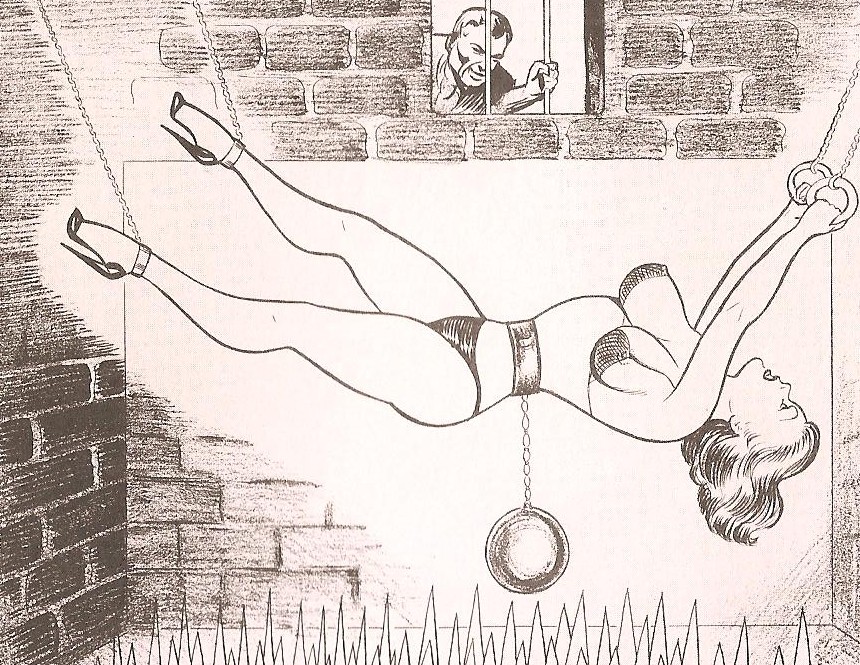
In 1954 a fetish comic series called Nights of Horror showed up in New York’s underground publishing. The tiny New York house Malcla put it out. The artist was Joe Shuster, the man who co-created Superman with Jerry Siegel. The scripts were by a writer working as Clancy, who used other pen names as the issues piled up. Sixteen booklets of BDSM, bondage, torture, and sexual slavery: men and women as tormentors, men and women as victims. Full nudity is scarce. Exposed breasts are about as far as the anatomy goes. Whips, foot worship, bloodletting, flagellation, lingerie fetish, interracial sex, lesbian scenes, and humiliation were already enough for 1950s New York to treat the pamphlets as poison. The series matters because a psychiatrist waved it in a murder trial, because New York City and then the state seized and banned it, and because the United States Supreme Court let the ban stand. Shuster’s name stayed off the art until Gerard Jones in 2004 and Craig Yoe in 2009 put it on him. For a BDSM reader the point is not nostalgia for an old booklet. One of the people who drafted the American superhero, broke and going blind after losing Superman, spent a stretch of the 1950s drawing the kink tableaux American law then burned. These are adult fetish comics. They are not sexual material about minors. The teenagers in the crime case that follows are part of the criminal record. They are not erotic subjects, and this article does not describe how the crimes were carried out.
Sadism drawn from a wrecked career
Shuster and Siegel started making comics together in the early 1930s after they became friends in high school. Superman, Clark Kent’s other self, was their idea of the American man: foreign-born, muscular, bulletproof. Both came from Jewish immigrant families, and both described themselves as quiet and unassuming. Drawing a hero who was strong and wanted by women was a way to put an ideal self on paper. They finally sold to National Allied Publications, later DC Comics. Editor Harry Donenfeld paid them $130 for the first story and bought the rights to Superman. The first issue landed in June 1938. Shuster’s eyesight was already failing, and drawing several features at once was a physical grind. In 1948 they sued to get Superman and Superboy back. The court gave them Superboy, left Superman with DC, and treated the original $130 as a work-for-hire sale. They walked out nearly broke. A second try at a hero, Funnyman, died after three issues. Shuster then took a drawing job from a neighbor who wrote for a publisher called Malcla. The writer was Clancy. Eugene Maletta ran a print shop in a Queens basement. Mal is Maletta. Cla is Clancy. The job was Nights of Horror.
Shuster never signed a page. The stories are situational: abduction, restraint, whipping, forced worship, torture staged as a spectacle. Power is the point, not a turn toward romance. Both sexes hold the whip. Both sexes take it. Faces in the panels often look like Lois Lane, Lex Luthor, or Jimmy Olsen. Those are not Easter eggs. They are the figure-drawing vocabulary he had left. Craig Yoe’s reading is the simple one: Shuster was repeating the handsome anatomy he already knew how to draw, because he needed the money. The pictures use the same visual grammar as Tijuana bibles and Irving Klaw stills. Shuster had already taught America how a strong jaw and a helpless pose should look. It is an adult fetish world. Genitals are inked over. Breasts are out. The SM staging replaces the plot twist.
The Brooklyn Thrill Killers and Wertham’s testimony
In the summer of 1954 a run of teenage violence hit Brooklyn. Jack Koslow, 18, Melvin Mittman, 17, Robert Trachtenberg, 15, and Jerome Lieberman, 17, terrorized girls with mail-order whips, beat vagrants, set people on fire, and forced a man off a pier to drown. The press named them the Brooklyn Thrill Killers. At the jury trial in November 1954, psychiatrist Fredric Wertham examined Koslow to see if he was fit to stand trial and found a young man steeped in violent booklets. Wertham brought a copy of Nights of Horror to the cell. Koslow confirmed it was his reading. He said the booklets gave him sexual pleasure, and that the gang had acted scenes out, making vagrants beg and kiss their feet while they were beaten. The ages belong to the court record. They are not an invitation to sexualize those teenagers, and the methods stay off this page.
Wertham had just published Seduction of the Innocent and was already in a moral war on comics. He did not know the horror panels were by Shuster, the Superman artist he had already attacked. In court he matched Thrill Killer acts to Nights of Horror panels. He said Koslow had fancied himself a Superman and that the boy’s mind was filled with violent stimulation. A psychiatrist had drawn a straight line from a fetish comic to a corpse. For the city’s lawyers that line was a gift. Wertham used the unsigned, Superman-house fetish art as exhibit A and never named the draftsman. Shuster had already been stripped of the hero. His kink pages were then used to justify a citywide seizure.
From a city injunction to the Supreme Court
On 10 September 1954 the Corporation Counsel of New York asked a court to stop the sale of Nights of Horror. The police commissioner said there was a definite relationship between the crimes pictured in booklets of this type and the sex crimes and violent crimes then hitting New York. The series had only started publishing that June. On 11 September, Corporation Counsel Adrian P. Burke got the order. Five Times Square shops were barred from distributing or selling it and had to surrender stock: Kingsley Books Inc., Metropolitan Books, Time Square Bookshop, Pelley Bookshop, and Publishers Outlet. In 1955 Kingsley Books and Time Square Bookshop appealed to the New York state court on First Amendment grounds. Judge Matthew M. Levy said the booklets offered nothing but glorified concepts of lustful and vicious concupiscence, that they derided love and virtue, invited crime and voluptuousness, and were pornography, dirt for dirt’s sake. He said it was not the court’s job to become a book burner, then upheld the ban, the seizure, and the destruction anyway, as public safety. The case went on to the United States Supreme Court.
On 24 June 1957 the Court upheld the ban, 5–4. Justice Felix Frankfurter wrote that nothing in the Due Process Clause of the Fourteenth Amendment restricts a state to the criminal process when it wants to stop the spread of pornography. A state could treat the book as a deodand, the medieval name for an object forfeited because it had caused a death, the way a runaway cart might, and could ban it as contraband without waiting for a criminal conviction. Among the four dissenters, Chief Justice Earl Warren and Justice William Douglas called it prior restraint. Destroying books before a hearing, they wrote, savored of book burning and cut against the First Amendment. The majority held that if the underlying issue could be tried, the state could choose its weapon. The decision let the government stop a booklet at the shop door and treat the title as a public nuisance. For fetish publishers, that is an existential difference.
The unsigned afterlife
After the ban, the art kept moving under other names, including Hollywood Detective, Rod Rule, and Pink Chemise. Shuster was never charged and never named in the trials. He kept drawing, including for magazines such as Continental. Collectors later found surviving issues in old boxes, and the attribution could be rebuilt. In 2009 Craig Yoe published Secret Identity, reproducing art from all sixteen issues and from the later work, with a foreword by Stan Lee. The outing is a comics-history event and a fetish-history event at the same time. Superhero scholarship got a scandal. Fetish scholarship got a documented run of 1954 bondage comics.
The booklets sit inside the wider 1950s panic. The same September, the Comics Magazine Association of America set up the Comics Code Authority and started censoring itself. Mainstream comics cut crime and sex to keep rack space. Fetish work like Nights of Horror was never going to get the seal. It lived in the same city as Superman and sold from a different counter, until the city decided the counters were connected. Wertham’s chart assumed the booklet caused the crime. A BDSM reading can hold two facts without merging them. The booklets are fetish art. Koslow was a murderer who liked them. Plenty of people liked them and did not kill anyone. The Supreme Court did not pause on that distinction. It let New York destroy the stock. The drawing did not stop. It changed mastheads and kept selling to the same hunger. The long afterlife of Nights of Horror is desire, panic, seizure, and a pamphlet that was supposed to be destroyed, kept as the object where American law and fetish print met.