
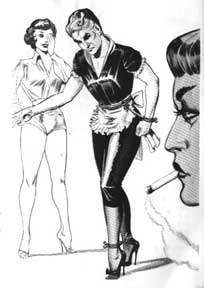
Eugene “Gene” Bilbrew was born in Los Angeles on June 29, 1923, and died in May 1974. Biographer Richard Pérez Seves calls him “the first black career fetish artist in history.” From the mid-twentieth century his line was one of the visual languages of early American fetish pulp, drawn for underground publishers rather than museum catalogs.
Before illustration he was a singer, with The Mellow Tones and the Basin Street Boys. A long-running story had him drawing the comic strip The Bronze Bomber for the African-American newspaper the Los Angeles Sentinel. Pérez Seves showed that the strip was by Bilbrew’s friend William Alexander, and that it ran in the Los Angeles Tribune. A Bomber page printed on March 8, 1943, later became the base layer of Mildred Howard’s collage Millenials & XYZ #IV. Tribune microfilm only starts in September 1943. Alexander was in the Army by early 1944. Later in 1943 Bilbrew evaded the draft on psychiatric grounds and helped found The Mellow Tones.
Around 1950 he moved from singing to illustration. His first professional art job was on Will Eisner’s The Spirit. After Jules Feiffer was drafted, Bilbrew took over the children’s humor backup Clifford. General Features syndicated Bilbrew’s Clifford as a weekly strip from 1951 to 1952. The fetish career started in 1951, when he met the underground artist Eric Stanton while attending the Cartoonists and Illustrators School, and then moved into fetish work through Stanton.
From 1951 he concentrated on “bizarre” art, drawing illustrations and covers for underground publishers Irving Klaw, Edward Mishkin, Stanley Malkin, the Sturman brothers, and Leonard Burtman. From 1955 to 1959 he did a large amount of work for Burtman’s fetish magazine Exotique. The market was mail-order bondage photos, spanking pulps, and covers of high heels and domination. Before harder porn was legal, Bilbrew’s line was one of the ways American fetish culture looked. He signed work in his own name and as ENEG (Gene spelled backwards), Van Rod, and Bondy.
In the 1960s, as censorship laws loosened, that commercial niche shrank. In the early 1970s his substance abuse got worse. Eric Stanton said Gene Bilbrew died in the back of a Times Square adult bookstore in May 1974. People in the same underground include Charles Guyette, Irving Klaw, Bettie Page as a photographic icon, Eric Stanton, and John Willie.
For decades he worked the edge of adult bookstores and mail order, not museum catalogs. In 2019 the National Leather Association International set up an award in Bilbrew’s name for creators of animated erotic art, a late institutional acknowledgment. Pérez Seves’s GENE BILBREW REVEALED, Eric Stanton & the History of the Bizarre Underground, Times Square smut history, and online collections of hundreds of attributed pieces are where that record sits. His bondage, spanking, high-heel, and domination silhouettes, including the ENEG and Van Rod covers, sit with Stanton and Willie in one shared “bizarre” underground. That economy still shows up in how BDSM illustration signals power, clothing, and pose.