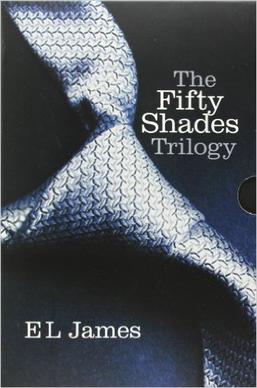
The Fifty Shades series is erotic fiction by the British writer E. L. James. It began as a trilogy: Fifty Shades of Grey (2011), Fifty Shades Darker (2012), and Fifty Shades Freed (2012). College graduate Anastasia Steele meets the young businessman Christian Grey, and he brings her into a contract-and-Red-Room version of BDSM. James said the explosion of interest surprised her completely. She called the trilogy her midlife crisis writ large, her fantasies put in the books, and that was it. She did not start writing until January 2009. On FanFiction.Net she wrote that she began after finishing Twilight, and that she discovered fan fiction in August 2009.
In August 2013 Forbes put her at the top of its highest-earning authors list, with $95 million, including $5 million for the film rights to the first book. Critics mostly hated the prose. The brand still held bestseller lists and movie screens. From 2015 a parallel trilogy retells the same events from Christian’s side: Grey (2015), Darker (2017), and Freed (2021), written through his control, trauma, and attachment. The characters are adults. Kidnapping, stalking, and the belt punishment are plot. They are not BDSM instructions.
Two tellings, and the reviews
Ana’s first-person books follow her into a dominant/submissive arrangement: contracts, hard and soft limits, emotional rules that run one way. Christian’s books go over the same events from inside his control, guilt, and attachment. Grey brings virgin Ana into the Red Room. Darker reopens the relationship after the belt punishment breaks them up, and it thickens the jealousy, the near-stalking threats, and his trauma history. Freed moves into marriage and pregnancy, climaxes with Jack Hyde’s kidnapping, and ends in a domestic life that still includes BDSM sex. The Christian books are fan service and character study at the same time.
Salman Rushdie said he had never read anything so badly written that still got published, and that it made Twilight look like War and Peace. Maureen Dowd in The New York Times called the writing a Brontë devoid of talent, dull and clumsy. Jesse Kornbluth in The Huffington Post called the experience a sad joke. Lisa Schwarzbaum gave it a B+ in Entertainment Weekly and said it was in a class by itself. Jenny Colgan in The Guardian said that, without breaking the trade-descriptions rules, it was a sweeter and safer piece of BDSM erotica than some “literary” erotic books. The Telegraph called the prose treacle and predicted women would argue the sexual politics for years. In December 2012 the first book won Popular Fiction and Book of the Year at the UK National Book Awards, and Publishers Weekly named James Publishing Person of the Year. Literary people were angry.
What players and critics argued
Katie Roiphe asked in Newsweek why free will would feel like a burden for women, and whether equality is something people want only sometimes. Andrea Reiher answered that sexual submission is not the same as being an abuse victim and is not the same as giving up equality. Jezebel wrote that most fans are attached to the emotional relationship, not to the sex acts. Dominatrices interviewed about the books stressed trust and noted how many of their clients are men. Melissa Febos said a mass pursuit of sexual fantasy does not cancel feminism. Soraya Chemaly set the series inside an older romance pattern and argued that the real success was women using e-readers to read explicit material in private, without the usual gendered shame. Sexologist Logan Levkoff said on television that the trilogy depicts a consensual relationship, not a document of violence against women. Dr. Drew called the writing awful and allowed that if it improved real intimacy, fine. Human-development professor Amy Bonomi argued the relationship is not consensual in practice: Christian “traps” Anastasia by privatizing violence, uses the NDA and intimidation to cut off support, and tries to convince her she enjoys punishment. Romance packaging wrapped around abuse dynamics is still the core community objection.
Libraries, then the films
In March 2012 public libraries in Brevard County, Florida, pulled the book, citing selection rules, bad reviews, and sexual content. Public demand put it back. In January 2013 a judge in Macaé, Brazil, ordered bookstores to remove the series or wrap it so minors could not reach it. Bans in other markets used the same moral frame and treated contract kink romance as public contamination.
Universal and Focus Features secured the trilogy rights in March 2012. Michael De Luca Productions was among the producers. Charlie Hunnam was cast as Christian first. Jamie Dornan took the role in October 2013. The first film opened on 13 February 2015, made on the order of half a billion dollars worldwide, and was reviewed poorly overall. The films of Fifty Shades Darker (2017) and Fifty Shades Freed (2018) followed the same pattern. For about a decade those movies were the default pop picture of “BDSM romance,” including Halloween costumes, jokes, and arguments about consent on screen.
The series is the highest-visibility commercial package that sold bondage contracts, safeword vocabulary, and a Red Room look to mainstream romance readers. Educators in BDSM still pull apart the abuse dynamics and the technique, and they also name what the books accidentally made ordinary. For adult media literacy the path is the point: fan fiction to money, the Christian-point-of-view expansions, the library challenges, and private “mommy porn” on an e-reader turned into Valentine’s Day box office.