
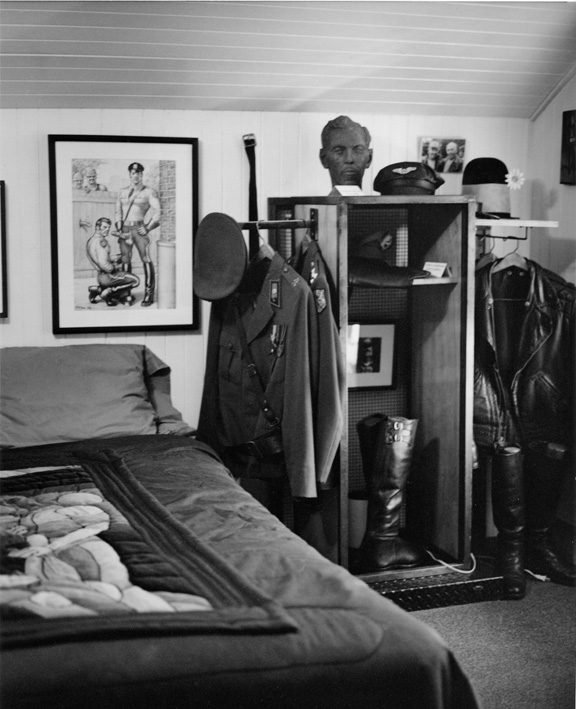
Durk Dehner is one of the people who built the institutions around homoerotic art. A businessman, film director, and publisher, he co-founded the Tom of Finland Company and later co-founded the Tom of Finland Foundation, which preserves, collects, and exhibits homoerotic art, including the work of Tom of Finland. For leather culture and BDSM, he is a central figure in turning Tom into a global brand: merchandise, an archive, public education, and a pro-sex frame that treats erotic art as culturally legitimate. In 2025 that public standing took a hard hit. Photographs of him in Nazi regalia circulated online. International Mr. Leather removed him as a judge, and he resigned as president of the foundation. The legacy splits there.
He grew up in Alberta, Canada. His father was a farmer. His mother was a doctor’s daughter. He was the youngest child, and his parents pushed self-reliance early, so he got used to moving through cities and the countryside on his own. At thirteen he started Transcendental Meditation. The daily practice, he has said, was how he dealt with a “painful experience of self doubt,” and it led him to think the answer was to devote his life to other people. That is the start of the philosophical and spiritual line he tells. At sixteen he and his girlfriend had a son. He remembered his parents as worried, and not judgmental. He learned to develop film at home so he could process erotic photography in private. A straight friend he met at the Calgary Allied Arts Foundation photographed him in the woods, and Dehner developed those pictures in the basement. He later posed for Bruce Weber. He studied fine arts at the University of Alberta in Edmonton, at the Allied Arts Center in Calgary, and at the Vancouver School of Fine Arts.
In 1976 he met the erotic artist Dom Orejudos, whom he later called his best friend for many years. Orejudos was a pen pal of Tom of Finland and brought Dehner into Tom’s world. Art-world ties and leather title culture together are the hinge of his public life. He was a fan of Tom’s work, and he organized and looked after the brand of the century’s best-known leather artist, moving between friendship, business, and the contest circuit. In 1979 he competed in the first International Mr. Leather and placed second.
He has worked as a director, publisher, publicist, editor, photographer, and art collector, and that mix is how he pushed Tom of Finland’s work. In 1984 he and Touko Laaksonen (Tom of Finland) co-founded the Tom of Finland Foundation. At first the job was to protect Laaksonen’s large body of work. It later widened into an archive meant to keep erotic art from being discriminated against or destroyed. Dehner pushed a healthy attitude toward erotic art and spent time telling the public what the work was worth. In 1978 he got an exhibition of Laaksonen’s work up in New York and there met Robert Mapplethorpe and Andy Warhol. It is early evidence that Tom’s leather men could share a room with the celebrities of contemporary art.
The foundation is housed in a craftsman home in Echo Park, Los Angeles. Laaksonen lived there in his last decade. The house now holds the foundation and thousands of archived works. To keep development off the site, Dehner asked that the building be named a historic monument because of its tie to Tom of Finland and its role in the LGBT rights movement. On November 23, 2016, the Los Angeles Cultural Heritage Commission approved that. TOM House is a fan pilgrimage stop, and it is a city landmark for the history of homoerotic leather art.
The break came in 2025. He had been inducted into the Leather Hall of Fame in 2017. In January 2025, after photographs of him wearing Nazi regalia spread online and drew protest, International Mr. Leather, the oldest major leather conference and contest, pulled him as a judge for that year’s contest. He then resigned as foundation president. For leather communities that treat anti-fascism as non-negotiable, and that have spent years arguing the line between fetish dress and actual hate symbols, this was an institutional break. Both sides of the record belong in the biography: he landmarked TOM House and helped move homoerotic leather art into public view, and the Nazi-regalia photographs cost him the IML judging seat and the foundation presidency.


![[Art Video] 1921 Fallen to Slave 9 Woman of the Female Core Pleasure Lust Prison Torment Pictures Aoi Uehara Hikaru Hara](https://bdsmwild.com/wp-content/uploads/2026/08/Art-Video-1921.jpg)