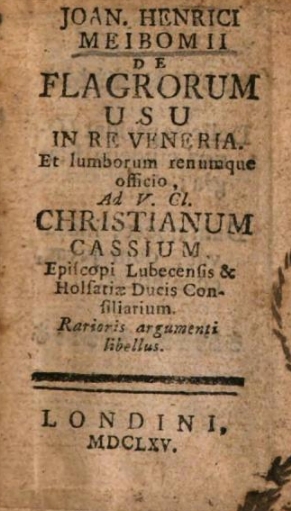
In 1639 Henricus Meibomius published the Latin treatise Tractus de usu flagrorum in re Medica et Veneria. The English publisher Edmund Curll later brought it into English as A Treatise on the Use of Flogging in Medicine and Venery. It is widely treated as the earliest printed book to gather flogging as both medicine and sex. Meibomius filled it with case-style examples instead of a straight moral sermon. Before modern fetish vocabulary existed, that casebook style made the tract a basic citation in the history of BDSM writing.
A seventeenth-century Latin medical-sexual essay with this kind of shelf life is rare. The later scholar David Savran said that for two hundred years it remained the authoritative text on the subject. Meibomius mixed a medical frame with the venereal use of the whip. That mix gave later writers a long-running reference whenever they discussed erotic or therapeutic flogging. For readers of kink history, the book shows how Western writing looked at whipping as physiology and treatment before anyone said “SM.”
Meibomius also recorded a grim social fact, and he sounded pleased about it. In Germany, he wrote, a person found flogging for sexual gratification would be burned alive. Early modern erotic writing could catalog the practice and still sit inside a culture that endorsed killing people for it. The text is a technical reference and a witness to that moral panic at the same time.
An important English version appeared in 1718. A physician translated the Latin. The title was A treatise of the use of flogging in venerial affairs: also of the office of the loins and reins. E. Curll of London published it and bound in Giles Jacob’s treatise on hermaphrodites. Archive copies of that English line still circulate online, including Wayback Machine captures of older hosts.
For people who read BDSM history and the history of erotica, De Usu Flagrorum is not a how-to and not a liberation manifesto. It is the early printed spine of Western writing on medical and sexual flogging. It was written under the morals of a persecution era, used as a standard text for centuries, and only later handed off to modern sexology and SM literature.