
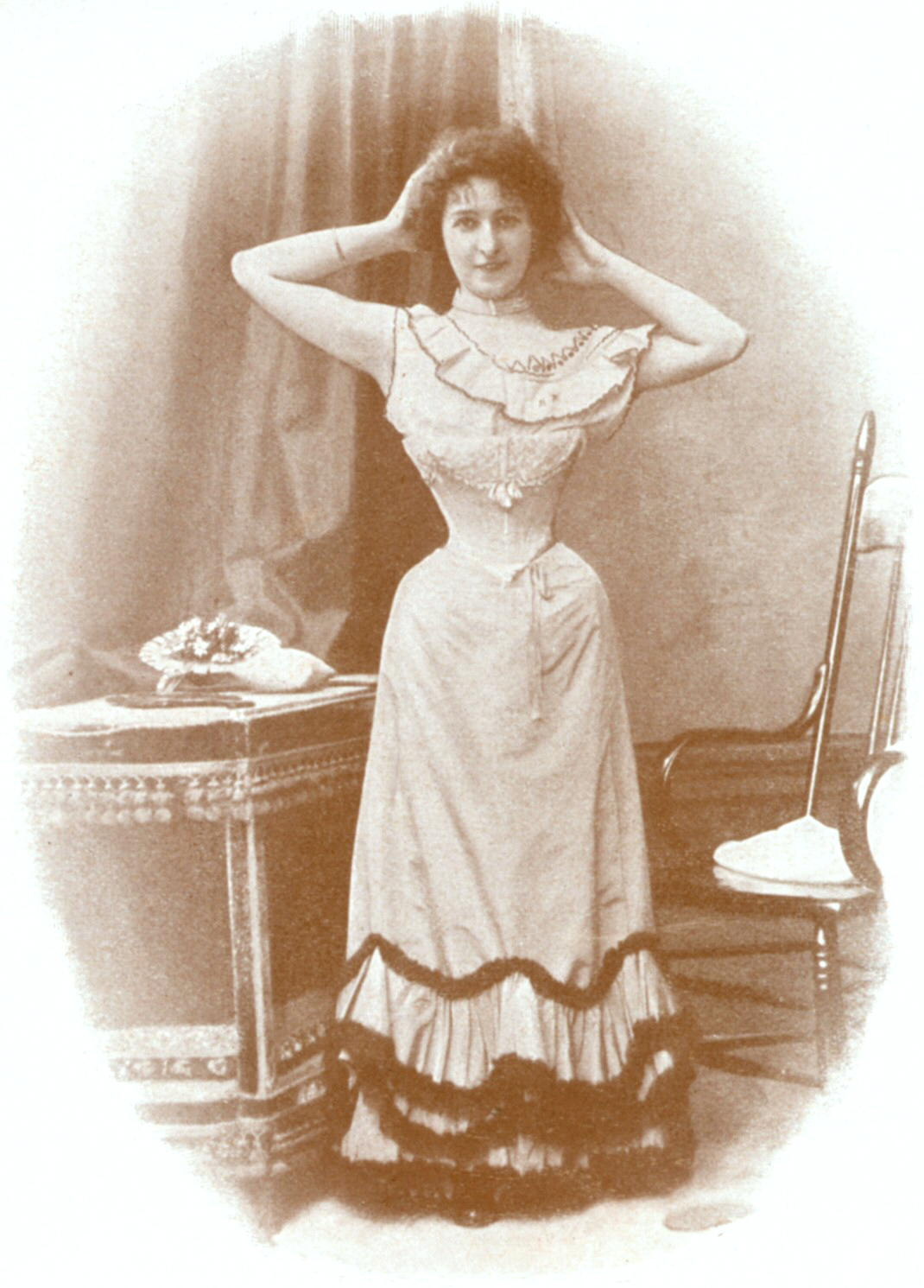
A corset is a structured garment. Its job is to hold and reshape an adult torso into a chosen line and posture. A traditional boned corset uses strong cloth that does not stretch, vertical bones, a stiff front busk that locks the torso upright, and lacing so the wearer or a dresser can tighten the shell. In earlier centuries the same idea was called stays. From the seventeenth century into the early twentieth, it was basic European women’s underwear. The early shape was conical and straight-sided. The nineteenth century produced the hourglass people now picture.
Corset is a diminutive of Old French cors, “body,” from Latin corpus: a little body. The craft is corsetry. A maker is a corsetier or corsetière. English was using corset for a lighter quilted French waistcoat, as against heavier stays, by 1828 in The Ladies Magazine. The word now runs from museum pieces to PVC club tops on plastic bones. Before you buy one for waist training, find out whether it is structural steel or costume theater.
What the garment is doing
The purpose was never single. Early stiffened layers kept expensive, heavily decorated outer clothes from creasing. The famous job is silhouette: a smaller waist, a bust lifted or flattened, a torso smoothed under fashion. A corset also carries some of the weight of crinolines and bustles and forces a posture. In fetish wear it deliberately limits breath and movement, and that restriction is the sensation. Medical corset braces use elastic panels and plastic or metal bones for mild to moderate low-back pain, or for a spine after surgery. Andy Warhol wore a corset for the rest of his life after he was shot in 1968, and he never fully recovered.
A good corset is sturdy nonstretch cloth. Coutil is the historical standard. Bones run in fabric channels. Eighteenth- and early-nineteenth-century makers preferred thin baleen. Mid-to-late Victorian work shifted to steel. Modern high-end pieces use spring steel, spiral steel, or synthetic whalebone, plastic made for corsetry. Cheap fashion corsets often use ordinary plastic, which will not tightlace safely. Lacing is usually at the back, tightened top-down, bottom-up, or both, the bunny-ears method. A Victorian front busk, with buttons or hooks, lets a loosely laced corset open without a full relace. If it is already snug, loosen it first. Otherwise the busk breaks under the pull.
Cut tells you the coverage. An overbust runs from under the arms toward the hips. An underbust starts just under the breasts. A longline passes the iliac crest, lengthens the torso line, and narrows the hip, a shape common in the slim-hip fashion of the 1910s. A standard length stops short of the hip bone. A waist cincher covers only the middle, from the low ribs to just above the hips. Historically a light linen or cotton chemise went underneath to take sweat, to keep the boned layer out of the weekly wash, and to stop steel bones from rusting or chewing skin. Modern wearers use a tee, a camisole, or a dedicated liner for the same reasons, and to keep lace from burning the back when the lace is pulled hard.
Factories and the tightlacing fight
The nineteenth century is when corsetry industrialized and when the argument peaked. Steel eyelets in 1827, and steel bones, made a tougher garment and a smaller waist, the curved silhouette people now treat as the default. Hip and bust gussets turned stays into corsets. Shoulder straps disappeared. Back eyelets sat opposite each other. A metal busk in front became standard. Tightlacing then set off a moral, medical, and political fight. Dress reformers blamed damaged organs, harder births, and general collapse. Defenders said fashionable dress required the corset and that it had its own pleasures. David Kunzle argued that some enthusiasts took sexual pleasure in tightlacing, or in rubbing against the front of the corset, which fed the outrage.
The main result of the fight was a redesigned “health” corset, not the end of corsetry. Roxey Ann Caplin became widely known for patterns that respected female anatomy. In the 1890s Inès Gaches-Sarraute designed a straight-front corset to reduce abdominal pressure for gynecological patients. Fashion houses turned that line into the S-curve worn roughly from 1900 to 1908. In 1873 Elizabeth Stuart Phelps Ward’s cry, “Burn up the corsets!”, became a slogan. Daily fashion barely moved before 1900. Most people accepted some kind of support. Few dropped it entirely.
Decline, protest, and the returns
Early in the twentieth century the corset reached its greatest length, then elastic girdles and bras took over. Narrow-hip, narrow-skirt fashion in the 1910s needed elastic. Rubberized elastic from 1911 helped the girdle replace the old corset. World War I material shortages sped that up. In the late 1940s and early 1950s Christian Dior’s New Look brought a short waspie revival, mostly while most women stayed in girdles. In the 1960s hippie culture, youth rebellion, and feminist protest rejected the wasp waist. At the 1968 Miss America protest, girdles and corsets went into a Freedom Trash Can as instruments of female torture. Fitness, diet, and modern liposuction became the preferred waist tools. Crop tops and athletic figures ended rigid corsetry as everyday mainstream dress.
The object moved into subculture instead of disappearing. Fetish, BDSM, and goth scenes kept steel-boned corsets. Living-history costumers still wear stays for a period silhouette. From the late 1980s, haute couture has periodically pushed corset shapes back toward fashion: Vivienne Westwood’s push-up bust, the pulse around Moulin Rouge! in 2001, steampunk’s remix of late-Victorian dress, and early-2020s regencycore lace-up tops inspired by Bridgerton and The Gilded Age, often with no real bones. Emma Stone and Cara Delevingne have publicly complained about costume-corset discomfort. That feeds the health argument. It has not put corsets back into daily dress.
Waist numbers, health, and adult fetish use
David Kunzle estimated that in the 1880s a corseted waist averaged near 21 inches (53 cm), against about 27 inches (69 cm) uncorseted. He treated extreme reduction, tightlacing, as largely a middle- and lower-middle-class aspiration. A corseted 19 inches (48 cm) counted as a “standard” fashion ambition. Thirteen inches (33 cm) was “severe.” Modern adults starting now rarely match historical reductions, because that training usually began in adolescence. The Guinness record for the smallest waist on a living person is held by Cathie Jung, at 15 inches.
Victorian women did not routinely have ribs removed. Chronic tight corseting does have documented effects. A moderately laced corset can cut lung capacity anywhere from about 2 percent to 29 percent, average near 9 percent, and it increases shortness of breath in exercise. Long wear atrophies core and back muscle, then the body depends on the brace. An underdeveloped pelvic inlet may have complicated birth. None of that means a carefully fitted, moderately laced modern corset worn for a few hours equals a lifetime of Victorian damage. Duration, tightness, age at the start, and recovery time decide the risk. Restricted breath is a real risk, not a selling point.
In fetish and BDSM, among consenting adults, the corset is core gear. A submissive may be ordered into severe lacing as restriction, posture training, or an endurance ordeal. A dominant may wear black couture corsetry as armor and as a status display. Open-breast or open-crotch cuts allow sex or impact without taking the silhouette off. Scene safety is slow training over months, quality steel, a hip spring that actually fits, scissors ready if panic hits, and a watch for numbness, nausea, dizziness, and color change. Do not stack extreme reduction with heavy drinking or with unsupervised sleep. Neck corsets and posture collars are neighboring toys. They are short-term aesthetic and posture theater, not physiotherapy.
A corset dress, sometimes called a hobble corset, carries the bones down the legs, so stairs in heels can become nearly impossible. Useful books include Valerie Steele’s The Corset: A Cultural History and David Kunzle’s Fashion and Fetishism. Adults commissioning a piece should be measured at hip, waist, underbust, and torso length, and should decide who holds the lace ends. A cheap costume corset mostly changes a photograph. A real one changes posture, breath, and outline.


![[Art Video] 1993 College Girl Beast Breeding Confinement Beast Yuna Komuro](https://bdsmwild.com/wp-content/uploads/2026/08/Art-Video-1993.jpg)