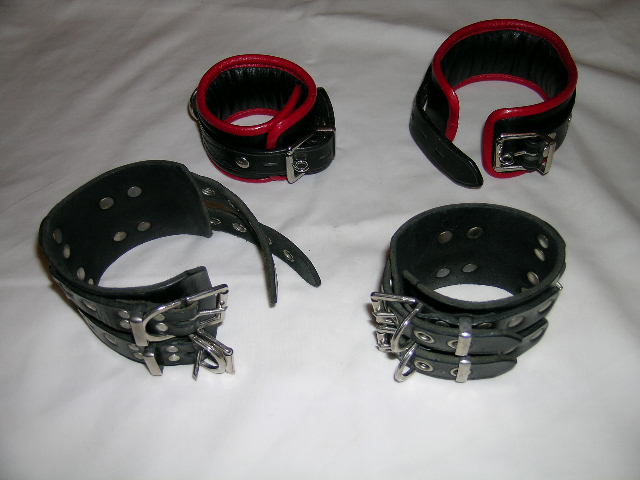
Bondage cuffs are restraints built for sexual bondage. Against ordinary handcuffs they are wider wrist and ankle pieces, usually leather, often lined with soft leather or fake fur. They fasten with a lock, a buckle, or velcro, then clip to each other or to another object. Many carry D-rings or buckles for nylon webbing, chain, or another strap, and the straps may include a loop for tightening. A typical kit is one pair for the wrists and one for the ankles; how you connect them decides whether the body folds, opens, or locks to a bed, a frame, or another person. The cuff is the attachment point. The rest of the kit does the geometry.
One set of cuffs can make a hogtie. A pair of ankle cuffs plus thigh-width straps can make a frogtie. Spreader bars and other gear usually sit in the same scene. Wrist pairs, ankle pairs, and the hardware between them are how most bedroom and dungeon restraint actually happens.
Bondage cuffs are designed to be safer than steel handcuffs. Handcuffs prioritize immobilization and escape-proofing, not comfort, and they are not padded against nerve damage. Misuse or poor monitoring can still injure people badly with any restraint. Ordinary bondage cuffs are not built to carry significant body weight. Suspension cuffs are the specialized form for hanging a body in suspension bondage. Related hardware includes bondage collars, the wider map of positions and methods, BDSM harnesses, gags, legcuffs, testicle cuffs, and thumbcuffs.
The working rule is simple: padded leather or fur-lined cuffs for negotiated sex; steel cuffs only if you accept police-grade risk; a different cuff entirely if the body is going off the ground.