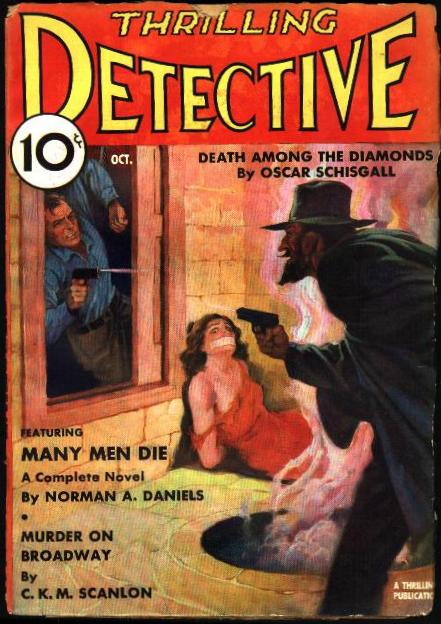
A bondage cover is not a fetish magazine. It is a sales tactic on a general-interest title—detective, adventure, or true crime—whose cover shows a bound woman, often gagged. Damsel-in-distress art sold the issue at the newsstand to anyone walking past. For fetish-history readers, bondage covers are how restraint imagery leaked into mainstream print long before specialty BDSM magazines owned the niche.
Painted covers and photo covers
Painted covers came first. They ran from about 1910, when the pulps became common, until roughly 1975, when men’s-adventure magazines started to disappear. Peaks hit in the 1930s with weird-menace and detective pulps, and again in the 1960s heyday of men’s adventure titles.
Photographic covers arrived later. Actual Detective Magazine, first issue November 1937, may be among the earliest detective magazines to use photo covers. The earliest color photo on a cover is about the February 1939 issue of True; the February 1940 True seems to be the first to put a gag on a damsel in distress. The photo-cover peak ran roughly from 1959 to 1986. The Meese Commission (Park Dietz contributed) and the shutdown of several detective and true-crime publishers ended the main era. A few Detective Dragnet issues survived in the late 1980s and early 1990s, and there was a brief revival from about 1994 to 2000, but nothing like the late 1960s, when at least two such covers could show up in a month. Over-the-mouth gags were common enough that the slang detective gag stuck.
Wertham and the Comics Code
Because many detective magazines and comics reached younger readers, bondage covers drew controversy. In the conservative 1950s that fight got louder. Psychiatrist Fredric Wertham’s 1954 book Seduction of the Innocent fed the panic. Pressure around bondage covers and related material helped produce the Comics Code Authority.
The term still names a newsstand tactic, not a fetish title: painted pulps, photo true-crime, detective gags, Meese-era tightening, and a moral panic aimed at what kids could see on a rack.