
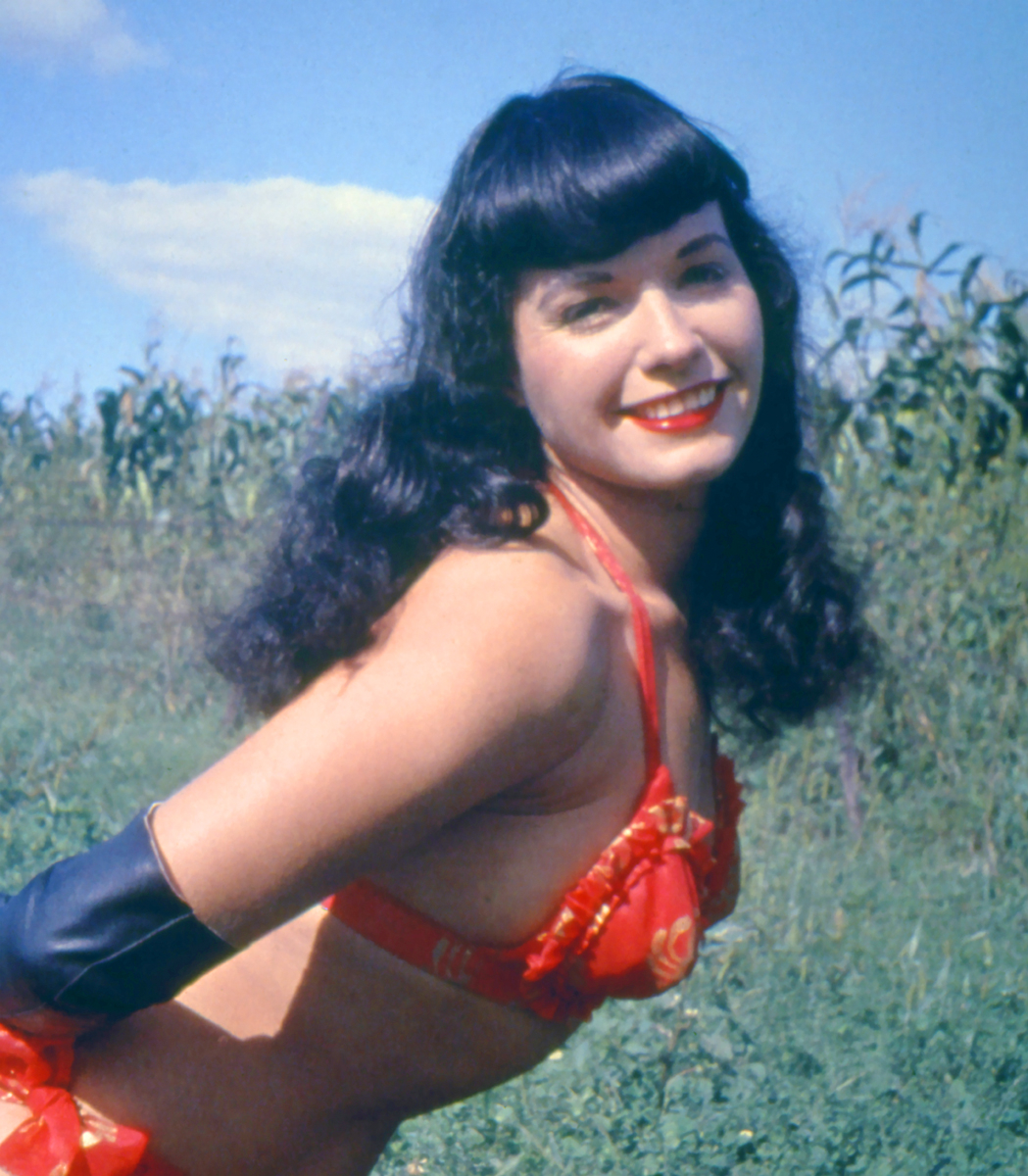
Bettie Page (Bettie Mae Page, 22 April 1923 – 11 December 2008) is the bondage pin-up a lot of later fetish photography is still answering. Jet-black hair, blue eyes, and those blunt bangs made her the Queen of Pinups for 1950s camera clubs. For kink readers she matters more as the first bondage model whose name left the mail-order underground. Irving Klaw and his sister Paula shot her in rope, leather, and 16 mm specialty reels for Movie Star News. Hugh Hefner put her on the January 1955 Playboy centerfold. A Senate crime committee later used images like hers as a moral-panic exhibit. After her death Hefner called her a remarkable lady and an iconic figure who influenced sexuality and fashion. Nashville-born, California-seasoned, New York–made: she is still the face people mean when they say vintage American bondage.
Nashville, orphanage year, New York bangs
She was born in Nashville, Tennessee, second of six children of Walter Roy Page and Edna Mae Pirtle. As a child she started spelling it Bettie. When her father went down for car theft, her parents divorced at her age ten. Edna worked two jobs and still parked Bettie and her sisters in a Protestant orphanage for a year. Page later said her father began sexually molesting her when she was thirteen. At Hume-Fogg High School she was a strong student and debate-team member, voted Girl Most Likely to Succeed. On 6 June 1940 she graduated as salutatorian, enrolled at George Peabody College intending to teach, then switched toward acting. She took a Bachelor of Arts in 1944. Just before high-school graduation she met William E. “Billy” Neal; they married on 18 February 1943 before he shipped out and divorced in 1947.
Late in 1947 she went to New York to act. In 1950, walking the Coney Island shore, she met NYPD officer Jerry Tibbs, a serious amateur photographer. He built her first portfolio free and told her to cut bangs so light would not bounce off her high forehead. Those bangs became the look later stolen by Dita Von Teese, Katy Perry, Uma Thurman’s Pulp Fiction fringe, and half the SuicideGirls roster. Late-1940s camera clubs existed to dodge laws against producing nudes. Page walked in as a glamour model, first with Cass Carr, uninhibited in front of the lens. By 1951 her face was in men’s magazines — Wink, Titter, Eyeful, Beauty Parade.
Irving Klaw, Paula Klaw, and the bondage 16 mm
From late 1951 or early 1952 through 1957 she posed for Irving Klaw. Paula worked the sessions with him. Klaw also put Page in silent black-and-white 8 mm and 16 mm specialty reels built to fill client requests: women in lingerie and heels acting out abduction, domination, and slave-training; bondage, spanking, leather costumes and restraints on a schedule. Page switched between stern dominatrix and victim tied hand and foot. Klaw’s highest-selling single image is Page gagged and bound in a web of ropes from the short Leopard Bikini Bound. The reels had the crude look of contemporary stag films, but Klaw’s all-female pictures never showed nudity or explicit sex. Page was blunt about how she landed in rope: every other Saturday he ran a four- or five-hour session with several models, and to get paid you had to do an hour of bondage. That, she said, was the only reason. She had no personal kink inclination that way, did not look down on the customers, and remembered laughing with the crew at mail-order requests from judges, lawyers, and doctors. Her line was do your own thing as long as you are not hurting anybody else.
Stage bits, Jungle Bettie, Miss January 1955
In 1953 she took classes at the Herbert Berghof Studio and picked up stage and television work, including The United States Steel Hour and The Jackie Gleason Show. She acted and danced in Jerald Intrator’s burlesque revue Striporama. Klaw put her in Teaserama and Varietease alongside Lili St. Cyr and Tempest Storm. All three films were mildly risqué; none showed nudity or overt sex. On a 1954 Miami vacation she met Bunny Yeager. Yeager booked her at Africa U.S.A. in Boca Raton. The Jungle Bettie set — nudes with cheetahs Mojah and Mbili, Page in a leopard-print jungle-girl costume she sewed herself — is still among her most reproduced work. Yeager sent frames to Hefner. He used one as the Playmate of the Month centerfold in the January 1955 Playboy: Page in nothing but a Santa hat, kneeling at a Christmas tree, holding an ornament, winking. That same year she took Miss Pinup Girl of the World. Nicknames piled up — Queen of Curves, Dark Angel. She posed nude often. She never did explicit sex scenes. In 1957 she also gave the FBI “expert guidance” on how flagellation and bondage pictures were being produced in Harlem — a reminder that the same government later used her image as evidence of interstate smut.
Kefauver, born-again years, hospitals
Why she quit depends on who is telling it. One version points at the Kefauver Hearings of the Senate Special Committee to Investigate Crime in Interstate Commerce. A young man had reportedly died during a bondage session rumored to have been inspired by images featuring Page. The hearings made Klaw’s catalogs a political exhibit. Page left modeling. Sam Menning took the last pin-up of her before she stopped.
On 31 December 1959, living in Key West, she converted to evangelical Christianity and became a born-again evangelist. She later said that once she gave her life to the Lord she began to think He disapproved of the nude pictures. The conversion actually started on New Year’s Eve 1958, when she walked into what is now Key West Temple Baptist Church. She attended three Bible colleges and tried for missionary work; a 1960s attempt to go to Africa failed because she had been divorced. Her romantic life in this stretch was a pile-up: she dated industrial designer Richard Arbib in the 1950s, married Armond Walterson on 6 November 1958 and divorced him on 10 October 1963, remarried Billy Neal very briefly in late 1963 or 1964 (soon annulled), and married Harry Lear on 14 February 1966 (divorced 18 January 1972). In October 1978 she moved to Southern California, had a nervous breakdown, fought with her landlady, and was diagnosed with acute schizophrenia. She spent twenty months in Patton State Hospital in San Bernardino. In 1982, after a fight with another landlord, she was arrested for assault, found not guilty by reason of insanity, and placed under state supervision for eight years. She was released in 1992. Richard Foster’s 1997 biography The Real Bettie Page published a Los Angeles County Sheriff’s report saying that on 19 April 1979, at fifty-six, she had stabbed her elderly landlords during a fit of insanity. The later decades were marked by depression, violent mood swings, paranoid schizophrenia, and years inside a state hospital — the part of the Queen of Bondage story the pin-up merch usually leaves off the calendar.
The cult comes back without her
Artists had been drawing her since the 1950s — Gene Bilbrew and Eric Stanton among them. Robert Blue showed Bettie paintings in a 1979 Los Angeles show. Olivia De Berardinis started painting her for Fiorucci and never really stopped. Eros Publishing’s 1976 A Nostalgic Look at Bettie Page mixed 1950s photos. Between 1978 and 1980 Belier Press issued four volumes of Betty Page: Private Peeks. Through the 1980s a larger following grew around the pin-up and lingerie work, not the fetish reels, and she did not know it was happening. De Berardinis called black bangs, seamed stockings, and snub-nosed six-inch stilettos Bettie signatures, and said that while fetish and bondage had always existed, Page was the first star of the genre. Marilyn Monroe had predecessors. Bettie did not. In 1987 Greg Theakston launched the fanzine The Betty Pages. Because almost all of her photos were in the public domain, merch appeared without her. A 1993 phone interview with Robin Leach on Lifestyles of the Rich and Famous had her saying she was penniless and infamous, living in a Los Angeles group home. Theakston found her. Her brother Jack steered her toward money: in 1993 toward Chicago attorney James L. Swanson, who with Karen Essex wrote the 1996 coffee-table book Bettie Page: The Life of a Pin-Up Legend. Three years later, still nearly broke and not seeing royalties, she fired Swanson and signed with Mark Roesler and Curtis Management Group, later CMG Worldwide. The image had become a brand. The woman was still trying to eat.
Death in 2008, and the look that outlived her
She died on 11 December 2008, at eighty-five, after being hospitalized in critical condition on 6 December. Forbes later listed her estate among top-earning dead celebrities — about $6 million in 2011, an estimated $10 million in 2013. Christian Dior’s Spring-Summer 2011 ready-to-wear used her hair as a reference. Folsom Street Fair’s women’s area launched in 2006 as Bettie Page’s Secret before it became Venus’ Playground. Poison Ivy wears her bangs; Beyoncé quoted her in Video Phone and Why Don’t You Love Me; My Life with the Thrill Kill Kult, David Lee Roth, and Katy Perry borrowed the look. Minor planet 184784 is named for her. Cult Epics’ 2004 Bettie Page: Dark Angel rebuilt six lost Klaw fetish shorts. Mary Harron’s The Notorious Bettie Page (2005) followed her with Gretchen Mol. Mark Mori’s Bettie Page Reveals All used more than six hours of Page’s own interviews. Rosario Dawson’s cut in Tarantino’s Death Proof is a direct hair homage. For readers who came for the rope rather than the Santa hat, the Klaw reels that matter are still silent, specific, all-female, no explicit sex — and still the template for how American bondage photography learned to look like itself.


![[Sanwa Publishing] Bitch Lady Bondage Training Video 2 Hours (SANWA MOOK)](https://bdsmwild.com/wp-content/uploads/2026/09/SANWA-MOOK.jpg)