
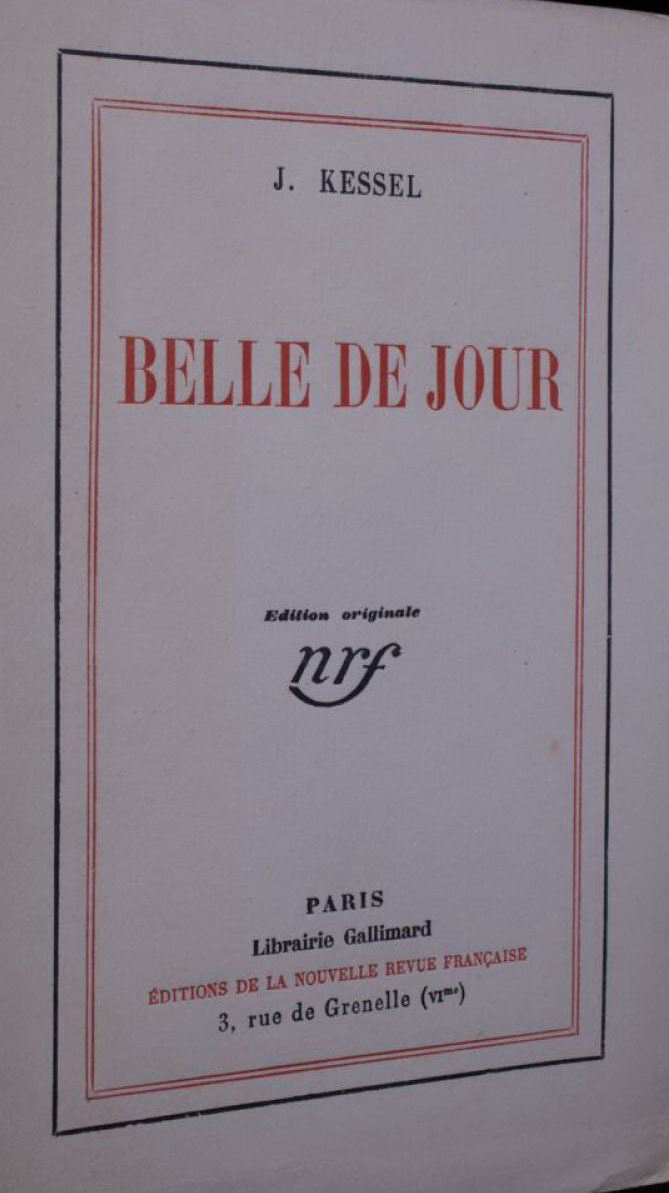
In 1928 Gallimard published Joseph Kessel’s novel Belle de Jour. The lead is housewife Séverine Sérizy. She loves her husband Pierre; physical intimacy between them is still a problem, and she cannot get her masochistic desires met at home. That split produces her double life: by day she works in a brothel under the name Belle de Jour — beautiful by day; by night she goes home as a respectable wife and tells him nothing. The engine of the book is that schedule — masochistic need on a daytime clock, respectability after five.
Séverine remembers a mechanic touching her when she was eight, on the way from her bedroom to her mother’s. Young and beautiful, she still cannot get that specific charge from Pierre until Monsieur Husson mentions an acquaintance who works at a local brothel. She starts treating prostitution as a possible way out. She sets a hard timetable: two to five each afternoon at the house; evenings belong to the husband who does not know; the daylight hours belong to the heat in her fantasies.
Among her clients, young gangster Marcel is the one who matches what she wanted. He also becomes too demanding and jealous of her husband. Séverine decides to leave; Madame Anaïs agrees. The secret does not stay sealed. Husson had arrived as a potential client who did not use her and so learned who she was; Marcel’s associate Hipollyte tracks her home. Marcel comes to the door and threatens exposure. She talks him into leaving, then learns Husson has arranged to meet Pierre in the square outside Notre Dame. The double life is already leaking.
To save her name Séverine finds Marcel in a hurry and asks him to kill Husson. He agrees out of love for her. A friend drives them to the rendezvous. When Marcel attacks, Pierre steps in and is stabbed; Husson escapes. Marcel is arrested and refuses to talk, which keeps the Belle de Jour name intact; police pin the motive on an unidentified woman. Then the maid recognizes Marcel from his visit to the house, and exposure is almost certain. Pierre leaves hospital paralyzed from the waist down. Hipollyte had kept the truth from her; that does not stop it from arriving.
Kessel does not give Séverine a clean exit. Marcel’s silence buys her name; the maid’s memory spends it; Séverine spends whatever is left by telling the paralyzed Pierre herself. Luis Buñuel’s 1967 film, with Catherine Deneuve, Jean Sorel, and Michel Piccoli, sits on top of this plot. Readers who only know Deneuve’s face still need Kessel’s layer if they want the full double life — the childhood mechanic, the gangster who will not stay a paying fantasy, Husson, Madame Anaïs, Notre Dame square, Hipollyte, the maid, and the confession to Pierre.