
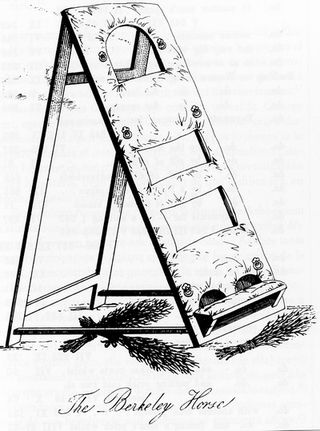
The Berkley Horse is one of the earliest pieces of commercial BDSM furniture with a clear name and designer. It was not adapted from a chair or a bedpost. It was built in 1828 for — and used by — Theresa Berkley, the London flagellation madam, who called it a chevalet. The point of the machine was to open a paying gentleman’s body to the cane, the birch, and a second pair of hands at once. It was invented for flogging, not as a general torture device.
Angles, a woman underneath, birch on the ass
Victorian collector Henry Spencer Ashbee left the description later writers still lean on. In the spring of 1828 the notorious machine was finished so Mrs Berkley could flog gentlemen upon it. The frame opened wide. The body could be brought to any angle a session needed — hips up, back stretched, buttocks offered — instead of being stuck with whatever a bed or kneeling bench allowed. Ashbee also recorded a print from Berkley’s memoirs: a man strapped naked on the horse; directly under the frame, a woman sat with bosom, belly, and pubic hair exposed, working his cock with her hand while Berkley birched his posteriors. The commercial layout is plain: client immobilized and opened, one woman at the front, Berkley at the ass with the birch.
A Georgian price list for measured damage
The designer told Berkley the machine would make her famous and go by her name after her death. Ashbee says the boast landed and the horse brought a great deal of business. One customer letter, written by a man who had only heard of the Horse, offered a sliding fee by how far she would take him: a pound for the first blood drawn; two if blood ran to his heels; three if his heels were bathed in it; four if blood reached the floor; five if she made him lose consciousness. It is a Georgian price sheet for measured damage, written by the man who wanted the damage.
Adelphi, Cannon, and the missing plate
Ashbee placed the original horse among the models of the Society of Arts at the Adelphi, presented by Doctor Vance, Berkley’s executor. That society is now the Royal Society of Arts; they took possession in 1837. Radical publisher George Cannon pushed a public exhibition. Whether the original timber was actually preserved there is unclear. An illustration of the apparatus appeared in the original 1880s edition of Ashbee’s Index Librorum Prohibitorum and was dropped from the 1969 reprint. Later books that keep a pointer to the 1828 machine include Ian Gibson’s The English Vice, John K. Noyes’s The Mastery of Submission, Anil Aggrawal’s forensic survey, Guillaume Apollinaire, Iwan Bloch on Sade, Ernest Borneman’s sexuality encyclopedia, and Mike Pentelow and Marsha Rowe’s Characters of Fitzrovia.
Not the wooden-horse torture device
The Berkley Horse is erotic furniture, not the wooden-horse torture device that splits a victim’s weight down a sharp ridge. One is a paying gentleman opened for birch and hand-job. The other is a garrison punishment engine. They share a nickname and almost nothing else. The name stuck on the bookshelf. The RSA still cannot quite say whether any of the original wood did.
![[SUNSET COLOUR] SK-6 Female Teacher’s Beautiful Ass 6 Yuriko Hosokawa 178sk00006](https://bdsmwild.com/wp-content/uploads/2026/08/SUNSET-COLOUR-SK-6.jpg)