
In BDSM a whip is not just a strip of leather or a stiff rod. It carries sound, speed, and force. For adults who have agreed to it, the strike starts from consent. Hurting an animal, or hitting someone who did not agree, is not play. Stunts, judicial punishment, and film effects are not what a dungeon does on an ordinary night. What follows is impact play with a safeword, a stated intention, and force the people involved have actually set. Some want a brief sting. Some want a heavy, ritual thud. The person on the receiving end can feel it and can say stop.
Two mechanisms: a firm rod, or a lash that accelerates
Almost every whip falls into one of two builds, and the use changes with the room, the target, and the force. The first is a firm rod, the better choice for a beginner or for a shot you need to place. That group includes the crop, the bat, the show cane, and the hunting stock. They are short, easy to hold, and meant to meet skin directly, as sting or as thud. Because they are short, they are easier to keep on a thigh or an ass than a line you have to throw.
The second is a flexible line: bullwhip, stockwhip, snake whip, signal whip, and the long-stock pieces that add a lash. You throw them. Energy runs down the thong and speeds up at the tip. They can crack, and the tip can pass the speed of the hand by more than thirty times. Whips were the first human-made objects to go supersonic. A single-tail punishes sloppy form. Throw it the way you throw a flogger, with too much arm and not enough wave, and you can wrap a kidney or take an eye. The historical cat-o’-nine-tails and the Russian knout were judicial tools built to tear skin. Religious self-scourging sits in another file. None of those is ordinary negotiated play.
What the crack is: from the stock route to the dungeon
The crack is not always there to hit flesh. It is a small sonic boom. A wave runs down the tapering thong, speeding up as the mass ahead of it shrinks, until the tip, or the cracker tied on as a popper, breaks the sound barrier. Speed at the end can be more than thirty times the speed of the hand. Stockmen use that crack to move cattle and horses. The sound does the work. The whip is not meant to cut hide. Single-tail players treat a clean crack in the air as its own skill: target work, flourishes, a boom beside skin that does not wrap.
A stiff riding crop usually will not crack in open air unless it carries a long lash, as a longe whip does, or a very soft shaft plus a lash. A wide leather loop can still produce a popper slap. Sound and sting arrive almost together. High-speed cameras, and the old MythBusters episode on Indiana Jones, confirmed that the tip goes supersonic. That episode also showed a trained throw yanking a pistol out of a hand. Those are stunts, not dungeon technique. A bullwhip with no cracker can still make a sound. It is quieter, and the replaceable fall wears out faster.
Single-tails, and what each one is for
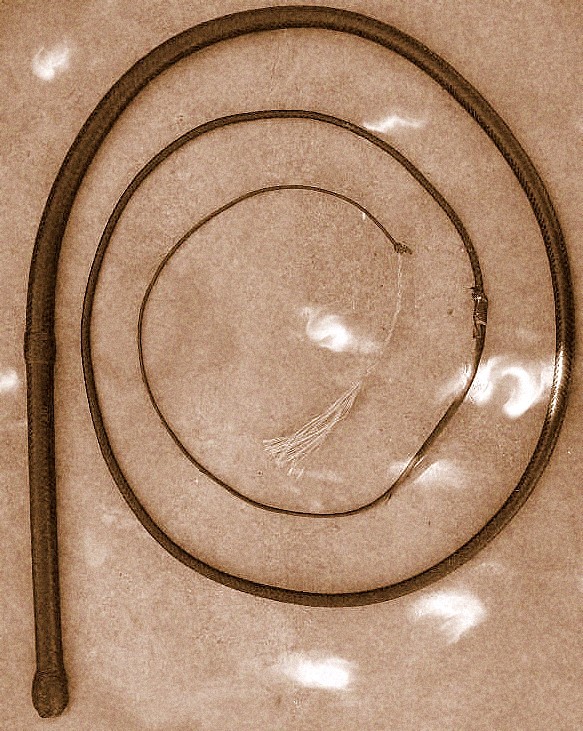
The bullwhip is the single-tail most people picture. The handle is often 20 to 30 centimeters. The braided thong runs from about a meter to several meters. The replaceable fall is often 25 to 76 centimeters, used with a cheap cracker that is meant to die. An Australian stockwhip is built differently. The handle is commonly 38 to 53 centimeters and joins the thong with a leather keeper. Traditional ones are tanned kangaroo. The crack moves stock. It does not cut. At the opening of the 2000 Sydney Olympics, Steve Jefferys reared an Australian Stock Horse and cracked a stockwhip.
Other working types are not toys, or they solve a different problem. Yard whips and drafting rods are for tight yards and for teams. The Florida cow whip has a short handle and a short thong, for brush where you cannot swing a long bullwhip, and it still works wet. A signal whip runs about 0.9 to 1.2 meters, with no separate fall. The cracker ties to the body. It was a cue for a dog sled team. A snake whip has no rigid handle core, so it coils. Many hide a shot bag along the length. Pocket versions pack smaller. The Western blacksnake loads shot from the butt down the thong. Some hide a steel or lead ball in the butt and can double as a blackjack. That is self-defense history, not a recommendation for a scene.
Riding rods: from the saddle to an impact toy
Equestrian rods are the other half of the toy chest. A crop or bat is about 0.6 to 0.8 meters, with a looped leather slapper, used to remind a horse. For a beginner the wrap risk is lower than with a four-foot bullwhip. A dressage whip, about 1.1 meters including the lash, is slightly flexible. A rider uses it to tap their own leg while both hands stay on the reins. In play, that reach lets someone stand beside a kneeling partner and place a light sting. A longe whip has a shaft of 1.2 to 1.5 meters and a lash at least that long. On the ground it signals a horse. The crack is occasional. A quirt is short, with two wide tails. It is loud, more noise than deep bruise, and relatively slow. Show canes of holly, cherry, or leather-covered wood are mostly formal riding accessories now.
In Victorian novels a horsewhipping stands for social punishment. Sherlock Holmes sometimes carries a hunting crop loaded in the shaft and head with steel or lead, and he uses it as a street weapon. A whip for a scene should not be loaded with metal. Buy a riding crop, or an impact cane from a kink shop or a tack shop. Check the shaft for splinters, and do not let the popper rot into a sharp edge.
The cat, the flogger, and what not to buy first
The cat-o’-nine-tails was made to tear skin. The British Royal Navy, and later civilian courts, used knotted cotton cords about 0.8 meters long. Nine tails come from the rope: three yarns make a small cord, three cords make a thicker rope, and unraveling twice leaves nine. Shipboard and judicial flogging was state violence. The knout and other national punishment whips belong in that same file. A modern flogger looks related, a handle and many falls, but it is usually deerskin, latigo, or suede, cut to thud or to sting, with a rhythm you can vary. It is not a cat.
A true cat, or a knotted nylon thumper, has edges and can break skin. If you go there, it is blood play, and the scene should be shorter. Do not sell one as a beginner flogger. If a partner asks for “the cat,” say what it does, show the knots, and agree on a stroke count and a stop rule before the first hit. Religious disciplines and knotted cords can share the outline and almost never share an erotic frame or a negotiated way out. Borrowing the look is theater if everyone knows it is theater. Restaging a naval flogging with no medical plan and no enthusiastic consent is how people end up in an emergency room and in court. A get-back whip on a motorcycle handlebar is there to scare a dog in a pinch. It is not an impact toy. A bian is a metal horseback blunt weapon. The chain whip is linked metal for wushu, not for spanking. The qilinbian, a late-twentieth-century mix of steel and leather, is an exercise and performance piece. Fine to collect. A bad first kink purchase.
Four jobs, and the places you do not hit
“Whip me” is not a plan. Say which of the four you want. Sting: a crop, a thin snake-whip fall, the last inch of a single-tail. Thud: a heavy flogger, some quirts, a thick slapper. Sound: a crack or a popper slap, which can drop someone into headspace before the next strike. Marks: the rectangular bruise of a crop, tramlines from a cane-like shaft, a small kiss from a well-aimed fall. Crops and short slappers work over jeans, leather, or bare skin. Calibrate clothed first.
Usual targets are the ass, the backs of the thighs, and the meat of the upper back beside the spine, not on it. If the person wants sexual sting, the fronts of the thighs or a protected chest. Stay off the kidneys, the tailbone, the neck, the face, joints, and bone. Hands and feet are advanced small-target work. Genitals and nipples can take a light tap from a popper. They cannot take a bullwhip wrap. On a single-tail, measure the distance. The person stays still, or moves on a cue. Land on the same side, or paint a pattern. A wrap is the failure mode: the fall curves a hip, a thigh, or the torso, and leftover energy dumps into a kidney, the genitals, or the far hip. Cracks beside the ear, or a wrap around a bedpost, are still edge play, because a miss is a hit. Rope, or a Saint Andrew’s cross, can keep the person from stepping into the arc. If you suspend someone, you have changed the physics. A person who can throw a whip is not enough. You need a rigger. This article does not give suspension steps.
Floggers fill the middle: warmup, endurance, heavy-leather ritual. Two-handed Florentine is a rhythm for after the warmup. When you want punctuation, switch to a stingier whip or a crop. People do hit themselves, in religious practice and in erotic play. A crop on your own calf or thigh is straightforward. Single-tailing yourself is a circus trick. Do not do it until you can hit a stationary target ten times in a row.
Safety, aftercare, and the law
A whip is not a heavier paddle. Learn the throw on objects first. Wear eye protection when you practice cracks. Crackers shed grit. Check ceiling fans, lamps, and anyone standing in the arc. Nylon is cheap and stands weather. Leather needs conditioning and should not sit wet in a bag. A broken strand can act like wire. Agree on force, on marks, and on whether blood is a hard limit. A single-tail can cut. Have gloves, saline, and a plan if a fall splits skin. Drinking is a common route to a wrap. If the thrower is performing for a crowd, assign a spotter who can stop the scene.
Say the body risk in plain language. A wrap to the side can bruise a kidney. A hit to the neck or throat is a hospital, not a hot moment. The spine is not a target. The gap between the shoulder blades is not a safe back if a supersonic tip is what lands there. Negotiate marks, clothing, and whether a throw that tags a shoulder blade ends the scene. Start far enough that only the last few inches kiss skin.
Afterward: warmth, water, and look at the marks together. Crop rectangles often bloom later. Photograph only if the person wants a record, and do not post without permission. Arnica or nothing, following that person’s skin history. An emotional drop after a loud, ritual beating is common even when the bruises are mild. The crack is a stress sound. Some people shake. The law is local. In some countries consensual impact is still prosecuted as assault. The British Spanner cases are the usual warning. Cracking in a park can look like a weapon. A metal-loaded crop or a chain whip is a customs problem. Know the jurisdiction before you treat a toy bag as harmless sports kit.
Animals, renamed tools, and how a throw actually travels
A working whip gives a directional tap, pressure, or a crack that makes a whole team flinch. Some equestrian classes require you to carry a whip, and punish abuse with fines. Welfare law treats beating an animal as cruelty. Scene people borrowed the crop, the dressage whip, the quirt, and the bullwhip, then renamed some of them wand, stick, string, or popper, to step away from the cruelty association. The physics did not change. A horse cannot safeword. A partner can. Horsemanship’s operant pattern, sound first and pain only if the cue is ignored, is not a template for kink. Adults who like pain are not livestock. Do not run a trainer-and-animal script unless that roleplay was negotiated and has an exit.
A single-tail throw is a wave, not a tennis serve. The hand starts the loop, the loop travels, and the tip finishes. Common errors are too much shoulder, the wrist breaking at the wrong time, and standing so close that unused length is still in the fall when it meets the body. Unused length is the wrap. Instructors teach an overhead crack, a sidearm, and a cattleman’s crack before they teach a kiss on a hanging jacket. Only then do they move to a person. If there is no local class, YouTube can show you what a good wave looks like. It is not a lesson plan. You cannot feel the timing from a phone.
Distance is a safety tool. A crop works at arm’s length. A four-foot snake wants a measured step back. A six-foot bullwhip wants a garage or open ground. Tape the floor if you need a mark. The person being hit should know whether they are allowed to sway. A step toward the thrower turns a kiss into a slap from the middle of the thong, which is a different and uglier hit. A spoken “throwing” lets them brace or breathe. A crack as a surprise belongs only to pairs who already have a thousand clean throws between them.
Public play adds spectators, low beams, and other scenes inside the arc. Ask the dungeon monitor. Clear a lane. Do not crack next to someone’s needle play. A demo at a leather contest, on a Folsom side stage, or over an IML-adjacent weekend is competence performed in public, and that pressure is how people rush a throw they have not warmed. Warm the shoulder. Hit a coat on a hanger first. Then invite someone who actually wants an audience. Leather that lives in a damp bag dry-rots. Condition sparingly. A greasy whip is heavy and slow. Nylon can be rinsed. Crackers are consumables, nylon paracord or a purpose-twisted string, replaced when they look like a used toothbrush. Replace a fall when it splits. A loaded butt, blacksnake or Holmes crop, is a weapon in a bag at an airport. Leave it at home.
For sting and sound in a bedroom, buy a well-made riding crop or a short leather slapper. For thud and ritual, buy a flogger whose falls you can see and feel, not a knotted cat. For the cinematic single-tail, budget for lessons, a nylon practice whip, eye protection, and months of target work before a human back. Measure the room. A six-foot bullwhip in a loft with a low fan is a joke on you. “Flog me” is not “single-tail me,” and neither is “crop me until I bruise.” The cat, the knout, and the judicial triangle can be borrowed as look and ceremony. State torture is not Saturday-night SM. Sound alone can drop someone into subspace. A wrap can be a trip to urgent care.
Names, books, and the screen
Flagella, Latin for whips, drive cells and sperm. Some large lizards use the tail as a real whip. Greek name-pieces Mastigo- and -mastix mark that shape. Whip snakes were mythologized as animals that lash people. They do not. Whip scorpions are named for the shape of the tail. Paleontologists have argued over ankylosaur tail clubs and over sauropod tails that were once described as whips. Newer models say a diplodocid tail could whip, and probably did not break the sound barrier. On screen the whip is Zorro in 1919, Indiana Jones, Catwoman, and the Belmont line in Castlevania. Holmes’s loaded crop is a literary cousin. For making and throwing, the craft books are Ron Edwards’s How to Make Whips, David W. Morgan’s Whips and Whipmaking, and Robert Dante’s bullwhip skill manuals. Niklaus Largier’s In Praise of the Whip is a cultural history of flagellation, not a scene guide. A Wikipedia livestock catalog is not a shopping list.