A whip is one of the few human-made objects that can throw a small sonic boom. A ripple runs down a flexible lash and the tip can move more than thirty times the handle speed, past the sound barrier. That physics gives whips both a visual reach and an audible cue. For kink readers, knowing the build helps separate a pain tool from a timing-and-command sound marker.
Sound versus pain
Control is the point. Plenty of traditional use never needs to land a full strike. Animals flinch from the crack, so sled dogs and harness teams are often moved by sound alone. A light tap or a visual extension of the arm can cue without a hard hit, and that can sit next to positive reinforcement. When pain is wanted, a firm rod is easier to place; a long flexible line hits farther and harder.
Main types
Structure decides the job.
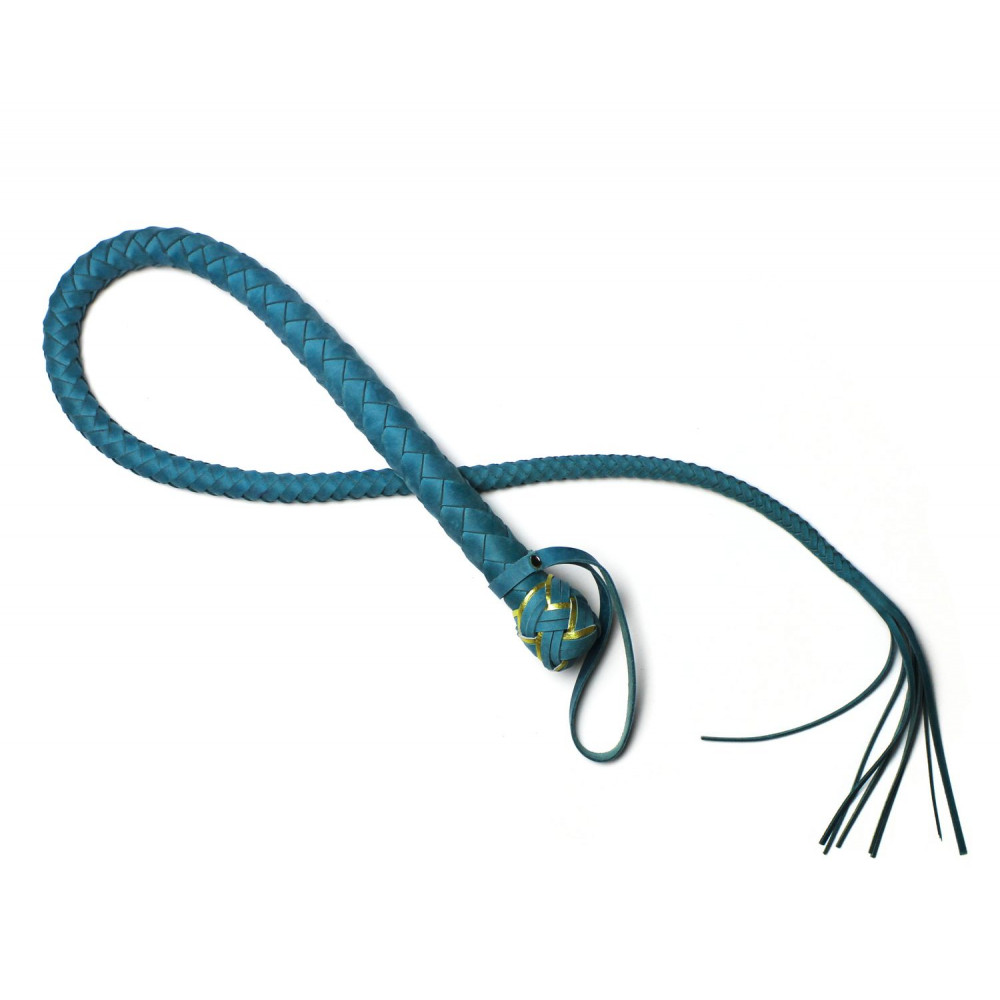
An Australian stockwhip has a handle about 38 to 53 centimetres and a thong one to three metres long, joined by a leather keeper. It is built to crack. The fine tip hurts badly if it lands and is hard to place, so stock work uses the sound more than contact. A bullwhip has a shorter handle (about 20 to 30 centimetres) and a braided thong one to six metres long, ending in a fall and cracker. Without a cracker it still cracks, only quieter. Both show up in modern performance and equestrian adjacent use.
Signal whips and snake whips suit people who want portability or a particular crack. A signal whip, originally for dog teams, runs about a metre, has no fall, and ties the cracker straight to the body. A snake whip has no rigid internal handle and coils into a small circle; a full-sized one is usually at least 1.2 metres. Florida cow whips are two-piece, often nylon parachute cord that still works wet, and heavier than an Australian stockwhip.
Horse work splits further. A dressage whip runs up to about 1.1 metres so a rider can keep both hands on the reins and still tap the horse’s side. A longe whip has a long shaft and matching lash for circling work and can be cracked to back a cue. A crop or bat is short and stiff, about 0.6 to 0.8 metres, with a leather popper, used close behind the leg. A hunting whip has a long thong to keep hounds off the horse’s legs and a hook for gates; it is not meant for hitting the horse.
Punishment and melee shapes
The cat o’ nine tails is nine knotted cotton thongs about 0.8 metres long, made by unraveling rope’s three-by-three plait, and was built for severe naval, military, and judicial punishment. In Chinese weapons, “whip” can mean a hard metal rod about 90 centimetres and 7–8 kilograms, or a soft chain of linked rods. Qilinbian, from the late 1900s, weighs about 1–2 kilograms with steel links and is used for exercise and performance.
Biology and pop culture
The Latin flagellum means whip. Some large lizards can injure a person with the tail. Diplodocid tails have been modeled as whip-like; newer work suggests they could be used that way without necessarily breaking the sound barrier. On screen and in games, whips mark Zorro, Raiders of the Lost Ark, Catwoman, and Castlevania. MythBusters tested Raiders-style gun-disarm, chasm swing, and tip speed. Victorian fiction horsewhipped cads; Sherlock Holmes sometimes carried a loaded hunting crop.
In BDSM
Between consenting adults a whip is an impact and sound tool, separate from judicial punishment or livestock driving. Hard-rod slap and long-lash crack each set a different pace. Handle length, lash weight, and tip build are chosen for whether the scene wants the crack, the sting, or both.