
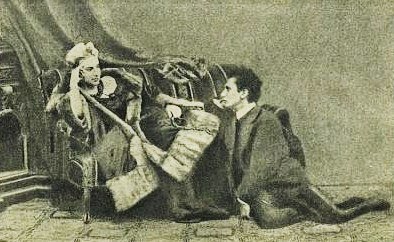
In 1870 the Austrian writer Leopold von Sacher-Masoch published Venus in Furs (German: Venus im Pelz). It appeared inside Love (Die Liebe). Love is the first volume of the unfinished epic he imagined as Legacy of Cain (Das Vermächtniß Kains). The novella did not later become that first volume. It was already inside it. In the 1870 Cotta edition from Stuttgart it runs from page 121 to page 368. For BDSM readers this is not a modern dungeon manual. It is a nineteenth-century template: female dominance, a contract, fur, and a man who wants to be owned. The literary root of the word masochism is here. That is not the later Freudian compound, sadomasochism.
The novel takes its charge from his life. Wanda von Dunajew, the central woman, is modeled on Fanny Pistor, a literary writer who was just coming up. Pistor wrote to Sacher-Masoch under the false name and title Baroness Bogdanoff and asked how to get her work into print. Real desire, roleplay, and literary ambition were already mixed. For fetish history that origin matters. The classic story of male masochism grew out of a private power arrangement, and the woman arrived already half in costume.
The story is nested. A framing dream has a man talking about love with Venus while she wears furs. An unnamed narrator confesses his obsession to a friend, Severin. Severin tells him to read a manuscript called Memoirs of a Suprasensual Man, as a cure. The inner story follows Severin von Kusiemski. He is infatuated with Wanda, asks to be her slave, and pushes her toward treatment that humiliates him further and further.
At first Wanda neither understands the request nor accepts it. Once she sees what the arrangement gives her, she takes it up with enthusiasm and despises him for handing himself over. He calls the state suprasensuality: sensation past ordinary limits, pain and humiliation turned into erotic knowledge. They go to Florence. On the way he takes the generic Russian servant name Gregor and plays Wanda’s servant. In Florence she treats him brutally and brings in three African women to dominate him with her.
The crisis is Wanda meeting a Byronic man, Alexis Papadopolis. She wants to submit to him. He is not a man who wants to submit to her. Humiliated by Wanda’s new lover, Severin loses the desire to keep submitting. When the outer narrator finishes the manuscript and asks for the moral, Severin answers that woman, as nature made her and as men currently educate her, is man’s enemy. She can only be his slave or his despot, never his companion, unless she has the same rights and equal education and work. The ending is not pure smut. It is a political sting about equality as the way out of the despot-or-slave pair.
In 1905 Sigmund Freud’s Three Essays on the Theory of Sexuality set Sacher-Masoch against the Marquis de Sade and coined sadomasochism. Freud argued that a person who takes pleasure in producing pain for a partner can also enjoy pain received in a sexual relation. After the Second World War, Gilles Deleuze pulled that neat pair apart in Masochism: Coldness and Cruelty and listed eleven differences between sadism and masochism. The famous one: sadism is an anarchic will to inflict pain, and masochism uses process, rules, and contracts to control and stage pain. For modern BDSM practitioners the distinction still lands. Many masochistic contracts are about structure and permission. They are not the same thing as a sadist’s uncontained cruelty. Sacher-Masoch’s fur-and-contract theater is a literary ancestor of boot worship and of written-protocol culture.
English readers often use the 1999 Zone Books edition, which prints the novella beside Deleuze’s argument. In 2021 Zachary Johnson and Verla Bond read an audiobook, so Wanda arrives as a voice. Public-domain German text circulates through Project Gutenberg and LibriVox, with the nineteenth-century tone left in place. This site also carries adaptations: the Velvet Underground track, Polanski’s Venus in Fur, Marzano’s 1967 sexploitation film, Dallamano’s censored Italian line, and the 1995 Dutch black-and-white feature. Each one is another century’s answer to Wanda’s furs. The novella is the root. The adaptations are branches. Do not collapse them into one plot.
![[Art Video] 2073 Slave Dispatch No.15 Collapsed Masochist Slave Mayumi Mayumi Kuroki [Exclusive]](https://bdsmwild.com/wp-content/uploads/2026/08/Art-Video-2073-Exclusive.jpg)