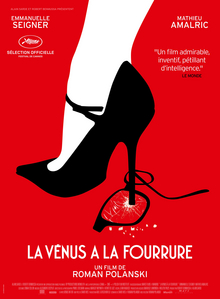
In 2013 Roman Polanski’s French-language erotic drama La Vénus à la fourrure (English title Venus in Fur) premiered in the main competition at Cannes. The film adapts a stage play by the American playwright David Ives, and the play draws on Leopold von Sacher-Masoch’s 1870 novella Venus in Furs. The scale is bare: one theater set, and two adult actors, Emmanuelle Seigner and Mathieu Amalric, carry the whole thing. There are no scene changes and no large prop department, only a lightboard, a costume trunk, and scattered script pages. That closed room is where the film’s fight over sexual domination and submission happens.
The story starts with writer-director Thomas Novacheck in a bind. He is preparing a new play adapted from Sacher-Masoch. The book opens on a line from the Book of Judith, “And the Lord hath smitten him and delivered him into a woman’s hands,” which sets the film’s tone of masochism and handing-over. After a bad day of auditions he is alone in a Paris theater, complaining on the phone about the actresses he has seen, about to go meet his fiancée. Then Vanda Jordan comes in out of the rain, clothes a mess. Her name is not on the list. She talks him into letting her read, with a hard, aggressive push. At first she seems to have no talent. As the audition goes on, that front comes off. She has the lines memorized, she produces the full script, she calls the staging exactly, she runs the theater lightboard without trouble, and she has brought full costumes, including pieces for Thomas that fit him. She even “guesses” details of his fiancée’s life, accurate enough to be unsettling. The woman who enters the story is named Vanda Jordan. On the cast list, Emmanuelle Seigner’s role is credited as Vanda Jourdain. The two spellings stay distinct.
As the reading continues, Vanda attacks the script as sexist soft-core S&M pornography. Thomas defends it as a faithful literary adaptation about passion and desire. She says he is feeding his own masochistic fantasies. He denies it. The denial becomes part of the game. Inside the theater the power turns over. Thomas thought he controlled casting, the text, and the interpretation. Vanda starts to control time, space, wardrobe, and then his body. Every time she “helps” with the staging, she is taking the room. Every time he defends the classic as literature rather than porn, he digs the hole deeper. The cruelty is psychological before it is physical. The black box becomes a temporary dungeon, and the director’s authority flips into the actress’s.
At the end the exchange is complete. Thomas is bound to a pole. Vanda appears, cries “Bacchae of the Cadmea. Dance for Dionysus!”, dances in front of him, and leaves. The Judith line comes back and closes on being delivered into a woman’s hands. The rope is a story beat, not a tying lesson. Calling the play soft-core S&M porn is both attack and seduction. Thomas’s denials are foreplay he will not admit. The submission is framed as a mythic handing-over: goddess, sacrifice, dance, and the man left behind. The film is not about how to be tied. It is about the erotic shock of finding you wanted the pole all along. In real life, dominance and submission still need to be agreed beforehand, and there has to be a way to stop. The danger in the movie is a scene that never admits it is a scene until the rope is already on.
Critics rated it highly. On Rotten Tomatoes, about 88 percent of roughly 119 reviews were positive, with an average near 7.1 out of 10. The consensus called it provocative, funny, and brilliantly acted, and put Polanski in top late-period form. On Metacritic, 33 critics gave it 69 out of 100, “generally favorable.” A. O. Scott in The New York Times wrote that the film keeps Polanski’s private fingerprint on a Broadway play: Emmanuelle Seigner, Polanski’s wife, is the center of the storm, and Mathieu Amalric’s performance is often read as an impersonation of Polanski himself. Director and performer sit locked in a private hall of mirrors. PopMatters said that, subtitles or not, the film is too gripping to look away from. There is always something to see, hear, and feel.
The adaptation was announced in September 2012, with Louis Garrel set as Novacheck. Filming was supposed to start in November 2012 and slipped to January 2013, and Garrel was replaced by Amalric. After Cannes, Sundance Selects and IFC Films took the U.S. rights. In January 2014 the film received five César nominations and won Best Director. That prize put institutional prestige on a two-hander about masochistic identification, the same seriousness the Cannes competition had already marked before awards season. It is not the 1967 sexploitation film, not Dallamano’s 1969 Italian picture of cuts and censorship, and not the 1995 Dutch black-and-white feature. Same literary bloodline, different century and different form.