
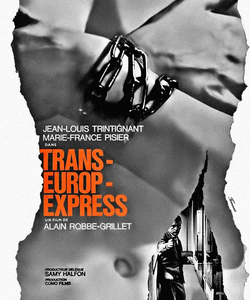
Trans-Europ-Express is a 1966 experimental film written and directed by Alain Robbe-Grillet. The title comes from the Trans Europ Express, then an international rail network linking major European cities. For viewers who know the erotic material, it is a meta-crime art experiment, not a conventional train thriller. Jean-Louis Trintignant and Marie-France Pisier carry the double game of erotic scenes and crime. What the film keeps doing is have the storytellers rewrite desire and violence, while the actors, inside a film within the film, play out bondage and rape fantasies that are never finished cleanly. For an adult audience the sexual power games are something the writers invent. The performance is incomplete. The outer frame can be taken apart at any time. The acts described here are the film’s fiction, not instructions.
The nesting is the structure. On the outside, a creative team sits on a train to Antwerp and invents a movie plot as they go. Inside that is the film-within-the-film: a novice cocaine smuggler and a prostitute perform the outline, and they perform it incompletely. The two strands are intercut. The formal point is that the people telling the story keep rewriting desire and violence, while the inner characters act out bondage and murder. Whether those events “count” inside the fiction can be revoked.
In the inner plot a Frenchman, Elias, carries his first cocaine consignment from Paris to Antwerp on the TEE. He is passed among mysterious intermediaries. In the spare time he and a prostitute named Eva enact a rape fantasy. His top contact later reveals that the cargo was powdered sugar. It was a loyalty test. After that job, Elias is assigned to take a shipment back to Paris. He finds Eva again and learns she has betrayed him to the police. He starts a bondage fantasy, strangles her, and goes into hiding. Buying a newspaper, he sees a murder report with an advertisement below it for a strip club whose bondage-act star looks like Eva. At the club the police surround him. Before they can arrest him, his contact shoots him dead.
The ending shows that this was fiction the frame can cancel. When the outer creative team returns to Paris and buys a newspaper, Elias and Eva, dead in the inner story, are in the crowd behind them, embracing. The murder, and the snuff-adjacent fantasy just played, are withdrawn because the narrator feels like withdrawing them. Bondage and sexual violence in the film are events inside the story world and toys in the author’s hands. Screenwriting teacher Robert McKee has called Trans-Europ-Express a “nonplot” film: it refuses ordinary story delivery. Robbe-Grillet’s script treats the plot as something that can be rewritten mid-journey.
The TEE in the title is a literal train and a formal metaphor. Desire and crime cross borders, and the authors rewrite the timetable. In 2008 Ripley’s Home Video issued a DVD in Italy. In 2014 Redemption Films issued a Blu-ray in the United States, so the bondage and rape-fantasy sequences stayed available to a later art-house audience and to kink-curious viewers. Further reading often points to the Robbe-Grillet volume compiled by André Gardies (Seghers, 1972), which includes contemporary documents and views on how the director staged sexual power as a narrative experiment.