
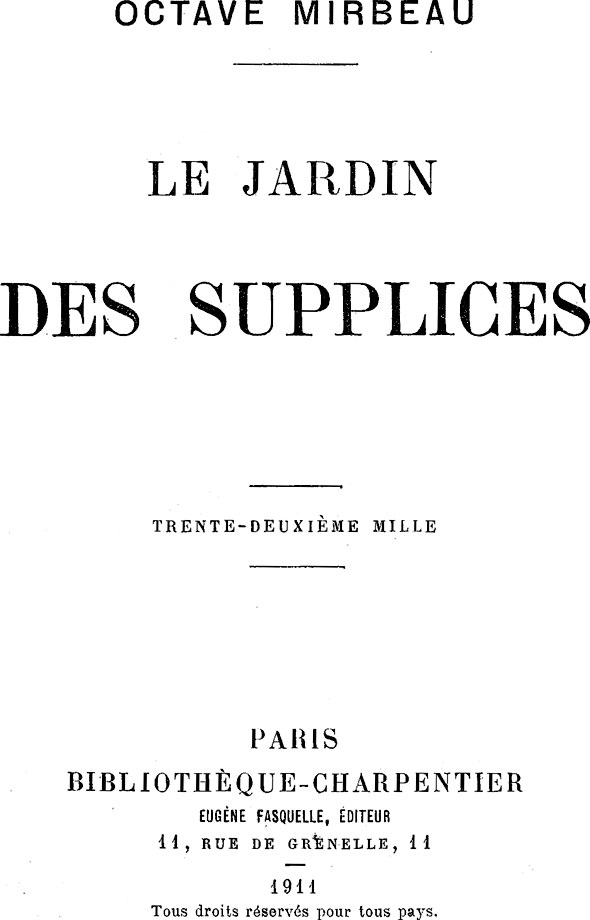
In 1899, at the height of the Dreyfus affair, the French journalist and writer Octave Mirbeau published The Torture Garden (Le Jardin des supplices). The dedication is aimed at priests, soldiers, and judges. He calls the book pages of murder and blood, and he means it as a slap across the face of those authorities. Clara, the central woman, goes into raptures among flayings and crucifixions in a carefully groomed Chinese prison garden. Beauty, sadism, and political rage share the same pages. Readers who track decadent literature and the eroticizing of cruelty still treat the novel as a primary modern text. It is a political-erotic nightmare, not a torture manual.
The structure is loose, a reworking of material from different periods and styles. It opens with front-matter from articles on the “Law of Murder” in “The Manuscript,” then shifts into “En Mission” (“The Mission”), a farcical demolition of French politics. A politician’s aide is packed off on a pseudo-scientific expedition to China because his presence at home would be inconvenient. The heart of the book is the visit to a Cantonese prison. The narrator tours it with Clara. She is a sadist and a hysteric. She delights in flayings and crucifixions, and in having those elaborate tortures staged inside beautiful, tended gardens. She explains the beauty of torture to her companion, reaches a hysterical orgasm, collapses from exhaustion, and starts again a few days later. Desire and cruelty are not opposites. They follow the same landscaped path.
The universe as a garden
Lines from the novel still circulate on their own. In “The Manuscript,” Mirbeau writes that woman holds a cosmic destructive force like nature’s: the matrix of life and therefore of death, because life is continually reborn from death. In chapter 2 of “The Mission” he separates robbery from business. Taking something and keeping it is robbery. Taking something and selling it on is business, and business can double the profit at less risk. Chapter 3 says the only irreparable trait in a statesman is honesty, which is “negative and sterile,” ignorant of appetite and ambition, the only powers that found anything durable.
Chapter 8, quoted in the liner notes of the Manic Street Preachers’ 1994 album The Holy Bible, attacks the cowardice of so-called civilization. You pretend respect for absurd people and institutions, you cling to moral conventions you despise, and that permanent contradiction between desire and dead formality poisons joy and personality. In chapter 9 of “The Garden,” the gates of life open only onto death. The universe appears as an immense torture-garden, blood everywhere. Where life is densest, tormentors dig into flesh and pull back skin with joyful faces. Passions, appetites, greed, hatred, lies, law, justice, love, glory, heroism, and religion are the garden’s monstrous flowers and the instruments of eternal human suffering. What the narrator sees is only a symbol of the whole earth. Quiet and rest in death are nowhere.
Translations, a film, and later borrowings
The novel went into other languages early. The first Spanish translation, by Ramon Sempau and C. Sos Gautreau, appeared in Barcelona in 1900. An English version followed in 1903. The Italian Il Giardino dei supplizi was published in Milan in 1917. That quick multilingual life shows how fast European decadent sadism found an export market. In January 2021 the British label Nucleus Films announced a Blu-ray, for that year, of the 1976 film version, The Garden of Torment — the British release title; France kept Le Jardin des supplices. Christian Gion directed it from a screenplay by Pascal Lainé. The cast includes Roger Van Hool, Jacqueline Kerry, Tony Taffin, Jean Rougeul, and Jean-Claude Carrière. The 1967 British horror anthology Torture Garden is a different film. John Zorn’s album Torture Garden takes its name from Mirbeau’s novel, another path by which the title entered late-twentieth-century extreme culture.
Where it sits for kink readers
Mirbeau did not write consensual SM. He wrote a political-erotic nightmare in which gardens, prisons, and orgasms share one aesthetic of control. Clara is a literary ancestor of the aesthete sadist: she wants the spectacle arranged, beautiful, and repeatable. The Cantonese garden sequence — torture as landscaped art, climax as critical commentary — gives kink-literature readers a template for how high culture can eroticize cruelty without dungeon props. The Dreyfus-era frame matters. Mirbeau’s rage at judges, priests, and soldiers turns the garden into a metaphor for European power, rather than a picture of “exotic” Chinese cruelty alone. Readers who only want bedroom flagellation may bounce off the political satire. Readers tracing a line from Sade through decadent modernism to modern SM aesthetics do not forget Clara.
For people browsing BDSM literature it remains a necessary novel. It is not a lifestyle kink guide. It is the modern novel’s best-known flowerbed of eroticized torment: beauty, blood, and desire planted in the same bed. Related reading includes Robert Ziegler’s essays on regenerated narrative and on utopianism and perversion in the novel, Tom McCarthy’s introduction to the Bookkake edition, and French texts of Le Jardin des supplices with Pierre Michel’s foreword.