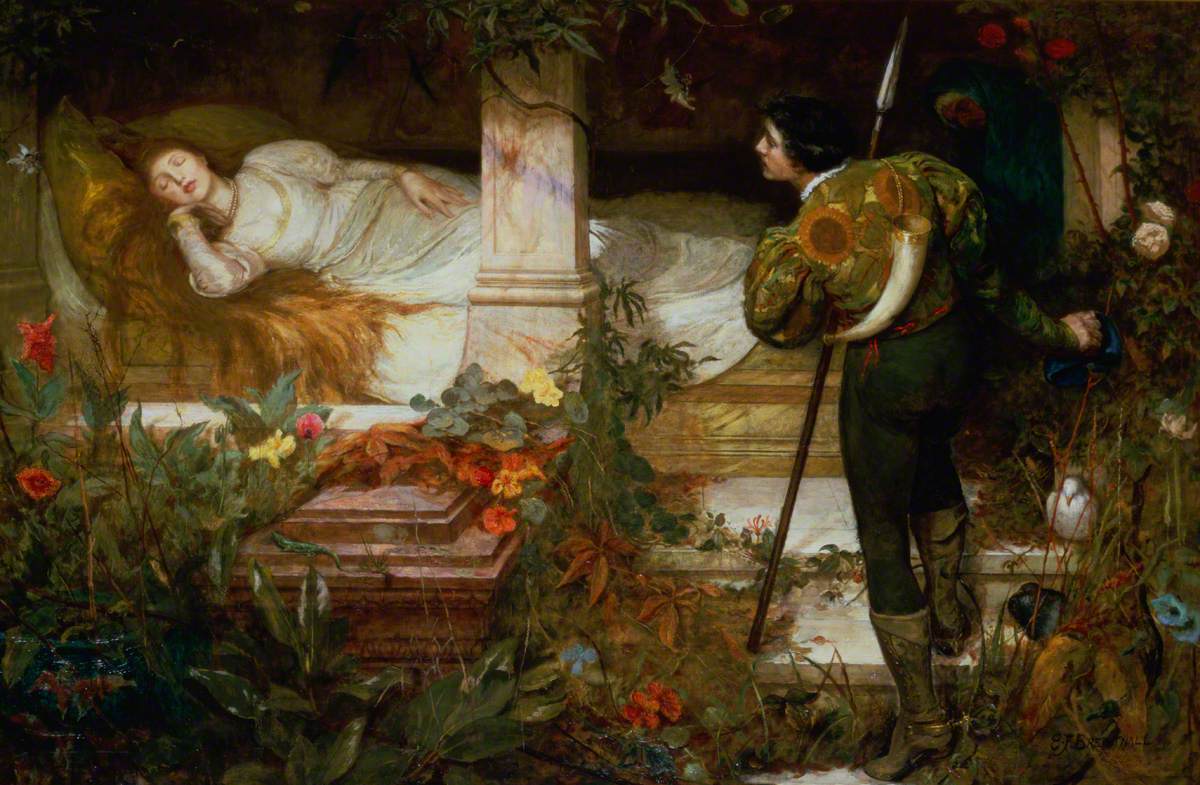
Anne Rice published the Sleeping Beauty quartet under the name A. N. Roquelaure. People file the books as straight pornography or as a how-to. They are adult erotic novels set in a medieval fantasy, and the power structure is the story. Sex is not decoration. In this world adult princes and princesses are sent as tribute into a queen’s castle, trained naked, put into pony harness, and shown on the auction block. The official word is “education.” What the training does is turn high birth into sexual property: spanking, humiliation, and obedience, then a return home “enhanced in wisdom.”
The fiction does not stay inside one kind of dominance. Women dominate men, men dominate men, women are sexual with women, and the desire moves in more than one direction. Rice writes from inside the submissive men Alexi, Tristan, and Laurent, and from inside the pleasure they take in pain, humiliation, and the loss of self. Those men want to be dominated. Kidnapping, forced auction, and public whipping are extreme fairy-tale situations in a novel. They are not a manual for real BDSM, and they are not a list of techniques.
From the castle to the village
The Claiming of Sleeping Beauty sets the rule. Beauty does not wake to a kiss. The Prince’s penetration is what puts her into slavery. In the castle she meets Prince Alexi, who had been stubborn. The Queen sent him to the kitchen. Crude servants tormented him, a stable boy humiliated him further, and his pride broke. He became a slave who obeyed. His story is a warning and a map, and Beauty still does not obey. At the end of the first book she is sentenced to brutal slavery in the neighboring village. The willfulness is how the series moves her from palace training into the public market of book two.
Beauty’s Punishment moves the stage to the village square and an inn. Beauty and Prince Tristan are sold naked on the block. Mistress Lockley, who keeps the inn, buys Beauty. Nicholas, the Queen’s chronicler, buys Tristan. The Captain of the Guard forces Beauty to pleasure him, then takes her to a drunken soldiers’ orgy. Tristan is harnessed as a pony, a tail plug in place, and whipped while he pulls Nicholas’s cart. In an orchard he has to pick up apples with his mouth. In the stable he is trained to satisfy other human ponies. Nicholas later paddles him at the Public Turntable, then forces sex on him in bed. The next day Nicholas marches him through crowded streets. Tristan says he loves anyone who punishes him, however crude or low, and that he wants the self to disappear inside the punishments until he “becomes” the punishments. Nicholas admits he is in love. The runaway Prince Laurent is bound to a wooden cross and whipped over his whole body by the Captain. Tristan later pulls a cart that carries Laurent in a penitential procession. Tristan and Beauty meet again at Nicholas’s house and have sex while Nicholas watches from behind a one-way mirror. Arab soldiers then kidnap Beauty, Tristan, and Laurent and send them across the sea to the Sultan’s palace.
Beauty’s Release opens on that palace after the raid. The harem is not a softer room. It runs on another harsh set of rules, and the damage is already done offstage: Inanna’s clitoris has been surgically removed. Laurent and Tristan are put through an all-male orgy, mounted on a cross and whipped. In private Laurent overpowers the steward Lexius and rapes him. When a rescue party arrives, Beauty is told she will be sent home to marry. She protests in hysterics. The “freedom” is not one she chose. Rice closes the captivity pageant of the first three books in a monogamous patriarchal marriage, and the dominance and submission do not stop. They continue under the crown.
Thirty years later
The trilogy came out from 1983 to 1985 and fixed Rice’s place in erotic fiction. After Interview with the Vampire (1976) she wrote two heavily researched historical novels, The Feast of All Saints (1979) and Cry to Heaven (1982). Readers called the first too dense. Reviews of the second were harsh enough to knock her back. She dropped a story set in Oscar Wilde’s period and returned to erotic writing she had already tried in the 1960s. The pen name A. N. Roquelaure comes from the French roquelaure, an eighteenth-century man’s cloak. The name was a disguise, so that hard erotic SM could be published without every review dragging the book back to Lestat. In the later 1990s the books no longer needed the disguise, and she said in public that the trilogy was hers. She treated the books as a political statement against 1980s feminists who called pornography a violation of women’s rights. Her claim was that women should be free to read and write what they want.
In 2015, thirty years after the trilogy ended, she published Beauty’s Kingdom. The cloak was gone. The Rice name could carry the sales. Queen Eleanor dies, and Beauty and Laurent take the throne. The erotic furniture is still there — pony stable, dungeon, whips — but the rule changes. Servitude is redefined as voluntary. The non-consent pageant of the first three books becomes, in the fourth, a tradition of chosen submission. Readers who wanted the earlier extreme of non-consent do not get a simple repeat. The ending has a comic color to it, and it is a later book looking back.
Sales, a library fight, and the critics
The trilogy sold and grew a cult. The next erotic novel, Exit to Eden (1985), was signed to Arbor House for a $35,000 advance, about $108,000 in 2025 dollars. People inferred from the dungeon on the page that Rice herself was a dominatrix. Her husband, Stan Rice, said she was “no more sadomasochistic than she’s a vampire.” That line is still the cleanest celebrity-kink disclaimer on file. Readers and critics kept interpreting the books anyway. In 1996 the director of the Columbus Metropolitan Library called the trilogy “hardcore pornography” and pulled every copy. Rice answered that the books were “elegantly sensual” and harmless. The American Library Association put the trilogy on its list of the 100 most frequently challenged books of the 1990s.
Amalia Ziv of Ben-Gurion University, in a 1994 Feminist Review essay, wrote that compared with Story of O the trilogy is “definitely more of a comedy,” and that “like all comedies, it ends in marriage.” Linda Badley of Middle Tennessee State University, in Writing Horror and the Body (1996), argued that rewriting the Sleeping Beauty myth as sadomasochistic fantasy let Rice explore “liminal areas of experience that could not be articulated in conventional literature, extant pornography, or politically correct discourse.” The characters go through a pony stable and a Sultan’s cross and still land on a wedding. Some folk versions of the tale have Sleeping Beauty raped and pregnant in her sleep, waking only after childbirth, and Rice’s books keep that motif in view while they run it through an SM plot. In 1994 Elizabeth Montgomery was among the stars who read abridged audiobook editions. A television project later picked up adaptation rights. Read them in publication order. They are adult fiction about power and desire, and about a marriage that does not cancel the power.