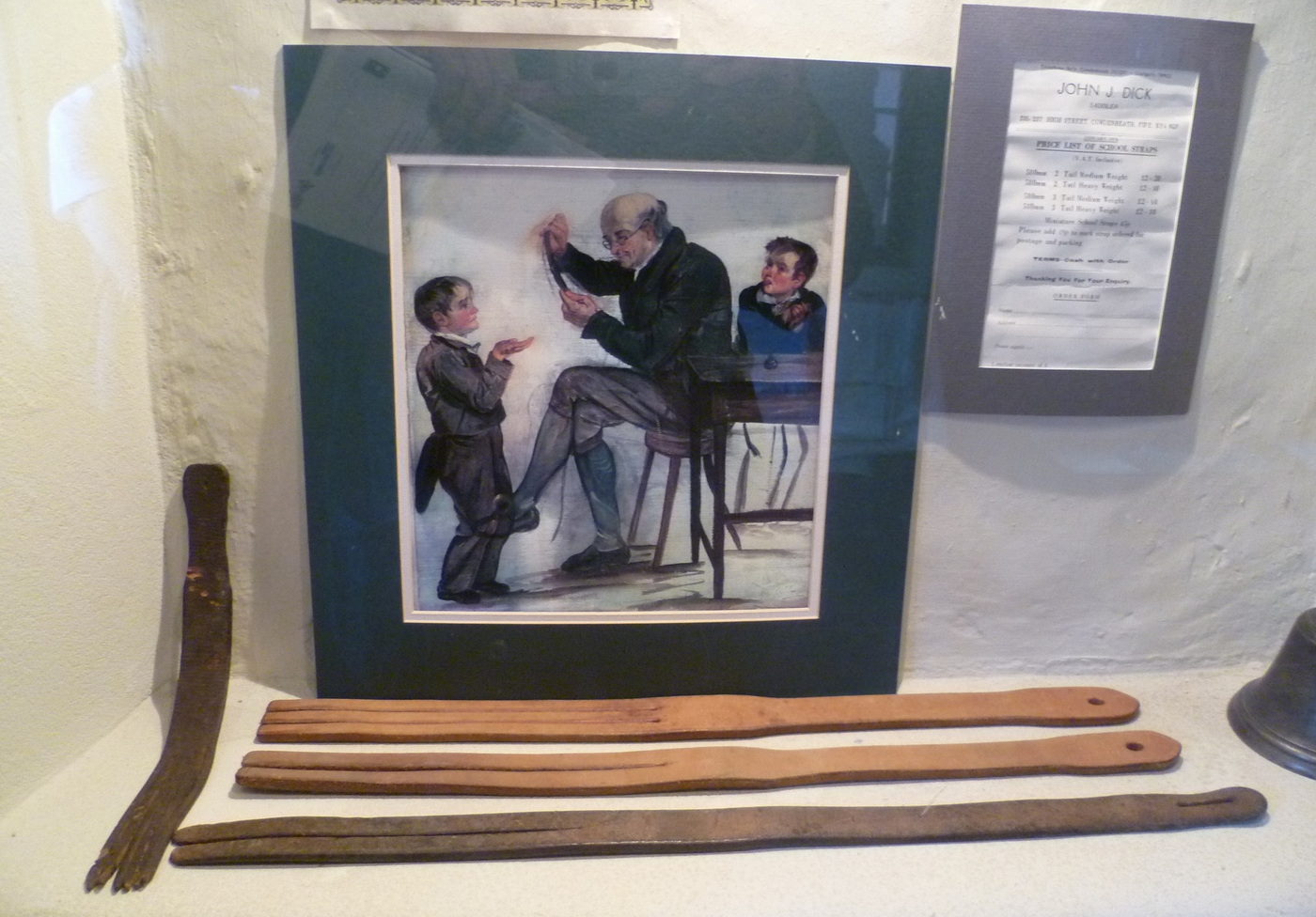
The tawse, sometimes spelled taws, comes from the plural of the Scots word taw, a thong of a whip. It is a leather strap with one end split into tails. Thickness and tail count change with the maker and the job. It started as a school punishment tool in Scotland and later moved into the adult BDSM impact kit. When this page talks about erotic impact, the people involved are consenting adults. The school history below is a record of institutional corporal punishment, not a sex scene and not a set of instructions.
Many Scottish horse-tack makers once produced tawses for local schoolmasters. Teachers and pupils rarely said “tawse.” They said school strap, or the belt, borrowing the ordinary word for the unforked leather strap in a pair of trousers. Among kink readers it is classic institutional impact gear: multi-tail leather, aimed at a palm or a seat, with a history that never pretended to be only “educational.”
How Scottish and northern English schools used it
Scottish state schools used the tawse on pupils of either sex, usually on the palm of an outstretched hand. The pupil was told to hold one hand out, palm up, with the other hand underneath, so it was harder to flinch and each stroke landed fully. A class teacher often did it in front of the room, as a warning to everyone else. Sometimes the pupil was sent out and a deputy head or similar authority did it. Primary and secondary schools both used it, for small offences and serious ones.
Girls were belted as well as boys. One report put the rate at nearly six in ten girls receiving the strap at school at some point, which undercuts the idea that the tawse was a rare boys-only tool. Outside Scotland, schools in a few English cities used it too: Newcastle upon Tyne, Gateshead, Liverpool, Manchester, and Walsall. In Walsall and Gateshead, and in some schools in Manchester and Nottingham, students — mainly boys — were tawsed on the seat of the trousers rather than the hand.
Some Scottish independent schools used it. Keil School is a documented case. St Aloysius’ College in Glasgow used a ferula instead, a thin metal strip covered in rubber. Fettes College and most schools in England outside the north-east preferred the cane. Where the border cities did use the tawse, it sat inside a wider British school-punishment culture, not as a purely Scottish oddity. Scotland is still the cultural home of the named Lochgelly strap.
The ban, then collectors and adult catalogues
In 1982 two Scottish mothers took a case to the European Court of Human Rights. The court held that parents had the right to refuse corporal punishment of a child. That judgment helped drive the legal ban on the tawse and on all other corporal punishment in UK state schools. The legislation took effect in 1987, though most Scottish local education authorities had already dropped the practice by the early 1980s.
The strap did not vanish as an object. It became collectible, and later adult-market impact gear. Use in that market is between consenting adults. John J. Dick Leather Goods in Lochgelly was estimated to have made about 70 percent of school tawses while they were still in regular use. Original pieces sold for roughly £6 in 1982. Twenty years later, collectors paid hundreds of pounds for rare examples. The Lochgelly tawse is still a named object in punishment history, museum notes, and adult impact catalogues.