
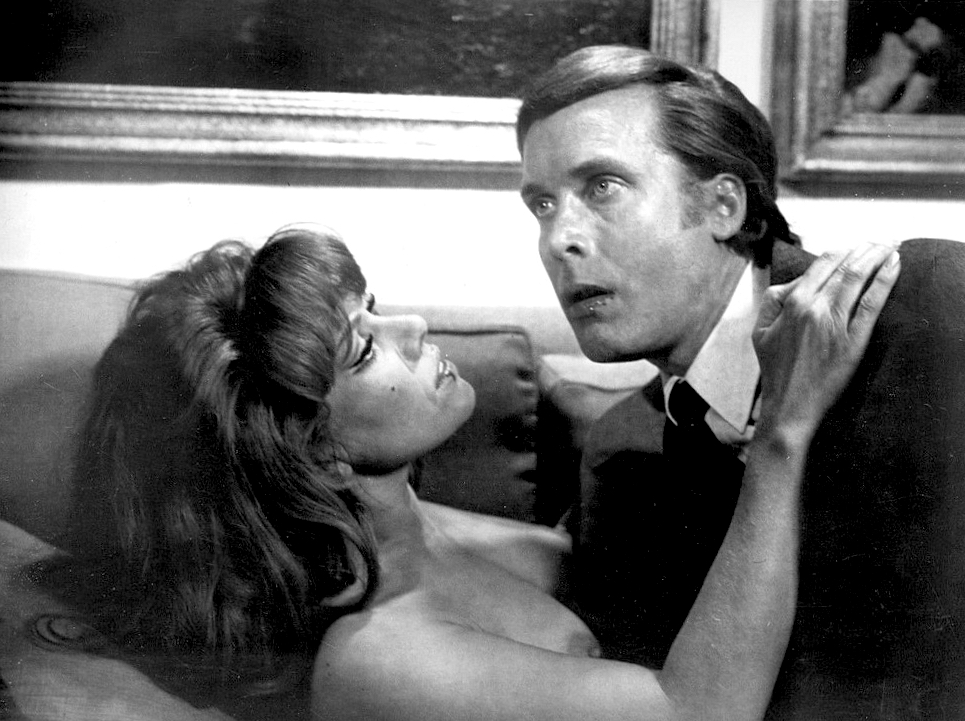
Succubus (German: Necronomicon – Geträumte Sünden, “Necronomicon – Sinful Dreams”) is a 1968 West German erotic horror film directed by Jesús (Jess) Franco and starring Janine Reynaud, Jack Taylor, Adrian Hoven, and Michel Lemoine. It follows Lorna Green, a Lisbon nightclub performer whose act is built from erotically charged sadomasochistic “murders,” and whose violent surreal nightmares suggest she may be under the mind control of a man who might be Satan himself. For adult viewers mapping SM aesthetics in 1960s European exploitation, Succubus is Franco’s first fully non-Spanish production—jazz, LSD parties, mannequin murders, and staged dungeon theater sold as art-horror rather than bedroom tutorial.
The film opened in West Germany in April 1968, was picked up by American International Pictures, and reached U.S. screens from April 1969 under the title audiences still search today. Critics split between “sleazy incoherence” and “bizarre appeal”; cult programmers later revived it with Franco in the room and a print borrowed from Quentin Tarantino. What matters for kink media history is the club act itself: simulated SM killing as nightclub entertainment, then the same choreography bleeding into dreams until fantasy and homicide stop being separable.
Plot: Club Act, Nightmares, and the Countess
In Lisbon, Lorna Green works as a nightclub dancer whose performances stage sadomasochistic violence ending in simulated murder—shock and titillation for patrons who came for both. Her manager, American William Francis Mulligan, “discovered” her and built the act. After a night’s show, William visits and stays. Lorna dreams she is a countess late for a castle dinner. On the trolley she meets Pierce, a mysterious figure who treats her as a “disciple of evil,” a devil on earth to do his bidding. She plays a word-association game with Admiral Kapp—famous writers and artists traded like passwords—then stabs him through the eye socket.
The next day, Lorna and William walk the city and stumble onto a street funeral. Lorna approaches the body, lifts the shawl, and recoils: the dead man, stabbed through the eye, resembles the Admiral from her nightmare. Later they attend a party hosted by psychiatrist Ralf where guests take LSD. Lorna slips into a trance and writhes on the floor while drugged partygoers crawl toward her like animals. William tells her a story of a countess who, under Satan’s influence, murdered the husband who built her a palace. At the club, Pierce watches from a distance, then greets her as the Countess; she rebuffs him and tells William’s circle she does not know the man.
In another dream, Lorna brings friend Bella to a dilapidated seaside castle. In a room of mannequins in period dress she seduces Bella, bludgeons her with a statue, and—when Bella flees—finishes the kill as mannequins come to life and Lorna uses a knife. She wakes to a largely emptied apartment: she is relocating to Berlin with William. In Berlin, unknown to her, William meets Pierce; the two have been colluding to manipulate Lorna. In a trance she reenacts the sadomasochistic club act inside their rented flat. A man and woman from her act are held captive. William watches as she stabs the man, then kills the woman who begs for her life. He calls her name, breaks the trance; she flees upstairs into gunfire and screaming.
William returns alone to Lisbon. In his apartment a nude Lorna lounges on the couch, asks for a kiss, then drives a knife through his neck. Pierce appears, drives her to the harbor, promises his power will “bring her peace,” names her his “Faustina,” and enters the castle with her. The loop closes: nightclub SM as rehearsal for real murder under a satanic stage manager.
Cast
- Janine Reynaud — Lorna Green
- Jack Taylor — William Francis Mulligan
- Adrian Hoven — (producer; on-screen roles as credited in production notes)
- Michel Lemoine — Pierce (and introduction of Reynaud to Franco)
Supporting players fill out the Lisbon–Berlin carousel of club patrons, party guests, and dream victims. Reynaud’s performance carries the film’s fetish charge: the body as both instrument of the act and object of someone else’s will.
Production: Leaving Spain, Losing Backers, Finding Necronomicon
After several Spanish productions, Franco sought German financing, fed up with Spanish production rules and censorship. Even with a Spanish crew he would have needed to shoot in Spain for co-production money; for Succubus, he said, “the censors had taken their red pen and crossed everything out, even the title.” The working title came from a book called Necronomicon he found at Pier A. Caminnecci’s home—only three pages of story—so Franco fused it with an earlier script. After finishing Lucky, the Inscrutable, he brought an eight-page outline to production manager Karl-Heinz Mannchen.
Model Janine Reynaud was cast after her husband, actor Michel Lemoine, introduced her to Franco. Shooting took place in Lisbon and West Berlin. Mid-production the German money collapsed. Producer Adrian Hoven contacted Caminnecci, who took an interest in Reynaud and agreed to finance; an affair between Caminnecci and Reynaud followed. Friedrich Gulda provided a jazz score. Franco claimed he wrote the screenplay and edited with Hoven. The result is pure Franco logistics: censorship flight, partial script, sudden producer romance, and a film that looks like it was assembled from fever and leftover financing.
Release and Promotion
Succubus screened at trade shows around the 17th Berlin International Film Festival in 1967. Variety noted substantial word-of-mouth for its sex and horror sequences. West German release came 19 April 1968 and was a financial success. American International Pictures bought U.S. rights and opened the film in New York on 25 April 1969 as Succubus. Promotion included a phone number for viewers who did not know what “succubus” meant—period exploitation marketing as dictionary service. In 2009 Fantastic Fest screened a print borrowed from Quentin Tarantino with Franco in attendance, locking the title into cult-circuit legitimacy.
Critical Response
Vincent Canby in The New York Times wrote that the film could not decide whether it wanted “to be a bare-breasted exploitation movie or a nice, erotic horror story about a demented lady of bizarre sexual tastes,” calling the whole thing “a bit of a drag.” Roger Ebert, reviewing Umberto Lenzi’s Orgasmo, ranked Succubus among the year’s worst—“a flat-out bomb” with “literally nothing of worth,” including an “ugly” lead. David McGillivray in the Monthly Film Bulletin said the most positive claim was that it was “strikingly different” from Franco’s work before or since; low-budget utilization was “relatively accomplished,” but otherwise “absurdly hit-or-miss,” with mannequins coming to life next to “crushing banality.”
Variety’s “Hans.” predicted controversy: many would see only sex and horror, others more; artistic outcome would split opinion, but technical quality—excellent color photography, fascinating optical effects—was hard to dispute. Kevin Thomas of the Los Angeles Times dismissed it as “another sleazy piece of European-made sexploitation, arty to the point of incoherence.” That critical range is the film’s reputation in miniature: trash bomb, technical curiosity, or SM-coded dream logic depending on the critic’s tolerance for Franco.
Home Media and Sources
Anchor Bay issued a DVD on 27 October 1998. Blue Underground reissued it 25 July 2006 with interviews featuring Franco and Jack Taylor. Secondary literature for collectors includes Danny Shipka’s Perverse Titillation (McFarland, 2011) on Italian, Spanish, and French exploitation cinema 1960–1980, and Stephen Thrower’s Murderous Passions: The Delirious Cinema of Jesús Franco (Strange Attractor, 2015).
Style: Jazz, Optics, and Delirium
Gulda’s jazz score and the film’s optical effects give Succubus a nightclub-modern sheen that pure gothic horror of the same decade often lacks. Franco stages Lisbon streets, funeral processions, and seaside ruin with the same dream logic as the mannequin murder: geography is mood, not map. The LSD party sequence—guests crawling like animals around a thrashing Lorna—is pure 1960s exploitation zeitgeist and also a metaphor for audience complicity. Viewers who came for SM spectacle become the crawling circle. That self-implicating structure is why some critics who hated the film still called it “strikingly different” from Franco’s other work: the delirium is the method, not only the plot.
Reynaud’s Lorna is both star of a sadomasochistic stage act and blank for Pierce’s will. William is manager, lover, conspirator, and finally victim—the classic Franco triangle of desire, commerce, and betrayal. Pierce’s “Faustina” naming at the harbor closes the literary loop: Faustian bargain rewritten as succubus recruitment. Adult viewers mapping erotic horror will recognize the template later films rework—performance killing, occult mentorship, woman-as-weapon—but Franco’s version remains stubbornly oneiric rather than procedural.
Why It Matters for BDSM Media Readers
Succubus is not a consent manual. It is 1960s Euro-erotica in which staged sadomasochistic murder is a nightclub product, then a nightmare grammar, then apparently real homicide under a satanic handler. The erotic charge is voyeuristic and occult: the audience watches Lorna’s SM act the way club patrons do, then watches her lose the boundary between performance and kill. For this site’s map of SM in film, Franco’s first fully foreign production is a key data point—jazz score, LSD crawling, mannequin room, knife through the manager’s neck—proof that European exploitation sold power, rope-adjacent theater, and female-as-weapon fantasy long before softcore prestige adaptations of literary S&M.
Home-video afterlife (Anchor Bay, Blue Underground) and the Tarantino-loan Fantastic Fest screening keep the title circulating among cult programmers who treat Franco as a genre of one. Pair Succubus with later literary SM adaptations if you want the spectrum from dream-kill nightclub to château softcore; pair it with pure horror if you want the satanic-control reading without the jazz. Either way, keep real power exchange, negotiation, and aftercare on a completely different shelf from Pierce’s castle and Lorna’s club act. The film’s perversion is the point of its history—not a blueprint for a scene.