
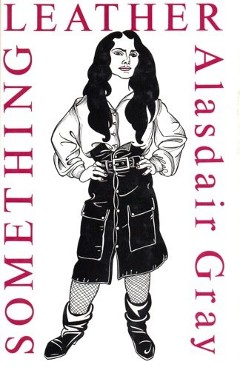
Something Leather, the 1990 book by Scottish writer Alasdair Gray, was sold as a Glasgow S&M initiation novel, and reviewers often filed it as a sadomasochistic lesbian adventure. The shape is stranger than that label. It is a collage of stories inside a leather-shop frame, and inside that a portrait of Glaswegians across class. For adult readers of leather and BDSM literature, the framing chapters really are a woman-led SM initiation. Gray kept saying the sexy title hid a wider city. Kink is one door into a lot of voices.
The frame follows June. She works in the civil service. The women who run a leather clothing shop in Glasgow bring her into sadomasochism. Four main figures sit in different social worlds: June; Donalda, a dressmaker; Senga, Donalda’s employer; and Harry, Harriet, an aristocratic English artist and dominatrix. A large cast of minor Glaswegian characters moves around them. Some sections rework Gray’s earlier broadcast material. The shop and Harry’s dominance give the book its fetish surface. Gray’s point was that the title made reviewers treat the whole book as a lesbian adventure, while the city material sits outside the frame of chapters 1 and 12.
The novel ends with a piece called Critic Fuel – An Epilogue. In that extended close Gray describes how the book developed, and in the acknowledgements he explains what the title did to the reviews. The episodes people classed as a sadomasochistic lesbian adventure happen mainly in framing chapters 1 and 12. He wrote that if he had called it Glaswegians, critics might have looked at the rest. In the 1990 book the S&M frame was central to what the book was. When the material was collected in Canongate’s Every Short Story 1951–2012 (2012), it was grouped under Glaswegians, and some of the heavier sadomasochistic writing was removed. That later version shows how much the S&M frame had carried the original.
Gray said the novel started from an attempt to write about a woman, an idea he credited to Kathy Acker. His earlier books had stayed with men who treated life as a task they never doubted until some unexpected collision opened their eyes and changed their habits. Reviews were mixed, and Gray later said the book sold badly. It is still an odd object for fetish readers: a major Scottish modernist wrote a woman-led SM initiation and power play inside a leather shop, then asked not to be read only for the whip. The book now exists under both titles, Something Leather and Glaswegians. Literary shelves and fetish shelves pull the same text in different directions, sanding the S&M frame or selling it, depending on which copy you pick up.
![[Art Video] 1998 Shadow Beast Academy Tsubaki Nakagawara [Exclusive]](https://bdsmwild.com/wp-content/uploads/2026/08/Art-Video-1998-Exclusive.jpg)