
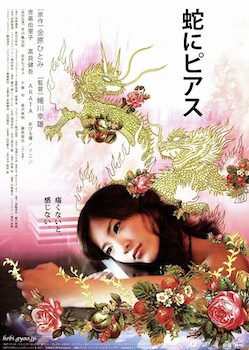
Snakes and Earrings (蛇にピアス, Hebi ni Piasu) is not a dungeon manual and not a romantic sadomasochism story with negotiated power exchange. Hitomi Kanehara’s novel is about a young woman, Lui, who is numb to ordinary life. She has already tried large-gauge ear piercings. She moves on to progressively larger tongue studs and a planned split, a tattoo that covers her whole back, and sadomasochistic sex that includes bondage, because that is how she checks she is still alive. Consent in the book is muddy. Pain is the thing that registers. For adult readers who know BDSM and fetish culture, the charge is what the body can do when feeling will not arrive in words.
Lui is obsessed with her new boyfriend Ama’s forked tongue and wants the same modification, so she goes to Shiba’s studio. Shiba is a tattooer and a body-modification artist. For Lui the shop is both a marking room and a place where sex happens. She gets interested in Shiba and, without Ama knowing, starts a violent sexual relationship with him that includes bondage and sadomasochism. Wanting the altered body and wanting the man who marks bodies become the same circuit. Love, violence, ink, and metal share one register. Intensity stands in for contact.
The erotic logic is not SSC or RACK. It is desire with no safety net. One night Lui, Ama, and Lui’s friend Maki are stopped in Shinjuku by two men who look like gangsters. One grabs Lui’s breast and insults her. Ama hits both. After one runs, Ama keeps beating the other and uses the heavy rings on his hand to knock the man’s teeth out. He gives the teeth to Lui as a sign of love. The gift is grotesque and sincere, and it warns you: affection in this book arrives as damage you can hold. Ama then disappears. His corpse shows sexual torture, rape, and strangulation. After Lui hears he is dead, grief becomes another modification schedule. She stops eating, drinks only alcohol, and forces larger studs in faster to speed the split, which hurts intensely.
The ending does not tidy the morals. Lui finds evidence that Shiba raped and killed Ama, and she still stays with him. The back piece gets finished. The relationship slides into something like domestic quiet. That is not redemption. It is another kind of seal. Lui thinks about putting in a still larger tongue stud. Modification continues. A kink-literate reading can still draw a line: the shop scenes are pain, marking, and erotic hierarchy. The murder is outside play. Fantasy is not a license to kill. Kanehara is writing the collapse of that line.
From dropout to the Akutagawa Prize
Kanehara’s background complicates the idea that she was a pure street voice. Her father, Mizuhito Kanehara, a sociology professor at Hosei University, took her to live in San Francisco and let her read Ryū Murakami and Amy Yamada, writers whose fiction is thick with violence and sex. Back in Japan, after middle school, she became anorexic and self-harmed. Against the wishes of her mother, Chieko, she dropped out in her first year of high school, left home, and started writing stories drawn from cutting, suicidal thoughts, body modification, and living with different boyfriends. Her father arranged for her to sit in on a sophomore fiction workshop at his university and edited the manuscript before it went in for the Akutagawa Prize. That support, a sociologist father plus an academic workshop, later made the “street voice” story harder to sell cleanly. The novel first won the 27th Subaru Literary Prize in 2003 and appeared in the November 2003 issue of Shōsetsu Subaru. In January 2004 the 130th Akutagawa Prize, whose committee favorite was this book, was shared with nineteen-year-old Risa Wataya’s Keritai Senaka. Twenty-year-old Kanehara and nineteen-year-old Wataya became the youngest winners in the prize’s history. Ryū Murakami was on the committee. He called the winning works a radical depiction of the time.
At the announcement Kanehara wore an off-the-shoulder cut jersey with the bra straps showing, a flared miniskirt, stilettos, nylons to mid-thigh, multiple earrings, and grey-tinted contact lenses. Coverage set that street look against Wataya’s demure, old-fashioned presentation. The press quickly cast Kanehara as an authentic narrator of Japanese youth culture, and interviews kept returning to suicide and self-harm. Critics said the novel was picked to market to younger readers and that the choice showed literary standards dropping. Sales still moved. The Bungei Shunjū issue that carried the story sold more than 1.1 million copies. The book edition sold more than 500,000 within three months. In Japan the novel eventually passed a million copies.
Academic reading outside Japan has clustered on subcultural resistance and commodification. Mark Driscoll argued that the tattooing and self-harm showed readers subcultures they did not know, but that Kanehara wrote the characters as closed-off consumers and reinforced stereotypes of Japanese youth. Rachel DiNitto offered a different resistance: in a society organized around commodification and virtuality, Lui uses pain, metal, and ink to experience her own body, against a body that shopping and screens have made abstract. That reading sets the novel next to postwar Japanese literature in which the body is a site of protest, including Tamura Taijirō’s Gate of Flesh. In Japan, literary scholar Eisuke Kotani noted the first-person everyday language and the anime-like feel of the narration, which makes readers collapse Lui into the author. The style invites that, and the prize-week press then sold it as authenticity.
The film: Shibuya, CGI hardware, a car crash
Shooting started in November 2007. The film opened in Japan in September 2008, directed by Yukio Ninagawa and starring Yuriko Yoshitaka, Kengo Kora, and Arata Iura, under the title 蛇にピアス. Ninagawa moved the story from Shinjuku to Shibuya so he could open on a panoramic shot of Shibuya Crossing, a gesture toward Werner Herzog’s Fitzcarraldo. The move turns a night story about gangsters into a city spectacle. Yoshitaka’s audition required her to perform nude. During the shoot she was in a serious car accident, and she later said the experience helped her understand the character’s pain. Most of the tattoos and piercings on screen, including the tongue stud, were makeup and computer-generated effects.
That production approach lines up with the cold international reviews. CGI tongue hardware, the crash, and a pop theme sung by Chara with lyrics by Kanehara package a short, cold first-person novel as a festival object. Yoshitaka won several best-newcomer prizes in Japan. Russell Edwards in Variety and Charles Webb at Screen Anarchy called the characters empty and the situations dull. Viewers who knew Kanehara’s media image better than her sentences met a cinematic body, not the Lui of the prose. The film can show a back piece and a stud. It has a harder time showing the police question about whether Ama was bisexual, Lui’s denial, and the domestic quiet she shares with the man she believes killed him. Those are the book’s SM-adjacent ethics: marking as intimacy, murder as the outside of play, housework as the last protocol.
Sixteen languages
The novel was translated into sixteen languages, from a Korean edition in 2004 to Swedish and Vietnamese in 2009, on the same clock as the Japanese sales spike. David Karashima’s English translation came out in 2005 from Dutton in the United States and Vintage Books in the United Kingdom. Reviews were generally positive. Complaints mostly hit the ending. The Guardian praised a portrait of alienation that is shocking but not sensational. The Financial Times treated the book as an example of a trend that lifted high-school girls toward a kind of iconic cultural status. Other critics kept pointing at length and a hasty close. Entertainment Weekly compared it to Bret Easton Ellis’s Less Than Zero: a cold ending that is also moving, with a question mark over originality.
On a map of BDSM literature, Snakes and Earrings sits closer to the shock-youth line of Ryū Murakami than to the French Story of O. O is trained into a system. Lui buys sensation, sleeps with the man who marks her, and stays after her boyfriend is killed. The Akutagawa machine then dressed the author for magazines, Playboy, a million copies, and a film. For adult readers the book does two jobs. It is an early-2000s record of Japanese body modification and SM as youth style. It is also a warning that play, self-harm, and actual homicide can collapse into each other. Ama’s murder is not a kinky twist. Shiba can finish a tattoo after that. Lui can think about a larger stud. Kanehara does not call this healing. Readers who wanted redemption found the ending strained. Readers who wanted resistance found a girl going domestic. Readers who wanted the hardware found the hardware. Readers who wanted a community ethics found a vacuum. The book is a record of body modification and SM when they are the only remaining way to feel, and of a man with needles who may also be the man who kills.
![[Fuji Kikaku] AS-02 Essence of Bondage 2 Hot Drool Maya Ogi Fuyuko Kitano -Chimuo Nureki- (Essence of Bondage 2) fuji-0073 [Exclusive]](https://bdsmwild.com/wp-content/uploads/2026/08/AS-02-fuji-0073-Exclusive.jpg)