
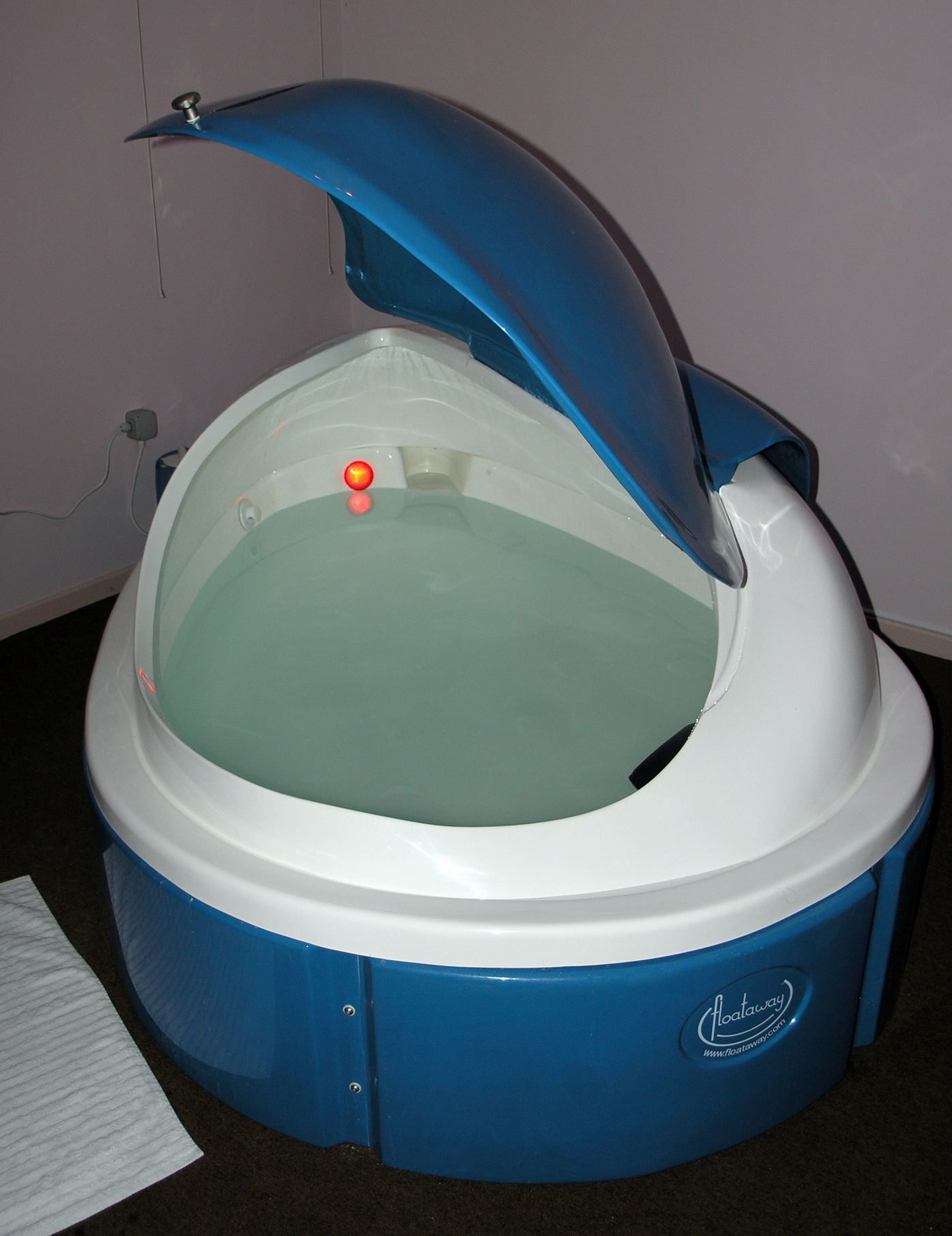
Sensory deprivation, also called perceptual isolation, is the deliberate cutting down or cutting off of one or more senses. In ordinary BDSM the usual door is sight and hearing. A blindfold or a leather hood takes vision. Earmuffs, or the padding of a tight hood, muffle hearing. More elaborate devices can also suppress smell, touch, taste, temperature sense, and vestibular orientation — the inner sense of which way is down. Psychologists have used the state in experiments and in restricted environmental stimulation therapy, REST. Armies have used versions of it in interrogation. The leather hood, the padded blindfold, and the dark room that kink uses at night are the cheap end of that same toolkit. This page is about what the scientific literature actually means for someone who hoods a partner. It is not a scene menu.
Partial Deprivation, and a Brain That Invents Input
Bedroom deprivation is usually partial. Unlike a laboratory chamber that cuts the senses off, a person under a hood often still has skin and temperature. That partialness matters. Most kink “deprivation” is not the total void Ibn Sīnā imagined. It is a chosen darkness, with a body still under someone’s hands. When channels drop, the brain gets hungry and tries to invent input, which is how hallucination starts. Short, voluntary isolation is often described as relaxing, something like meditation. Extended or forced isolation can bring anxiety, hallucinations, strange thoughts, and depression. A related phenomenon, perceptual deprivation or the Ganzfeld effect, does not remove stimulus. It replaces the world with a constant, uniform field. A white-out is not a blackout, but both can unhook the usual contract between the eye and the world.
REST: Chamber and Float
Clinical REST comes in two forms that do not work the same way: chamber REST and flotation REST. In chamber REST the person lies on a bed in a fully dark room with sound reduced by about 80 dB, for up to twenty-four hours. Movement is limited, but food, a toilet, and an intercom are available. Fewer than 10 percent leave early. The research shows changes in thinking, perception, memory, motivation, mood, and psychophysiological processes. The questions go back to the 1950s: what the brain needs from outside stimulation, and how arousal depends on the world. Clinicians have also pointed the method at problems such as substance abuse. Flotation REST puts the person in skin-temperature water and Epsom salts, mixed to a specific gravity that lets the body float on its back. Turning over takes major deliberate effort. Touch drops away and the body feels weightless. A session is usually about an hour, and fewer than 5 percent leave early. Work in the United States and Sweden has published reductions in pain and stress. The relaxed state includes lower blood pressure, lower cortisol, and high blood flow, and it also appears to improve well-being and performance. The Epsom salts may act on hypertonic muscles as well. After several hours the float gets uncomfortable because you cannot easily roll, so flotation cannot match the chamber’s length. The extract contains only one statistical comparison. Nineteen people used chamber or flotation REST to relax, or to deal with smoking, obesity, alcohol, or chronic pain. The effect size d treats 0.5 as moderate and 0.8 as large. Nineteen chamber subjects showed d = 0.53. Six flotation subjects showed d = 0.33. Combining REST with another treatment did not change much. Flotation’s practical advantage is about 45 minutes instead of 24 hours. That is not a ranking of techniques. The two are not interchangeable.
The Floating Man, and the Hood
Philosophers have used sensory deprivation as a thought experiment. Ibn Sīnā’s floating man is a person in a vacuum who cannot perceive any external signal or any signal from his own body, and who can still be sure that “I exist.” From that he argues the soul is an immaterial substance separate from the flesh. René Descartes later proposed substance dualism, treating the mind as an entity that can exist without a physical body. The floating man and Descartes’s thinking thing are not BDSM texts. In a scene the thought experiment gets run backwards. A hooded person is not there to strip touch away. Cutting sight and hearing makes the remaining touch enormous. Philosophers cut the world away to look for a soul. A scene cuts the world away to amplify whatever is left. Someone under a hood who feels the “I” get louder while the room disappears is brushing the same idea with their senses.
Smoking, Alcohol, and Other Clinical Numbers
REST has been tested as an aid in substance-abuse treatment. In studies running from twelve months to five years, 25 percent of REST patients reached long-term abstinence from smoking. Combined with methods such as behavior modification, that figure reached 50 percent. Combined with weekly support groups, it reached 80 percent. In the comparison given, a nicotine patch alone was 5 percent. Those are the source’s figures, not a kink statistic. On alcohol, people who did two hours of REST along with anti-alcohol educational messages cut consumption by 56 percent in the first two weeks, and the drop held at three- and six-month follow-ups. The extract notes that a placebo effect is possible. A University of Arizona project used chamber REST as a complement to ordinary outpatient substance-abuse treatment. Four years later, 43 percent were still sober and drug-free. Eight months later, nobody in the control group remained clean. These numbers come from timed clinical programs with follow-up. They are not the same thing as a hood in a dungeon. What they do show is that a reduced environment can change how plastic the brain is, enough that researchers have tried to aim that plasticity at habits.
Hallucinations, Source Monitoring, and a “Presence of Evil”
A brain short of outside input fills the gap itself. One study took nineteen volunteers from the lower and upper 20th percentiles of a questionnaire about healthy people seeing things that are not there, and put them in a pitch-black, soundproof booth for fifteen minutes. Five reported seeing faces. Six reported shapes or faces that were not there. Four noted a heightened sense of smell. Two felt a “presence of evil” in the room. People who scored lower had fewer distortions, and they still hallucinated. A 2009 paper in the Journal of Nervous and Mental Disease put a related effect down to faulty source monitoring: the brain misidentifies where the current experience is coming from. In a BDSM scene, if a hooded partner starts talking to someone who is not there, that is not automatically role-play going well. It is a known product of the technique. The literature does not tell you how to do three hours safely. Other evidence says time in isolation is not a clean dose-response curve. Schizophrenic subjects appear to hallucinate less in REST than people who are not psychotic. One explanation is that non-psychotic people live with a higher ordinary level of sensory input, and in REST the brain tries to rebuild that level.
The Five Techniques, and the Line
Sensory deprivation has been used as a way to relax. It has also been used to wreck a person’s orientation. Britain’s “five techniques” in early-1970s Northern Ireland were wall-standing, hooding, noise, sleep deprivation, and deprivation of food and drink. After the Parker Report of 1972, the United Kingdom formally abandoned them as aids to interrogating paramilitary suspects. Ireland took the case to the European Commission of Human Rights (Ireland v. United Kingdom, 1976). The Commission considered the combined use of the five methods to amount to torture. In 1978 the European Court of Human Rights measured the facts against the United Nations definition of torture and ruled that the techniques did not occasion suffering of the particular intensity and cruelty implied by the word “torture.” They did amount to a practice of inhuman and degrading treatment, a breach of Article 3 of the European Convention on Human Rights. The techniques were used on fourteen men. The hood was a black or navy bag, kept on, at least initially, at all times except during interrogation. The same object can be voluntary darkness in an erotic context, and the person can stop it. In this political history a state puts the bag on, then adds a hiss, a wall, and no sleep. Guantánamo sits in the same family of practice. People who find hoods hot are playing next to that history, not in a vacuum a fetish shop invented. This is the line. It is not instructions.
What a Kink Reader Can Honestly Keep
The usable science fits in five points. First, ordinary BDSM objects such as blindfolds and hoods already meet the definition. You do not need a tank or a chamber. Second, short voluntary isolation can feel like rest, because the nervous system is looking for signal. Third, the brain will hallucinate — sights, smells, a sense that someone is present — and that is a glitch, not magic. Fourth, forced deprivation is on the other side of a bright line, next to anxiety, depression, and the legal category of inhuman treatment. Fifth, clinical REST has published effects from reduced stimulation, and that does not make play into therapy. Hoods, blindfolds, and isolation play borrow a laboratory and an interrogation history and try to run them as sex. The science that exists is about tanks, chambers, fifteen-minute booths, and states that put bags on detainees. If you take sight away, the brain will try to give it back. If you take it away and leave no way out, you have left the erotic file and entered the judgment from Strasbourg.