
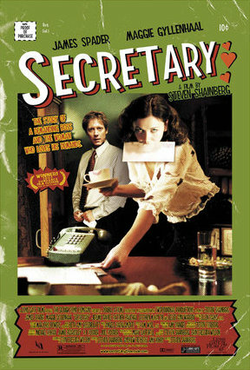
Secretary (2002) is an erotic romantic comedy-drama directed by Steven Shainberg, with a screenplay by Erin Cressida Wilson, adapted from Mary Gaitskill’s 1988 short story of the same name. Socially awkward Lee Holloway and the dominant lawyer E. Edward Grey start as boss and secretary and slide into a D/s relationship. For adult viewers who already know BDSM, the film plays that power exchange as a romance with real chemistry: kinky, funny, and sincere. It does not treat the relationship as nothing but a pathology.
Typos, a spanking, and Grey pulling back
Lee Holloway is the youngest daughter of a dysfunctional family. After severe self-harm she spends time in a mental hospital, then tries to put an ordinary life back together. She learns to type and goes to see the lawyer E. Edward Grey. Grey tells her she scored higher than anyone he has ever tested, and that she is overqualified. The work is very dull, typewriters only. She says she likes dull work and takes the job. When Grey finds her self-harm habit, he orders her never to hurt herself again. He turns that dominance toward protection, and away from pure sadism. After a spelling error he has her bend over the desk and spanks her. Lee is electrified. Employer and employee move into a BDSM relationship. Through the sadomasochistic contact Lee finds a sexual and personal awakening and falls in love with him. Grey is flooded with shame and insecurity about his own desires and starts to withdraw. Lee mistypes on purpose, inviting more punishment.
Peter, the worm, and three days in the chair
Off the office line, Lee tries a “normal” romance with Peter, a friend of the family. The sex is lukewarm, and Peter is confused by her wish to be spanked. That flatness makes the bond with Grey look specific. After Lee sends Grey an envelope with a worm in it, he bends her over the desk, has her take off her skirt and underwear, masturbates behind her, ejaculates on her bare legs, and then fires her. Peter proposes. Lee accepts reluctantly. Trying on her wedding dress, she bolts to Grey’s office and tells him she loves him. Grey is still unsure. He tests her: sit in his chair and do not move hands or feet until he returns. Over the hours, family and friends come to argue with her or to take her side. Grey watches, caught by her compliance. She even urinates in the wedding dress rather than break the position. The media read the vigil as a hunger strike. Three days later Grey comes back, takes her upstairs, bathes her, and feeds her. They marry and go on with a happy dominant/submissive marriage. The film’s thesis is plain: this can be love.
Plants in the office, plastic on the house
Production designer Amy Danger spent about two years, with the director, building Grey’s office. The room is meant to show his obsession with plants: natural wood, bamboo, ironwork, botanical wallpaper, natural colors, a private room that feels grown rather than bought. Lee’s house is the opposite, covered in plastic sheeting, artificial materials, manufactured color, so her life there reads as fake. The contrast makes the SM office the place where the two of them can be themselves. Shainberg cited My Beautiful Laundrette as an example of a film that can show a stigmatized love to a wider audience and have it look ordinary. Kink viewers still claim Secretary as a mainstream ally text, even while the community argues about how consent is shown on screen.
Sundance, the gross, and the home-video afterlife
The film premiered at the 2002 Sundance Film Festival, where Shainberg won a Special Jury Prize for Originality. It also played the Toronto International Film Festival, then opened in limited release in the United States that September. The theatrical take was modest, about $9.3 million worldwide, with a stronger afterlife on home video. The Blu-ray issued in 2010 carries a stack of behind-the-scenes extras and a director’s commentary. Rotten Tomatoes sits near 77 percent fresh. Metacritic sits near 63 out of 100. Critics singled out Maggie Gyllenhaal’s performance, and the film’s balance of sadism and romance.
Grey, Fifty Shades, and the consent argument
Because the man is surnamed Grey, and the subject is dominance and submission, commentators have set the film next to the later Fifty Shades of Grey phenomenon. Some suspect it influenced E. L. James’s naming of Christian Grey. Feminist critics including Emily Kenway and Adele Melander-Dayton argue that the film idealizes a relationship that begins without an explicit talk about consent. For an adult viewer it is a useful piece of media literacy. It shows dominance as care and submission as a form of agency. It also says that a real D/s relationship needs clearer safewords, a limits talk, and ongoing consent. A workplace power gap plus a “surprise” is not that talk.
The score is by Angelo Badalamenti, and the album includes “I’m Your Man” among other songs. A lyric is changed to “what grace have I, to fall so in love,” a shift that fits the film’s framing of submission as redemption. The screenplay was published in 2003 as Secretary: A Screenplay. Two decades on, the typing pool is mostly gone. The power exchange, the romanticized D/s, and a marriage ending that refuses to pathologize the couple are still being argued in fetish circles.


![[Fuji Kikaku] W-07 Bandage Bondage Soft Flesh Scented White Beauty Kitano Kotobuki Satomi Fuji -Chimuo Nureki- (Bandage Bondage Soft Flesh Scented White Beauty) fuji-0010 [Exclusive]](https://bdsmwild.com/wp-content/uploads/2026/09/W-07-fuji-0010-Exclusive.jpg)