Writers were putting the birch, the contract, and the dungeon on the page before BDSM was a culture with that name. Anthony Storr noted that the sheer volume of sadomasochistic pornography shows how widespread the interest is in Western society. For players now, the useful question is not whether a story “contains SM.” It is what script the story teaches: which books showed people a way of doing it, which ones filed the desire as pathology, and which ones sold a harmful cartoon of consent to a mass audience. The history is how you tell play from literary exaggeration.
Both naming events come from novels. In the late eighteenth century the Marquis de Sade, in The 120 Days of Sodom and other books, equated sexual pleasure with inflicting pain, humiliation, and cruelty. Richard von Krafft-Ebing later lifted the word sadism from that body of work. In 1870 Leopold von Sacher-Masoch’s Venus in Furs staged contractual female domination, and medicine built masochism from his name. These are not the same moment. Gilles Deleuze insisted that Masoch’s masochism is not sadism run backwards. It runs on waiting, fur, and the contract, not on Sade’s institutions of endless demonstration. For anyone who has actually negotiated a D/s contract, Masoch is closer to a real scene than Sade is. Story of O, the Gor books, Anne Rice’s Beauty trilogy, Secretary, and Fifty Shades are later arguments with those two origin myths.
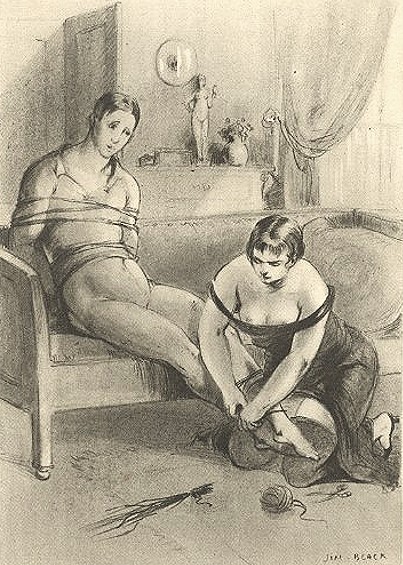
Birch fiction was already a trade before medicine named it. A Dialogue between a Married Woman and a Maid (1660) treats flogging as spiritual and erotic education, an older woman instructing a younger one. In the eighteenth century John Cleland’s Fanny Hill takes whipping from an aphrodisiac, something supposed to improve performance, and makes it a sexual act in its own right. Fashionable Lectures (1750) fixed the template of a woman in authority delivering a “lecture” with a rod. Victorian porn industrialized that template. Sade blows the scale up. He supplies the vocabulary and the dungeon-as-encyclopedia, and a moral universe in which consent is a joke. That is an extreme point of view, not a manual.
The nineteenth-century underground was a boom in birch books, mostly commercial, often eroticizing coercion. Exhibition of Female Flagellants (1830) describes women whipping women. Rosa Coote’s The Convent School (1876) is a school-setting title; the plot is not retold here. Other books of the period center on abduction and assault and are not how-to guides. Raped on the Railway (1894) is one of them. They show that the birch sold. They are not models for modern play. When a later story uses school uniform or a campus, the people acting it are adults.
At the end of the nineteenth century Venus in Furs set a world that runs on waiting, the contract, and the education of a dominant. In the early twentieth century France became a factory for spanking novels. Paul Guérard produced around a hundred of them between 1903 and 1936. Guillaume Apollinaire’s Les Onze Mille Verges belongs on that shelf. Pauline Réage’s Story of O, published in 1954, taught a mass audience the grammar of erotic slavery: collar, branding, silence, and love proved by surrender. Unlike Sade’s institutions of crime, Réage builds a house with rules and marks that still has to face ordinary daylight. The literature shifts from a display of violence toward the problem of a relationship.
From the middle of the twentieth century on, SM fiction moves into science fiction, work, and daily life. John Norman’s Tarnsman of Gor (1967) put a master-and-slave culture on another planet and leaked into the real-world Gorean subculture. Anne Rice’s Beauty series, written as A. N. Roquelaure, begins in 1983. From 2000, Laura Antoniou’s Marketplace series imagines a secret, professionalized world of trained slaves and owners, with its own schools, contracts, and ethics. Fifty Shades of Grey (2011) is the best-selling item on the shelf and the one most often criticized as inaccurate and harmful. Contracts show up as props. Stalking and isolation are framed as romance. Aftercare and community are thin. A wide range of BDSM is flattened into mall-Gothic. It still matters, because a large vanilla audience came away thinking that was the whole of SM.
Film is not a list of whips. Sade adaptations such as Pasolini’s Salò, which moves the 120 Days schema into Fascist Italy, are about representation, not about technique. Luis Buñuel’s Belle de Jour and Liliana Cavani’s The Night Porter—the latter a concentration-camp erotic bond that is still fought over—work through psychology and history. The films that treat a dynamic as a relationship problem do the harder job. Peter Strickland’s The Duke of Burgundy is a lesbian D/s household in which the dominant is tired and the submissive wants more ceremony. Thrillers keep using leather as a killer’s uniform. Basic Instinct and 8 mm are that habit, not evidence about players. Television is more fragmentary: CSI’s professional dominatrix Lady Heather on one side, Boardwalk Empire using breath play as high-risk character business on the other. Asphyxiation is dangerous. It is not a lesson. TV rarely stays with a negotiated dynamic that is not a punchline or a corpse.
Pop music kept its own record. The Velvet Underground’s Venus in Furs (1966), Depeche Mode’s Master and Servant, and Nine Inch Nails’ Happiness in Slavery, which takes a preface from Story of O, sit on a line that is either cool and literary or a whip used as a dance-floor noun. On stage, Jean Genet’s The Maids and David Ives’s Venus in Fur treat SM as performance, older than the modern club. Read from a dungeon, the fiction is older, thicker, and more commercial than the psychiatric compound “sadomasochism.” Sade and Masoch are the two poles later readers attached to it. The books that actually shaped scene language are the ones that bother with contracts, rules, and what people do to each other. Fiction does not replace negotiation, safewords, or a community. It is how the culture dreamed the scene before there were clubs, and how it keeps dreaming it afterward.