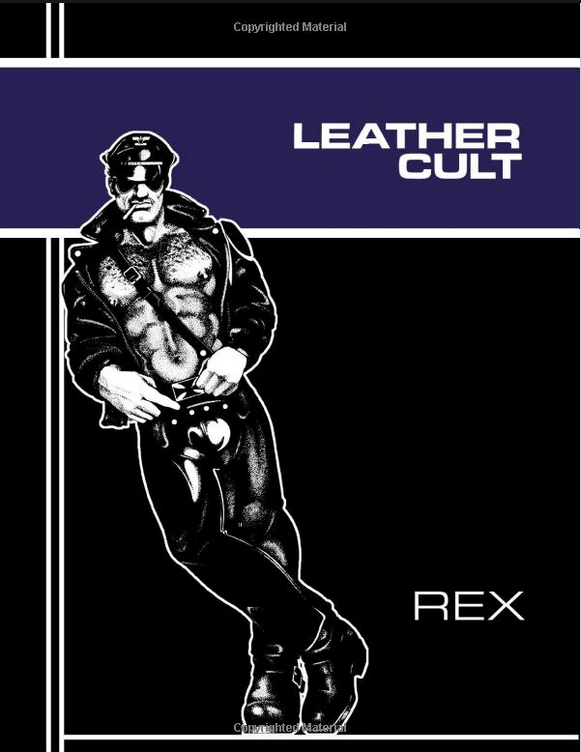
Beside Tom of Finland’s sunlit, monumental uniform fantasies, twentieth-century gay fetish art kept another picture memory. That is REX (1943 – March 2024). He was an American visual artist and illustrator. In black-and-white pen and ink he drew gay S&M life in 1970s and 1980s New York and San Francisco. Tom drew an idealized body. REX drew flophouse rooms, dripping urinals, glory holes, greasy workers, bikers, stained mattresses, and men who pay by the night. The sheets smell like beer, piss, and cigarette smoke leaking through a hallway crack. Civic authorities, some gay critics, and the “politically correct” America he later blamed for driving him to Europe could not file that smell as harmless decoration.
He was abandoned at birth. His legal name and exact birthday are unknown. Leather historian Jack Fritscher’s research points to 5 February 1943. As a teenager he drifted among beatniks in Greenwich Village, then became the protégé of a fashion designer and studied at the School of Visual Arts in Manhattan. That work took him to London and Paris. His sharpest memories there were the “cottages,” public toilets that did not sort people by class, race, or whether they were straight or gay. A urinal that does not ask who you are was already, for him, a theory of sex. Back in the United States he turned that toilet democracy into a cracked stall in a blue-collar hotel and a wall drilled with a glory hole. That room is the politics of the later drawings.
Three letters, and the bars that paid for them
In the 1970s, disillusioned with commercial art, he dropped out and came back as one of the main visualizers of fetish subculture in New York and San Francisco. A bootleg magazine of Tom of Finland drawings hit him hard. Men having sex with men, eagerly, gave him permission, not new information. Before and after Stonewall, explicit homosexual art lived under vague law and uneven policing. He signed “REX,” three letters, so the cops could not trace him. The name was a survival tool. Freelance work started in 1972 with the Rough Trade pulp series, twelve images for each story, then posters for leather shops and gay bars around the United States. He did not start in a museum. Mineshaft was a members-only sex club in New York. He made three posters and the T-shirts. Across the club’s thirteen years they sold in the tens of thousands. When the film Cruising rebuilt the club’s rooms, the REX posters were on the walls. In 1976 the Pleasure Chest poster was a poster, not a magazine cover. That job led to early Drummer covers in 1977 and to advertisements for the poppers brand BOLT in 1980. The clients are the visual equipment of a subculture in the short stretch before AIDS, when it was briefly allowed to advertise itself.
The Hallam Street fire, then the mail-order sheets
On 1 July 1981 he opened the gallery Rexwerk in his studio on Hallam Street, South of Market, San Francisco. Ten days later a fire destroyed it. The fire started at The Barracks bathhouse, across the street, which was being renovated. July 1981 was also the month the first case of what would soon be called AIDS was diagnosed in San Francisco. The mail-order business did not begin after that fire. The advertised sets start with Icons in 1977. From the early 1980s his main income was Drawings by REX, privately printed unbound portfolios of hard-core images, including Rexwerk, Uncut, and Armageddon. Buyers wanted loose sheets they could frame. Most erotic artists of the time sold photographic prints. REX sold art prints. The nearer earlier model is George Quaintance. Critics place the drawings closer to graphic novels, gay comics, Japanese shunga, and Franz von Bayros than to a disposable stroke magazine. A single plate could take months. When the epidemic took hold, civic authorities and voices inside the gay community demanded a clampdown on sexual permissiveness. He would not submit to what he felt as suffocating censorship, and he was ground down by the AIDS deaths of nearly all his contemporaries. Only then did he stop publishing for several years. That silence was not the start of the mail-order work.
Who met him, and who refused the sheets
Robert Mapplethorpe knew REX and was drawn to the hard-core Mineshaft imagery. He built a camera portfolio on related themes. They did not take the same road. Mapplethorpe leaned toward Los Angeles and, later, the museum and a First Amendment fight. REX preferred San Francisco, then mail order, appointment galleries, and the Netherlands. The person who met REX face to face in San Francisco in April 1978 was not Mapplethorpe. Robert Opel invited REX to a one-man show at the new Fey Wey Gallery on Harrison Street. Jack Fritscher, Drummer’s editor and one of Mapplethorpe’s lovers, met REX for the first time at that opening and wrote the description that still works as a wall label: urban toilets, blue-collar hotels, greasy workers, bikers, unshaved men in jockstraps, leather, and boots, stained mattresses, a urinal dripping beer piss, a stall drilled with glory holes. In 1985 REX was named one of San Francisco’s “100 Most Influential Artists” and shown at the Mayor’s Art Gala. The sheet on the wall was titled “Dogtreats.” The San Francisco Chronicle condemned it at once. This article does not describe that sheet as a bestiality picture. Other images in the catalogue have been read as suggesting bestiality and urolagnia, and some have been accused of involving minors. Those last sheets are not described here and are not treated as erotic content. The accusation is part of why the work was refused. Richard D. Mohr, at the University of Illinois, struggled to find a publisher for Gay Ideas: Outing and Other Controversies (1994) because the book included REX. Richard Goldstein, in the Village Voice, condemned the sex of the fetish community and what he called its “Naziphile” sympathies, and pointed at REX’s work as evidence.
Mainstream art long ignored the more difficult sheets. Inside leather, the recognition came later. His work was shown during Folsom Europe in Berlin in 2016. He was inducted into the Leather Hall of Fame in 2022. In 2023 a supporter compiled the authorized collection Leather Cult. He found a more accepting climate in Amsterdam and kept a pay-to-view site. He refused the antiseptic, idealized homoeroticism of “cookie cutter nudes.” He drew muscle and he drew piss, boots and toilets. He signed three letters to keep the police from tracing him, and the line work outlived the rooms. For adult fetish readers, REX is an ink-black archive of leather desire before AIDS and in the early years of it. The drawings were made for walls that were never supposed to hang in City Hall.