
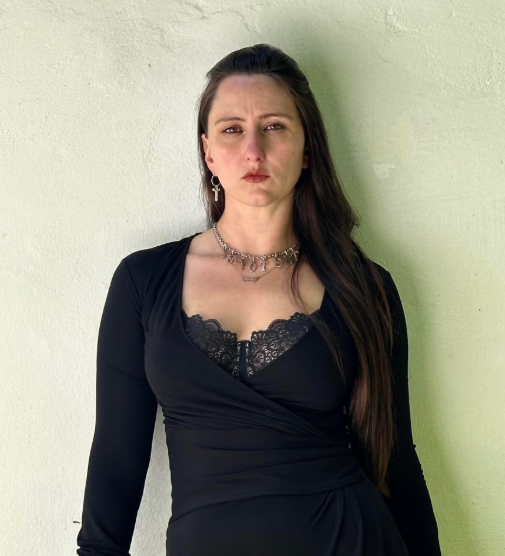
Reba Maybury was born in Oxford in 1990. She is a British-Pakistani artist, writer, lecturer, and professional dominatrix, often under the name Mistress Rebecca. Her mother is Pakistani, her father is Welsh, and she has a younger sister. In 2013 she graduated in Fashion History and Theory from Central Saint Martins in London. That training shows up in how she handles clothes, branding, and the look of desire, and in how she moves between the art world and commercial sex work while talking about money on both sides.
The line people repeat is that men are her medium. For viewers who already know BDSM and fetish, she is not a dominatrix posing for a photo series, and she is not a gallery artist who never takes a session. Male submissives pay or serve, and she keeps what they make as art property. The question is property, credit, and who walks out with the object. The submissives are consenting adults.
She sets them to menial creative work: drawing a show’s cover in pencil, or filling in paint-by-number kits. The man who came for a fantasy of a dominant woman spends his time producing something she owns. In the 2021 series Used Men, as Jeppe Ugelvig describes it, the clothes of a presumably naked male submissive are strewn on the gallery floor and relabeled as the artwork. The naked body stays in the viewer’s head. They are mutual, consenting collaborators, and the joke is that they do not get credit. That mocks the art-world story of the lone genius and points at uneven power in sex work. Consent is real. Authorship is not shared equally. She treats that gap as the work, in a spirit of reactionary feminism, not as a mess to tidy up for polite feminism.
In 2018 tabloids gave her attention she did not want, over what looked like the “political re-education” of submissives who were typically conservative. She has written about the hypocrisy of men who are sexually drawn to dominant women and still deny those women rights outside the session, and about the abuse she took in the right-wing press. Her line: “Sex is about play and I want to play with politics too.” Scene power and public politics use the same body. A mistress who votes, teaches, and exhibits can use the dungeon as a critique. Critics have compared the work to Toulouse-Lautrec’s pictures of sex workers resting between jobs. Maybury’s version is sharper, because the person put to work is the client, and the client is a man. The name that stuck is political dominatrix.
She teaches critical thinking on Central Saint Martins’ MA Fashion course. She has also taught at HEAD Geneva, Kunstakademie Düsseldorf, the University of Applied Arts Vienna, and the Copenhagen Art Academy Sculpture School. Sessions and seminars share the calendar. Students meet domination as a way to talk about labor, gender, and who gets paid for whose fantasy, not only as a lifestyle brand.
Solo and duo shows include My Deep Secret at Arcadia Missa, London, 2018; A-good-individual at LUMA Westbau, Zürich, 2019; Faster than an erection at MACRO, Rome, 2021; From Paris With Love at Treize, Paris, 2022; and From Paris With Love: The Book at Tiny Mutual Admiration Societies, Vienna, 2024. MACRO and LUMA matter because museum and kunsthalle walls took the Mistress name as contemporary practice. That is the friction she wants: the economy of sex work inside institutions that still pretend the art market is cleaner than the session market.
Group shows run from Hardcore at Sadie Coles HQ in London to Putting Out at Gavin Brown’s Enterprise in New York, and through a run of exhibitions in Berlin, Geneva, Turin, London, and Zürich in 2021 and 2022. Those rooms put her in arguments about domination, excess, queer literary inheritance, and hardcore aesthetics, not only in a corner labeled sex-work art. That 2021–2022 stretch is when the political-dominatrix name was especially visible. The people in the work are consenting adults.
![Legend of Shima 114 Legend of Shima 114 Mania Secret Records Married Woman Slave VOL.18 Momoko Sugiyama -Shiko Shima- [Shima Planning] SS-0295](https://bdsmwild.com/wp-content/uploads/2026/08/Legend-of-Shima-114-SS-0295.jpg)
![[SUNSET COLOUR] SK-6 Female Teacher’s Beautiful Ass 6 Yuriko Hosokawa 178sk00006](https://bdsmwild.com/wp-content/uploads/2026/08/SUNSET-COLOUR-SK-6.jpg)
![[Art Video] 1921 Fallen to Slave 9 Woman of the Female Core Pleasure Lust Prison Torment Pictures Aoi Uehara Hikaru Hara](https://bdsmwild.com/wp-content/uploads/2026/08/Art-Video-1921.jpg)