
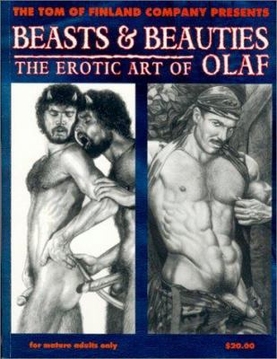
Olaf Odegaard (15 December 1938 – 25 December 1997), better known by the pen name Olaf, was an American artist and playwright active in the later twentieth century. In the history of gay male SM art he sits with Tom of Finland, Etienne, Domino, and the other leather-era draftsmen. His drawings are of adult men. The subjects run to the devil, satyrs, and BDSM, including master/slave relationships, and he is best known for graphite pencil. Work that once lived in private collections later reached museum walls.
The training started on a Wisconsin campus. He graduated from Carroll College in Waukesha in 1961. Campus life was theatrical. He wrote, directed, crewed, or starred in Macbeth, The Lady’s Not For Burning, and Rashomon. He joined Phi Theta Pi in 1958, became president of Alpha Psi Omega in 1960, and collected awards in art and theatre. In 1961 he took second place in the President’s Cup oratory contest with a speech arguing that pornographic or “sick” humor was gradually replacing clever satire. Readers of the erotic work later heard the irony. That same year he and classmates appeared on the television show About Faces. Further study took him to Harvard Divinity School and the University of Tokyo. He later earned a Master of Fine Arts in playwriting from the University of Hawaii.
The erotic career stood up through Drummer, the leather-era flagship for gay male SM. By the 1980s he was a working artist inside that network, not a purely underground hobbyist. In 1985, thirty of his illustrations appeared in Personals: Only Real Men Need Reply, from Glenlee Enterprises. A portion of the sales went to charity for people with AIDS. In 1986 he organised Naked Eyes for the International Gay and Lesbian Archives, a showcase of gay men’s visual art that included Harry Bush, Domino, Dom Orejudos, and others. His work was also exhibited at Fey-Way Studios. Magazine circulation, a charity book, and archival shows put him in the middle of the trade.
The recognition did not make the life steady. He lived alone and his housing was insecure. Close ties with Jim Kepner and Durk Dehner mattered in practical ways. Both supported him at times and kept him from homelessness. The move into a house in Silver Lake, Los Angeles, was with Dehner’s help. In 1996 Dehner and the Tom of Finland Company published a 64-page book, Beasts and Beauties: The Erotic Art of Olaf, fixing the satyrs, beasts, and master/slave pencil work for collectors.
The Tom of Finland Foundation called him the erotic master of the graphite pencil and one of the greats alongside Tom of Finland and the others. After his death, remaining works were sold to fund his nephew’s education. Much entered private collections. Pieces also reached the Leather Archives & Museum, ONE National Gay and Lesbian Archives, and the Leslie-Lohman Museum of Art. In 2015 his art appeared in Sille Storihle’s book and film on the Stonewall Nation movement. Chuck Conner and Sean Platter cited him as inspiration for their comic series DEMONICSEX, which carries a foreword by Clive Barker. In 2016 he was in the GLBT Historical Society retrospective “Stroke: From Under the Mattress to the Museum Walls,” and the same year in Cock, Paper, Scissors, the exhibition and book from ONE Archives and the Leslie-Lohman Museum.
For readers mapping gay male BDSM illustration, Olaf’s graphite line joins mid-century campus theatre, Drummer-era leather media, AIDS-era charity publishing, and twenty-first-century museum collections. He is a separate pencil. Master/slave fantasy moved, through these drawings, from magazine culture into permanent collections, and the heat stayed.
![[Art Video] 1921 Fallen to Slave 9 Woman of the Female Core Pleasure Lust Prison Torment Pictures Aoi Uehara Hikaru Hara](https://bdsmwild.com/wp-content/uploads/2026/08/Art-Video-1921.jpg)
![Legend of Shima 127 Legend of Shima 127 Electric Current Scream -Shikou Shima- [Shima Planning]](https://bdsmwild.com/wp-content/uploads/2026/09/Legend-of-Shima-127.jpg)