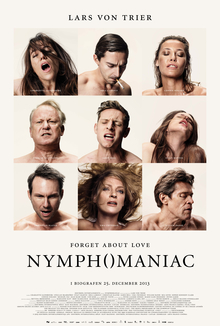
Nymphomaniac (stylized onscreen as NYMPH()MANIAC, sometimes NYMPH(;)MANIAC) is Lars von Trier’s 2013 erotic drama, an art-house epic split into two volumes because the thing would not fit in one commercial slot. Charlotte Gainsbourg and Stacy Martin share Joe, a self-diagnosed “nymphomaniac” who tells her life to a bachelor after he finds her beaten in an alley. Stellan Skarsgård is Seligman, the listener who converts every confession into fly-fishing, Bach, Fibonacci, and church history. Around them: Shia LaBeouf, Christian Slater, Jamie Bell, Uma Thurman, Jean-Marc Barr, Willem Dafoe, Connie Nielsen, Mia Goth. Martin and Goth made their feature debuts. The story runs from adolescence to damaged adulthood across eight chapters. It was supposed to be one film; length forced the split. Denmark, Belgium, France, and Germany financed it. Uncut Volume I premiered 16 February 2014 at the 64th Berlin International Film Festival; uncut Volume II at the 71st Venice International Film Festival. The full Director’s Cut world-premiered in Copenhagen on 10 September 2014. It was nominated for the 2014 Nordic Council Film Prize. It is the third and final film in von Trier’s unofficial Depression Trilogy, after Antichrist (2009) and Melancholia (2011).
For a BDSM-aware audience the film is not a leather-bar documentary. It is a long, cruel, sometimes comic inquiry into compulsion, numbness, sadism-as-therapy, and the lie of the sympathetic male listener. Volume II’s chapters with K—the professional sadist played by Jamie Bell—are the hardest SM passages in von Trier’s fiction: negotiated-looking brutality that is also self-destruction, climax purchased with tissue damage. The rest of the movie keeps asking whether “nymphomania” is diagnosis, insult, identity, or a story a woman tells to stay in control of the telling. Then the listener tries to rape her. She shoots him. Fade out.
Depression Trilogy and the Two-Volume Machine
Von Trier’s unofficial trilogy moves from a couple’s cabin horror (Antichrist) through a wedding-end-of-the-world opera (Melancholia) into this five-and-a-half-hour sex confession. Depression is the weather, not a PSA. Executive producer and Zentropa co-founder Peter Aalbæk Jensen said from the start they were making two films, hoping for Cannes, shooting and editing both together, finishing both at once. There would be two versions of each: an explicit cut and a softer cut. That dual-track was not a last-minute censorship panic. It was how the project was sold: enough explicitness to be “the von Trier sex film,” enough shortenings and genital-blur to clear territorial boards and still play as art cinema.
The complete director’s version runs about five and a half hours. What most territories got first was a four-hour “international” cut edited without von Trier in the room, ninety minutes gone, issued as Volume I and Volume II. Zentropa’s own statement was unusually frank. From 25 December 2013 the four-hour pair would roll out worldwide over about four months, sometimes same-day, sometimes staggered. Each country had its own censorship rules; the four-hour cut was the cohesion product, and even that version would take “minor additional changes” in some markets. Von Trier had already allowed censored versions of Antichrist; he approved this shorter Nymphomaniac too. Technically the abridgement cut the most explicit genital close-ups and, “in agreement with Lars von Trier,” was shortened by his editors to a length decided with stakeholders: two parts of two hours each. The long version would follow in 2014 wherever law allowed. Editor Molly Malene Stensgaard later told the 2014 Venice issue of DFI-Film that they did not really work with multiple versions at once. They worked one film—Lars’s version, the Director’s Cut—for eight months, then spent a month making the shorter one. “A long film with a break, basically.”
Volume I: Fibonacci Sex, Little Flock, Mrs. H
Highly educated, cloistered, middle-aged bachelor Seligman finds Joe beaten in the alley behind his apartment. He takes her home and listens. He cannot stop analogizing. Fly fishing is his favorite sport; her life becomes a stream he can read.
Joe is raised by a loving father and a detached mother. In adolescence she loses her virginity to neighbor Jerôme, who then leaves to fix his moped. Seligman notes that Jerôme penetrated her three times vaginally and five anally—the Fibonacci sequence, because of course he would say that. Years later Joe and her friend B run a contest to see who can have sex with the most passengers on a train before arrival; the prize is a bag of chocolate. Joe wins by fellating S, a married passenger who resists both girls until Joe forces the issue. She tells Seligman about first love, which she defines as “lust with jealousy added.” She and her friends found a club, “The Little Flock,” dedicated to freely having sex in order to reject society’s fixation on love. Joe leaves when the others develop serious attachments to their conquests.
As a young adult she drops out of medical school and works as a secretary at a printing company. Her first employer is Jerôme. She avoids his advances and sleeps with other co-workers instead, to his consternation. She writes him a letter after realizing her feelings, then discovers he has left with the jealous secretary, Liz. Jerôme’s uncle, the owner, fires her immediately. She goes back to nymphomania while still wanting Jerôme.
While she is with lover H, his wife arrives and admonishes them in front of their children—something present-day Joe admits barely affected her. Another lover, A, walks into the middle of Mrs. H’s breakdown. The family finally leaves after Mrs. H verbally attacks Joe, slaps H, and flees wailing. Uma Thurman’s Mrs. H is the volume’s most famous set piece: bourgeois rage as aria, children as unwilling audience, Joe as the still point who will not perform shame. A conversation about Edgar Allan Poe’s death reminds Joe of the last time she saw her father. She is the only one who visits him in hospital as he dies of cancer. She watches violent spasms and paranoid delusions, him screaming for his wife. To distract herself she has sex with several people at the hospital. When he dies she becomes aroused, then overwhelmed with depression.
After Seligman asserts that Bach perfected polyphony, Joe discusses the lovers leading up to her “cantus firmus”: F, tender but predictable, who prioritizes her sexual needs; and G, whose animalistic control thrills her. Walking in a park she meets Jerôme again—he has left Liz. They embrace and have authentically passionate sex. She is distraught when she can no longer “feel anything.” Volume I ends on that numbness. The rest of the film will try, with increasing violence, to get feeling back.
Volume II: The Sadist, the Therapy Room, the Gun
Joe becomes annoyed with Seligman’s allegories. He cannot relate. He confirms he is asexual and a virgin, then claims that makes him the best listener. Joe remembers a childhood vision of Valeria Messalina and the Whore of Babylon looking over her as she levitates and spontaneously has her first orgasm. Seligman calls it a mockery of the Transfiguration of Jesus. The religious sarcasm is the movie in miniature: Joe offers a body event; Seligman offers a cathedral footnote.
She suffers a crisis over her inability to climax, eventually has a baby, Marcel, with Jerôme. The relationship strains further when he allows her to see other men. She begins visiting K, a sadist who assaults women who seek his company. At Christmas, after rescuing an unattended Marcel who has wandered onto a snowy balcony, Jerôme makes her choose between the family and herself. She chooses herself. She then takes an especially brutal beating from K that makes her climax again. Marcel is sent to a foster home. Years later she has pleasure back, but her genitalia are irreversibly damaged. A new boss, knowing her habits, demands she attend sex-addiction therapy.
She becomes pregnant and seeks an abortion; the doctor insists she speak to a counselor first. When that ends disastrously, she performs the procedure herself with household implements and a wire hanger. In the present, Joe and Seligman argue about abortion rights. She reluctantly attends therapy and tries sobriety. During one meeting she sees her younger self in the mirror, insults the other group members, proclaims pride in her nymphomania, and leaves. Feeling ostracized from “normal” society, she becomes a debt collector. She remembers a house call to a man she initially finds sexually unreadable. She ties him to a chair, strips him, and provokes him until she understands he is a repressed paedophile. She fellates him. She tells Seligman she empathized with his status as a sexual outcast and praises him for never acting on his desires. The scene is one of the film’s most disputed: Joe’s identification with a man who wants children, her decision to give him adult sex as recognition, Seligman’s moral algebra. It is plot about stigma and self-story, not an invitation to eroticize that desire.
Joe’s superior, L (Willem Dafoe), suggests she groom P, the fifteen-year-old daughter of criminals. Joe is initially repulsed. After P turns eighteen they begin a sexual relationship; Joe later invites P to move in and hesitantly teaches her the collection job. During one round Joe realizes they are at a house belonging to Jerôme and tells P to handle it. She then learns P is having an affair with Jerôme. Joe ambushes them in an alley and tries to shoot them. Jerôme beats her viciously, then has sex with P in front of her. P urinates on Joe before they leave. The golden-shower humiliation is the film’s ugliest remix of kink gesture: not negotiated play, but triumph displayed on a beaten woman’s body.
In the present Seligman suggests Joe’s experiences were fueled by differences in gender representation; her guilt and shame made her fight “like a man,” and she ultimately “forgot” to rack the gun because her human worth forbade killing. Joe finally feels content, having unburdened the story to someone she considers a friend. As she sleeps, Seligman attempts to rape her. She wakes, reaches for the gun. He tries to justify himself. She shoots him and flees the apartment. The listener was never safe. The fishing metaphors were camouflage. Volume II’s last joke is that the man who claimed asexual virginity as a credential for hearing women’s sex was waiting to take his turn.
Cast: Two Joes and a Roomful of Von Trier Regulars
Charlotte Gainsbourg plays Joe from about thirty-five to fifty; Stacy Martin plays her from fifteen to thirty-one. Skarsgård’s Seligman is the framing device with a body. LaBeouf is Jerôme Morris; Michaël Pas is older Jerôme. Christian Slater, aged with makeup, is Joe’s father. Jamie Bell is K, the sadist. Uma Thurman is Mrs. H. Willem Dafoe is L. Mia Goth is P. Sophie Kennedy Clark is B. Connie Nielsen is Katherine, Joe’s mother. Jean-Marc Barr is the debtor gentleman. Udo Kier is the waiter. Volume I also uses Maja Arsovic and Ananya Berg as Joe at seven and ten, Sofie Kasten as young B, James Northcote and Charlie G. Hawkins as lads on the train, Jens Albinus as S, Felicity Gilbert as Liz, Jesper Christensen as Jerôme’s uncle, Hugo Speer as Mr. H, Cyron Melville as Andy (A), Saskia Reeves as a nurse, Nicolas Bro as F, Christian Gade Bjerrum as G, and, in the extended version, Anders Hove as Odin. Volume II adds Shanti Roney as Tobias the interpreter, Laura Christensen as a babysitter, Caroline Goodall as a psychologist, Kate Ashfield as a therapist, Tania Carlin as Renée, Daniela Lebang as Brunelda, Omar Shargawi and Marcus Jakovljevic as thugs, and Severin von Hoensbroech as a debtor in a greenhouse.
LaBeouf got the role by sending von Trier a tape of himself having intercourse with his girlfriend Karolyn Pho. Slater connected through an agent in Denmark and used makeup under his eyes to look old enough to be Joe’s father. In August 2012 LaBeouf told press the movie was “what you think it is,” that a disclaimer at the top of the script said they were “doing it for real,” that anything illegal would be shot in blurred images, and that otherwise “everything is happening.” He called von Trier dangerous. “He scares me. And I’m only going to work now when I’m terrified.”
How They Shot the Sex
Principal photography ran 28 August to 9 November 2012 in Cologne and Hilden, Germany, and in Ghent, Belgium. To produce simulated sex, von Trier used digital compositing to superimpose the genitals of pornographic-film performers onto the bodies of the named actors. Producer Louise Vesth explained at Cannes: they shot the actors pretending to have sex, then body doubles who really did have sex, then digitally imposed the two. “Above the waist it will be the star and below the waist it will be the doubles.” Gainsbourg and Martin said prosthetic vaginas and closed sets were used. Martin called the experience enjoyable and, after saying the characters reflect the director himself, called the process an “honour.” She also said shooting the sex scenes was a bit boring because of their technical nature. That boredom is useful context for anyone who imagined the set as an orgy. It was a compositing problem with intimacy coordinators avant la lettre, porn doubles, and a director whose public persona is itself a sadism performance.
A seven-track soundtrack appeared digitally from Zentropa on 27 June 2014: classical pieces, modern rock, and two sound clips from the film’s prologue. The mix is typical von Trier: high-culture quotation laid over bodies in rooms, Bach as alibi and as structure.
Appetizers, Orgasm Posters, NC-17 Surrendered
In early 2013 the first teaser poster came off the official site. Zentropa then released a promotional photo shoot of the main characters in suggestive positions and a list of the eight chapters. A picture of Trier with duct tape over his mouth launched the official campaign—self-silencing as brand, after his Cannes Nazi-joke exile. An incremental campaign followed: brief videos, each called an “appetizer” by the production company, released online on a monthly Friday pattern. “The Compleat Angler” appeared 28 June 2013. “Jerôme,” with Martin and LaBeouf, followed in August; “Mrs. H” in September; the predominantly black-and-white “Delirium,” with Skarsgård voice-over, in October. November’s “The Little Organ School” went up on YouTube and was quickly removed for explicit content. “The Eastern and the Western Church” was released exclusively on Vimeo on 29 November. December brought “The Mirror,” again on Vimeo. On 25 December, into the European release, “The Gun” went up on the official site. The chapter titles themselves are the film’s joke about education: angling, organ school, Eastern and Western church, a gun. Joe’s life is curriculum. Seligman is the worst teacher in Europe.
In October 2013 a poster series showed each main character at the moment of orgasm. Five theatrical posters followed—three for the complete feature, one for each volume—plus an international trailer that included some of the explicit sex. In July 2014 Zentropa revealed the Director’s Cut poster for Venice: the original teaser with von Trier standing between the two parentheses of NYMPH()MANIAC. Early in 2014 the film received an NC-17 from the MPAA, then surrendered the rating and opened unrated in the United States. The surrender is a distribution fact, not a purity badge: NC-17 still kills playdates; “unrated von Trier” plays the art houses.
Festivals, “Film X,” and the Fainting Abortion Scene
A “secret” advance screening of Volume I ran at Sundance on 21 January 2014 at the Egyptian Theater, tickets billed as “Film X,” with rumors the mystery title was either von Trier or Wes Anderson’s The Grand Budapest Hotel. The UK premiere was 22 February 2014. In the United States the volumes opened on separate dates: 21 March and 4 April 2014. In Australia and New Zealand, Transmission Films released the four-hour version on 20 March 2014, volumes back-to-back with an interval. February 2014 brought uncut Volume I at Berlin; September brought uncut I and II at Venice. The complete Director’s Cut reached a general audience in Copenhagen on 10 September 2014, shown with a half-hour intermission at a red-carpet gala with von Trier in the house. During the restored abortion sequence—Joe performing the procedure on herself—three male audience members fainted and had to be carried out. That anecdote has done as much publicity work as any orgasm poster: the film still has the power to drop bodies in a room, and the bodies that dropped were men.
Reception: Volume I Loved More Than Volume II
On Rotten Tomatoes, Volume I sits at 76% approval, average 6.9/10, from 202 reviews; the critics’ consensus calls it “darkly funny, fearlessly bold, and thoroughly indulgent,” von Trier “provoking viewers with customary abandon.” Volume II is at 59%, average 6.4/10, from 126 reviews; the consensus says it does not quite live up to the first installment but still benefits from von Trier’s craft and vision and from Gainsbourg’s bravura performance. On Metacritic Volume I is 64/100 from 41 critics, Volume II 61/100 from 34—both “generally favorable.”
Michelle Orange of The Village Voice called it a “jigsaw opus, an extended and generally exquisitely crafted riff.” David Stratton in The Australian—a critic who has said he “detested” some of Trier’s films—wrote that Nymphomaniac “seems designed to be his magnum opus, the film in which he gets to rail against everything he loathes about contemporary life and contemporary cinema.” Australia screened the modified “international” version. On television’s At the Movies Stratton found the four-hour runtime “daunting” but praised performances, especially Martin and Bell. Co-host Margaret Pomeranz praised the boldness of the acting but felt the unsimulated sex did not add to the narrative and carried “such an undercurrent of sadism that I was, not repelled, but distanced.” Thought Catalog complained that the plot failed to stay consistent or plausible. Keith Uhlich of The A.V. Club named Nymphomaniac the third-best film of 2014. On Melbourne community station 3RRR, “Plato’s Cave” presenters Thomas Caldwell and Josh Nelson defended von Trier against misogyny accusations, noting that actresses such as Nicole Kidman and Björk have delivered excellent work for him; Nelson called Antichrist and Melancholia “masterpieces.” Caldwell said that if you were new to von Trier, this film was “a real crash course in all his preoccupations.”
When the complete Director’s Cut had its general world premiere in Copenhagen, major Danish critics gave high ratings. Ticket sales still tanked: 3,494 admissions in Danish cinemas. The gap between festival prestige and domestic walk-up is the last von Trier joke. Home media in the United States offered the two volumes together and separately on DVD and Blu-ray on 8 July 2014; the Extended Director’s Cut followed on both formats on 25 November 2014.
K, Damage, and Why the SM Chapters Matter
Jamie Bell’s K is not a leather-community educator. He is a specialist who hits women who ask him to. Joe’s Christmas session—the beating that restores orgasm after the numbness that followed “real love” with Jerôme—is the film’s central SM thesis, and it is a bleak one. Pleasure returns as tissue trauma. Years later the genitals are permanently damaged. Therapy wants to pathologize the hunger; Joe walks out proclaiming pride. The movie does not give you a safeword seminar. It gives you a woman who uses a sadist the way other characters use religion or work, then pays a medical price, then refuses the recovery script.
That is why the film belongs on a BDSM media shelf even though it is hostile to scene ethics. Consensual kink culture insists on negotiation, aftercare, and the right to stop. Joe’s visits to K look like booking a pro-Domme and then throwing the aftercare out the window. The debt-collection bondage of the unreadably “quiet” client looks like interrogation play until the content of his desire appears. P’s urination on beaten Joe is kink imagery stripped of consent theater and used as contempt. Seligman’s final assault is the oldest bad story in the book: the man who listened to SM and sex for hours deciding he is owed a turn. Joe’s gunshot is the only aftercare the film will allow.
Read Volume I as the comedy of analogies—Fibonacci penetration, Bach’s polyphony of lovers, Mrs. H as bourgeois opera. Read Volume II as the bill coming due: sadism, abortion, therapy revolt, criminal work, the young woman who replaces her, the friend who was never a friend. Gainsbourg’s older Joe is tired, literal, impatient with metaphor. Martin’s younger Joe is the experiment. Together they make von Trier’s most sustained attempt to film female appetite without converting it into a male director’s alibi—and then he ends on a male listener’s attempted rape anyway, which either critiques the alibi or confirms it, depending on how much credit you still extend him after Antichrist.
Related viewing includes the rest of the Depression Trilogy, the long history of unsimulated or composite sex in European art cinema, and other two-part erotic “event” releases that used scandal as distribution. Related reading includes every argument about whether von Trier’s actresses are liberated or used. Martin called it an honour. LaBeouf said he was terrified. Three men fainted at the abortion. The sadist chapter still sits there in the middle of Volume II: a woman paying for pain because pleasure went dead, and a movie that will not tell you whether that was freedom, addiction, or both.
Eight Chapters and the International Cut’s Missing Flesh
The eight chapter titles advertised in the campaign are the film’s table of contents and its joke: “The Compleat Angler,” “Jerôme,” “Mrs. H,” “Delirium,” “The Little Organ School,” “The Eastern and the Western Church,” “The Mirror,” “The Gun.” Angling and organ school are Seligman’s hobbies turned into Joe’s syllabus. The Eastern and Western Church chapter is where religion and the sadist share a building. The Mirror is therapy and the younger self. The Gun is the ending everyone pretends they did not see coming. Watching the appetizer clips in order is a legitimate way to remember how Zentropa sold a five-hour confession as a monthly striptease. YouTube yanked the organ-school clip. Vimeo got the church and the mirror. Christmas Day got the gun. That is not only marketing trivia. It is the film teaching you its own chaptering before the feature exists.
The four-hour international cut is the version most English-language viewers still mean when they say they “saw Nymphomaniac.” Ninety minutes of genital close-up and connective tissue are gone. Von Trier approved the shorter object the way he had approved carved versions of Antichrist: as a passport, not as the work. The Director’s Cut restores the self-abortion at full length—the sequence that dropped three men in Copenhagen—and the more explicit composite sex. Home-video dates matter for that reason: July 2014 U.S. discs were the split theatrical pair; the 25 November 2014 Extended Director’s Cut is the one that behaves like the film Stensgaard said they actually edited for eight months. If you are watching for the SM chapters, the long cut is the text. K’s beatings, the damaged body, the debt-collection chair, P’s urine, Seligman’s attempted rape—those images lose moral and formal context when the surrounding hours of analogy and numbness are trimmed for nervous exhibitors.
Place the film next to Antichrist’s genital horror and Melancholia’s depressive stillness and the trilogy’s logic is ugly and clear. First the body as wound, then the world as ending, then the life as sex story told to a man who was never safe. Jamie Bell’s K is the only character who gives Joe what she says she needs without converting it into love, fishing, or therapy—and the movie charges her a permanent medical price for that transaction. That is not a recruitment poster for impact play. It is a European art-house argument that pain can restore feeling and still be a bad bargain. Adult viewers who already know the difference between a negotiated scene and a self-erasing booking will get more from Volume II than viewers who only came for the scandal of composite penetration. The scandal was the sales pitch. The sadist is the chapter that remains.