
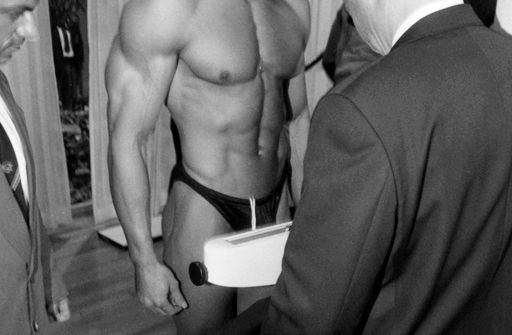
Muscle worship (also called sthenolagnia) is a form of body worship in which one participant—the worshiper—touches the muscles of another—the dominant—in a sexually arousing way. Practice can include wrestling holds and lifts, plus rubbing, massaging, kissing, or licking a dominant’s hard flesh. Participants may be any gender or sexual orientation, but the dominant is almost always someone with large body size or a high degree of visible muscle mass—professional bodybuilders, fitness competitors, wrestlers—while the worshiper is often, though not always, skinnier or smaller.
How Sessions Work
As with many BDSM-related practices, force and pain levels depend on what partners want. Some dominants use size and strength to pin a smaller worshiper, forcing contact with flexed muscle. Others only display the physique and allow touch on invitation. Erotic wrestling, lifts, ab worship, and foot service layered onto a pumped physique are common variations. The shared engine is strength made intimate: vascular arms as fetish object, quads as cage, the body as both idol and instrument of control.
Sexology sources list related labels. The Encyclopedia of Unusual Sex Practices associates sthenolagnia (“sexual arousal from displaying strength or muscles”) and cratolagnia (“arousal from strength”) with erotic wrestling, though dedicated studies are scarce. Anil Aggrawal’s 2008 monograph Forensic and Medico-Legal Aspects of Sexual Crimes and Unusual Sexual Practices defines both terms without much additional case material. In scene language, people simply say muscle worship, muscle dom, or bodybuilder sessions.
Money, Fans, and Online Posing Culture
People who practice muscle worship generally find it sexually arousing, but some male bodybuilders offer sessions primarily for cash—bodybuilding does not always pay the bills. For well-known competitors, sessions also draw fans who want a rare chance to meet and touch the muscles they idolize. Gay male muscle-worship culture supports websites where bodybuilders pose for admirers and sell private online posing shows. Other sites serve women who enjoy worshiping male bodybuilders. Many more orient toward straight men who worship female bodybuilders and other fit, muscular women, either virtually or through booked in-person appointments.
In Death, Drugs, and Muscle: Surviving the Steroid Underworld, bodybuilder Gregg Valentino called muscle worship a “taboo subject in the world of muscle,” and noted that Arnold Schwarzenegger might have participated in sessions in the past. When Dan Savage researched his 2002 book Skipping Towards Gomorrah, an advance helped him explore the Seven Deadly Sins, including paying “a male escort with a body like an SUV whose specialty was ‘muscle worship’ and who liked having his feet kissed for $500 an hour.”
Female Muscle and Subscription Media
In the documentary Supersize She, Joanna Thomas said she could not be a professional bodybuilder and hold a conventional job, which is why she ran a members-only subscription website. One of her photographers described the audience as attracted to large biceps and vascularity: “It’s all about the movement and it’s all about the muscles swelling and blood flowing though the muscles.” That description maps cleanly onto fetish viewing—pump, veins, and flex as erotic motion, not only as contest aesthetics.
Metaphor Outside the Dungeon
Critics have long used “muscle worship” as a metaphor for cultural glorification of brute physique. Margaret Bourke-White’s master’s thesis treated Wilkie Collins’s Man and Wife (1870) as “a satire on muscle worship,” citing Collins’s attack on England’s glorification of mere physical qualities. Arnold Lunn’s novel The Harrovians (1913) condemned a “school tradition of muscle worship”—athletocracy favoring elite athletes. Kōbō Abe’s The Ark Sakura (1984) includes an Olympic Prevention League that shouts “Down with muscle-worship!” Jean-Marie Brohm folded the phrase into a critique of sport ideology under capitalism, listing “virility, sexual athleticism, physical dominance, the superman, muscle worship” among values of the “capitalist jungle.” Dance critic John Martin argued that late-nineteenth-century culture fixated on muscle—“Every boy wanted to be a Sandow”—and that oversized biceps leave the body muscle-bound.
Those polemics matter for kink readers mainly as vocabulary history. In essays, “muscle worship” can mean school sports ideology or authoritarian body ideals. In the session room, it means negotiated touch, strength display, and often money. Keep the registers separate when you search or write about the fetish.
Consent and Why It Fits BDSM Maps
Because the dominant’s advantage is often real physical superiority, stop signals and negotiation matter as much as in wrestling or rough body play. Pinning, breath-restricting holds, painful squeezes, and genital contact should be explicit agenda items, especially in paid sessions where photography and time limits also need rules. Related interests include erotic wrestling, general body worship, female muscle fetish, and gay jock or muscle subcultures online. Muscle worship is not usually treated as a clinical diagnosis in ordinary kink talk; it is a descriptive label for a durable adult pattern: strength as erotic authority, flesh as altar, and the flex as both performance and dominance.
For bdsmwild readers: book or offer sessions as specialty power-exchange work with hygiene, negotiation, and aftercare; agree which holds are theater and which are real strength tests; and remember that posing-show sites and live markets are how a lot of competitive muscle stays funded—taboo inside some gyms, ordinary catalog line on fetish platforms.