
The Mineshaft was a heavy place in New York gay BDSM and leather history. It stood in Manhattan’s Meatpacking District at 835 Washington Street, at Little West 12th Street, on the edge of the West Village and Greenwich Village. The members-only leather bar and sex club for gay men opened on October 8, 1976, and the New York City Department of Health closed it on November 7, 1985, with tax pressure in the shutdown as well. It ran nine years. No sign, a grimy upstairs room, and it defined a period of public sex, fist-fucking culture, and a strict masculine dress code, then ended under AIDS-era legal pressure. This is a historical place for adult men, not a guide to how to cruise.
The crowd was wide, and some of it was famous. Writer Jack Fritscher was there opening night and came back hundreds of times. Photographer Robert Mapplethorpe, his lover, was at one point the official photographer and said, “After dinner I go to the Mineshaft.” Gay erotic artist Rex made images and posters for the club. People said to have passed through include Freddie Mercury, Rock Hudson, Rainer Werner Fassbinder, and Michel Foucault, among others. Manager Wally Wallace, born James Wallace, said he once refused Mick Jagger. A bouncer turned Rudolf Nureyev away. Annie Sprinkle has claimed she was one of only three women ever let in.
Upstairs, the dress code, and what the rooms were for
You came in through an entrance with no sign and went up the stairs to the second floor. Door staff enforced the clothes rule and turned away preppie looks and cologne. That rule shaped the bar’s style, and the style traveled past the membership list. The club started on the second floor only, then expanded to the first floor, reached by rear stairs. The second floor worked as a bar. No alcohol was sold, for legal reasons, and there was a roof deck. The rooms were built for sex: a jail cell, a truck-back area, dungeons, slings, cans of Crisco (a common lubricant among gay men before modern commercial lube), spotlighted bathtubs for watersports, a wall of glory holes, and a scat room that existed briefly and was dropped as too extreme even for that house. Fisting was commonplace. The Mineshaft Newsletter reported that the Fist Fuckers of America held meetings there. Recreational drug use was common. Promiscuity was not a side effect. The architecture was for it.
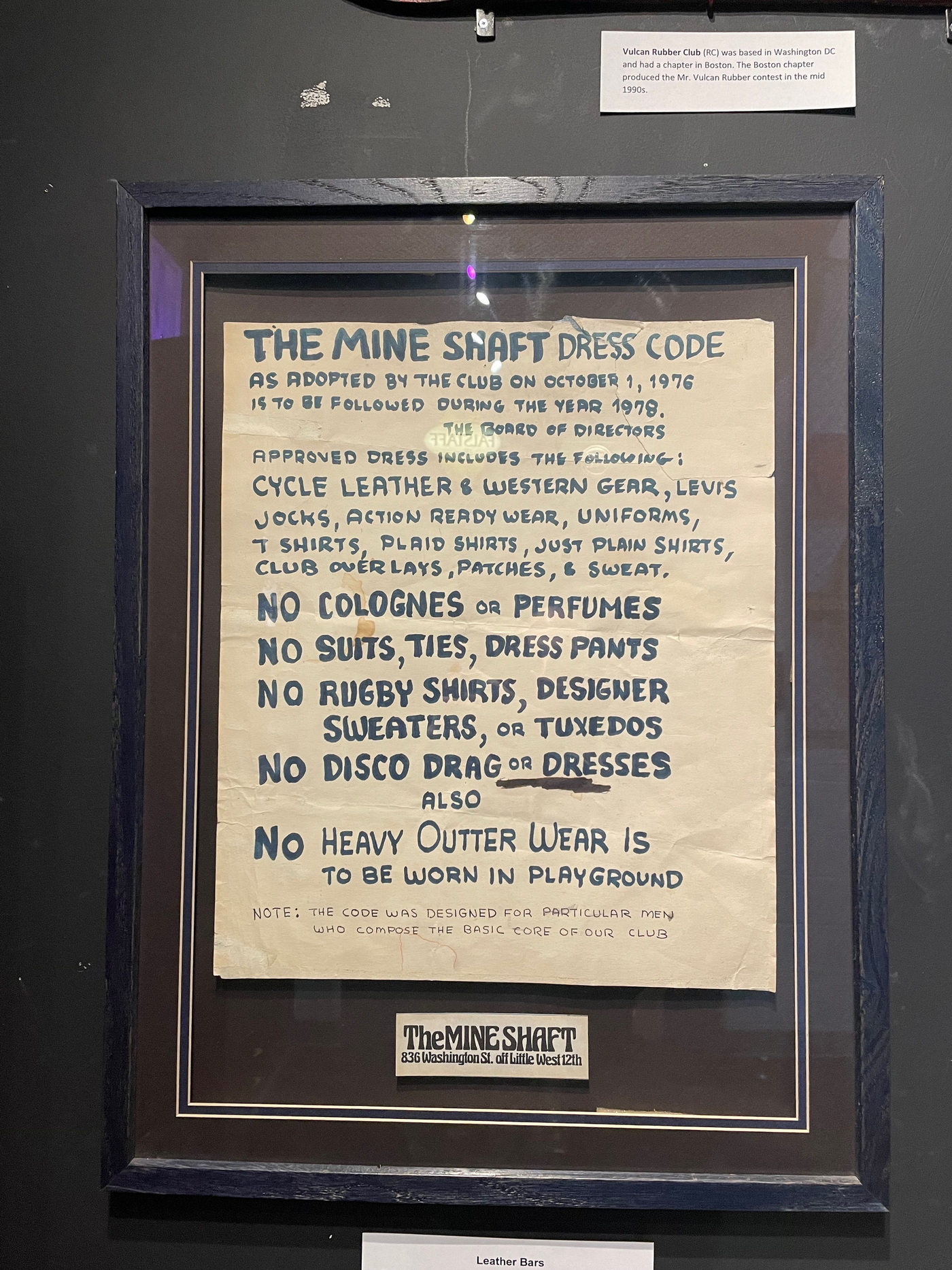
The dress code was adopted on October 1, 1976, restated in 1978, and approved by the board. Allowed: cycle leather and Western gear, Levi’s, jocks, action-ready wear, uniforms, T-shirts, plaid shirts, plain shirts, club overlays, patches, and sweat. Banned: cologne or perfume; suits, ties, and dress pants; rugby shirts, designer sweaters, or tuxedos; disco drag or dresses; and heavy outerwear in the area called the playground. The document is still cited as a classic of leather-bar style policing. Work gear and sexual readiness could come in. Middle-class fragrance and formal clothes stayed out.
The close, the records, and the films
After the 1985 closure, six men tied to both the Mineshaft and an affiliated heterosexual club, the Hellfire, faced criminal charges. Four pleaded guilty. Former New York City police officer Richard Bell was convicted. A sixth fled the United States. Wally Wallace later gave the club’s full records, including work by Rex and Al Shapiro, to the Leather Archives and Museum in Chicago.
William Friedkin’s film Cruising, starring Al Pacino, was meant to evoke Mineshaft-style gay cruising even though the bar is not named on screen. The Mineshaft refused filming, so the production used the Hellfire Club dressed to look like it. Regulars appeared as extras, and street scenes were shot nearby. Pacino went to the real club while researching the role. Gerald Walker’s 1970 novel Cruising, the loose source for the 1980 film, does not mention a bar called the Mineshaft. Jack Fritscher has argued that Jacques Morali drew the four Village People archetypes from the Mineshaft dress code. Glenn Hughes, the original leather biker in the Village People, was a regular. Freddie Mercury wears a Mineshaft T-shirt in the official video for Queen’s “Don’t Stop Me Now.” In episode 5 of the Netflix series Uncoupled, Brooks Ashmanskas’ character Stanley wears one too.
For adult leather readers the Mineshaft is not a romanticized safe-space club. It was a historical hard-sex venue. Its mark on gear, public sex culture, and film stereotypes has outlasted those nine years in the Meatpacking District.


![SO-28 GAG’S Gagged Women Shinobu Hosokawa, Rie Akiyoshi, Yui Kawana, Hikaru Masaki, Ruka Aida, Riho Kawauchi [Exclusive]](https://bdsmwild.com/wp-content/uploads/2026/09/SO-28-Exclusive.jpg)