
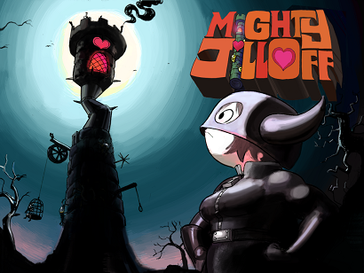
Mighty Jill Off is a 2008 independently developed freeware platform video game designed by Anna Anthropy, with art by James Harvey and music by Andrew Toups. It stars a submissive named Jill—a boot fetishist who must climb a tower after her Queen kicks her to the bottom as punishment. Players jump and slowly descend past obstacles that kill Jill in one hit, sending her back to the last checkpoint. The game is an homage to the 1984 arcade classic Bomb Jack and its console and computer sequel Mighty Bomb Jack. Follow-ups include Mighty Jill Off – Jill Off Harder Edition and Jill Off With One Hand. Jill later appeared as a playable cameo character in the 2010 platformer Super Meat Boy.
Anthropy, a BDSM practitioner, built the game’s BDSM and lesbian themes to put legitimate “dykes” into video games rather than male-authored stereotypes. She also made the climb punishing on purpose, so mechanical difficulty and erotic power exchange rhyme. James Harvey tried to keep the art legible and attractive to people inside BDSM culture without alienating everyone outside it. Critics at Rock, Paper, Shotgun and Game Set Watch praised the SM themes; GamesRadar and Bitmob praised the ruthless difficulty. 1UP.com listed it among favorite free PC games of 2009. For kink-aware players, it remains a landmark “masocore” indie: submission as vertical ascent, death as failed service, checkpoint as aftercare-adjacent retry loop.
Gameplay and Scenario
The scenario is pure D/s comedy with teeth. Jill is a submissive lesbian with a boot fetish. Her Queen kicks her down the tower for acting like a “greedy slut.” Jill must climb back up; when she reaches the top she receives affection, is constricted and gagged, and is made to do it again. Pleasure and ordeal are the same loop. Controls are minimal: move, jump, and slow-descend. In the air, rapidly tapping jump while holding a direction makes Jill drift; she can change direction mid-drift. That float is the core skill—precision under pressure, not button-mashing combat.
Three obstacle types kill on contact: spikes, fire, and spiders (spiders can move to attack when Jill approaches). Death is instant; respawn is at the latest checkpoint, typically at a room change. There is only one main level, but it is divided into many rooms. The screen scrolls vertically as Jill ascends. Room transitions are marked by background color changes. Jill has infinite lives, so players can grind the tower as long as they like without a game-over that wipes progress to the title screen. The design converts “one-hit death” into a masochistic comedy of retries—painful, funny, and thematically on-brand for a sub who is not allowed to quit the climb.
Development Intent
Anthropy (also known as Auntie Pixelante) designed and developed the game in 2008. Harvey provided character and environment art; Toups wrote the music. Anthropy’s stated goal was to put “dykes and perverts” on screen to counter “the distinct lack of real dyke characters and dyke desire in games.” She argued that “supposed dykes” in commercials are “written and drawn by men,” adding that “they don’t look like us, they don’t express themselves like us, they don’t lust like us.” She compared the challenge of guiding Jill through hazards to the challenge of a top guiding a bottom through a scene—difficulty as shared structure of control and trust, not only as macho hardcore bragging rights. That analogy is one of the cleanest design-to-BDSM translations in indie game history: the player’s hands become a kind of dominant caretaking, while Jill’s body takes the hits.
Art Design: Queen, Jill, and the Line Between Cute and Creepy
Anthropy first sketched Jill as a sprite; Harvey produced the finished character art. He was initially wary of BDSM-themed cartoon work, worrying that cartoony sexuality can make viewers uncomfortable—he cited Japanese harem anime as a cautionary zone. He argued that humorous sexual cartoons walk a “fine line” between “cute and funny” and “repulsive.” His aim was a Queen/Jill relationship that BDSM people could recognize while not repelling non-kink audiences. European comics’ relatively permissive attitude toward sex in cartoons guided him, as did Japanese cartoonists he felt handled sex successfully, including Monkey Punch of Lupin III.
Harvey designed the Queen from Anthropy’s loose brief as “sexy and authoritative,” a “fully grown human with relatively realistic proportions,” and an “amalgamation of every lesbian friend” he had “secretly been attracted to.” An early veil felt too girly and superfluous; he replaced it with spikes. He tried to make the title-screen background dramatize the power situation expressionistically. The Queen’s tower was first imagined as smooth and straight; he rejected that as too phallic and thematically meaningless for a lesbian D/s story. Anthropy and Harvey also ran a fan-art contest; five winners received handmade Mighty Jill Off activity books (tasks included inventing make-out partners for grotesque oafs and writing a poem for the Queen). Harvey scanned a book online so others could contribute. The books themselves carried BDSM-related themes, extending the game into playful community craft.
Jill’s design was harder. Harvey oscillated between a “funny little Mega Man character” and a grown woman: the first risked lolicon-adjacent readings; the second risked making the story too solemn. The Queen’s realistic proportions made a childlike Jill especially problematic. He drafted multiple proportion sets and sent them to Anthropy. He compared two options to Nintendo’s Mario (standard game-character design) and Link (slightly more realistic). Extreme realism, he feared, would reduce player identification and kill the humor. He also wanted Jill “dumpy and podgy” so she would feel more “lovable.” Anthropy preferred more realistic proportions; the final design landed at about three and a half heads tall. Because Jill is submissive, Harvey drew her as an “innocent,” “eager-to-please” figure with “benign, wide-eyed” expressions. That forced title-screen redesigns. Color coded feeling: rose tint for “blissful” affection toward the Queen, grey wash for sadness. He considered red accents on her rubber suit for readability, then rejected them as looking like a “crazy wrestler costume”; grey accents and chest initials were also considered before settling on all-black rubber. Making the suit shiny without reading as “gross lolicon manga porn” was a persistent technical-aesthetic problem. The art process itself is a case study in ethical cartooning of adult kink: how to keep lesbian SM readable, funny, and sexy without collapsing into either sterile seriousness or illegal-looking cuteness.
Follow-ups and Cross-Game Cameo
In October 2008, about eight months after the original, Anthropy released Mighty Jill Off – Jill Off Harder Edition. Clearing the original level in under twelve minutes unlocks a second, far harder climb. Finishing that climb shows Jill gagged and bound to a large X-cross, whipped once for each minute she took to reach the top again—score as aftercare-as-punishment spectacle. Anthropy compared the expansion to Super Mario Bros.: The Lost Levels: same toolkit, higher cruelty, no recycled challenges. She also released Jill Off with One Hand, a OneSwitch-style build playable with a single button, made over Buy Nothing Day with mobile play in mind. In 2010 Jill appeared in Super Meat Boy among other indie guest characters, pushing a boot-fetish sub into a mainstream-indie platformer roster.
Reception and Promotion
Reception was largely strong. Jess Ragan of Retronauts praised Anthropy’s grasp of what made Mighty Bomb Jack work. Scott Sharkey of 1UP.com listed the game among favorite independently developed freeware titles of 2009. Gamasutra named it a runner-up among the top five indie games of 2008. IndieGames’ Tim W. featured both the original and the Harder Edition as “game picks.” Nathan Meunier of GamesRadar put it among the “most ruthlessly punishing indie games,” wondering whether “the pain of a million deaths is worth the pleasure awaiting” players. James DeRosa of Bitmob called it “tough-as-s***” and credited Anthropy with coining the genre tag “masocore.”
BDSM-literate criticism was equally central. Kieron Gillen at Rock, Paper, Shotgun called it an “interesting examination of the master/slave relationship.” Alec Meer, also at RPS, described a “wry, subversive examination of why video game protagonists put themselves through a torturous amount of struggle to reach their objectives.” DeRosa praised Anthropy for topics most games avoid and summarized the work as a “hypersexualized, bondage-themed platformer” that “explores the power dynamics of sexuality and disassembles essentialist male and female sex roles as portrayed in video games—as well as the significance of difficulty and reward as a design method.”
For adult readers of BDSM in games, Mighty Jill Off is more than a novelty skin on Bomb Jack. It is a coherent argument that lesbian D/s, boot worship, and sadomasochistic retry loops can be the mechanical and narrative heart of a platformer—not a paste-on “mature content” flag. See also broader discussions of BDSM in culture and media. The official site and contemporary indie coverage remain the best starting points for anyone who wants to climb the tower, fail gloriously, and notice how much the failure feels like the point.
For readers of adult BDSM media and community history, this entry is kept at full informational density: names, dates, venues, and practices retained so the rewrite can stand alone without sending you back to an encyclopedia stub. Use it as a practical orientation piece—what the person, place, work, or title is, why it matters to kink culture, and which related threads (leather titles, rope craft, club geography, pop imagery) connect outward.