
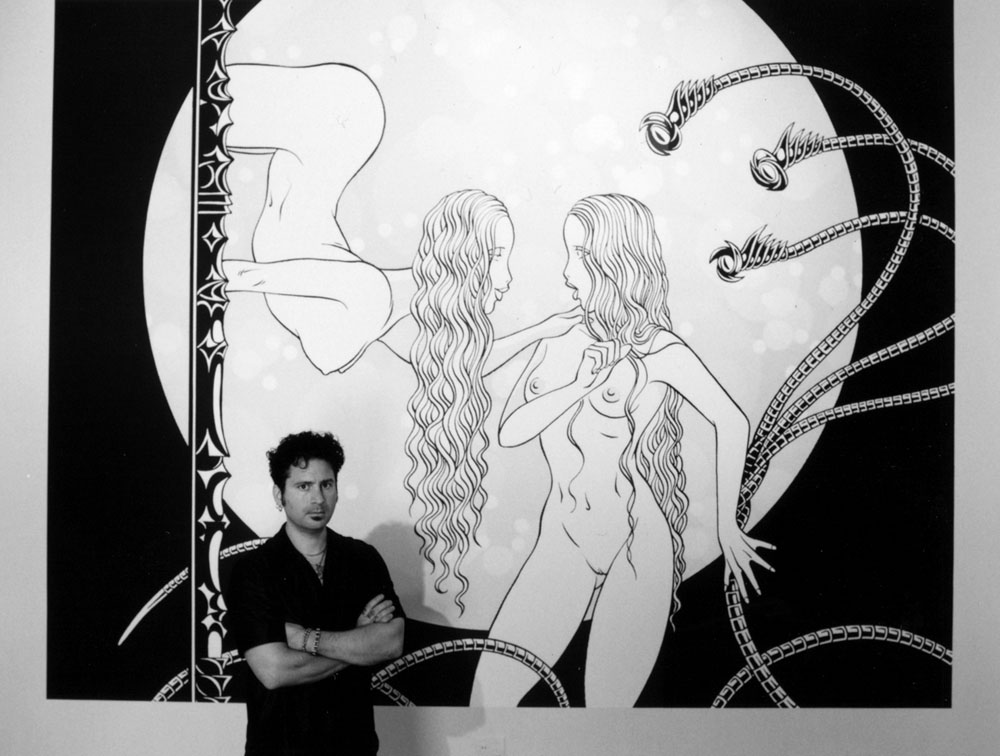
For adult readers of BDSM, fetish, and erotic comics, rope and leather in Michael Manning’s work are not decoration stuck on a cheap story. They are how power, desire, and clan politics move on the page. Manning, born in 1963 in Flushing, Queens, and raised in Beverly, Massachusetts, is an American comic artist, painter, and illustrator with classical animation training. His pictures have hung in galleries in San Francisco, New York, Tokyo, and other cities. The books kink readers know him for are the graphic-novel cycles The Spider Garden and Tranceptor. Both braid pansexual fetishism and BDSM into dense science fiction and fantasy: collared pets, ritualized power, and characters who do not sit in a simple male/female split.
He studied film and animation at the School of the Museum of Fine Arts in Boston. In 1987, at Olive Jar Animation in Brookline, he worked as an animator and directed short films, commercials, and music videos. He was also self-publishing. Cartoonists John Bergin and James O’Barr, creator of The Crow, showed that work to Kevin Eastman at Tundra Publishing. His first professional comics credit was in Tundra’s anthology Bone Saw. In 1991 he moved to San Francisco and made comics and erotic illustration his full-time work. He drew for the Bay Area’s growing BDSM and sex-zine scene, and he designed stages and costumes for music venues and fetish events. Work from that period was later collected in the art book Lumenagerie — dated 1996 in the account of those years, and 1997 in the bibliography — and in the 1997 anthology Cathexis.
The Spider Garden
The Spider Garden is the long cycle. In reading order the four volumes are The Spider Garden (1995), Hydrophidian (1996/1997), In a Metal Web (2003/2004), and In a Metal Web II (2003/2004). Volume one had been under contract to Kevin Eastman’s Tundra. After Manning left that contract in 1994, The Spider Garden became the flagship of NBM’s Amerotica imprint, and the later three books came out under the same roof. Italian and French editions followed.
The setting is a futuristic matriarchy with a flavor of feudal Japan, and the clans are at war. The Spider Garden itself is a palace-fortress of concubines, human pets, and the spider-like automata that give the place its name. Its ruler is Shaalis the Sacred Androgyne, a seemingly immortal hermaphrodite addressed with the pronouns Hir and S/He, spoken like her and she. Those pronouns mark a multi-gendered status. They are part of how power is named in that world, not a blank to fill in for a joke. Politics sets Shaalis’s Metal Spider Clan against the Serpentine Sisters, the twin commanders Squamata and Lichurna, who lead the Water Serpent Clan. Between the two camps stand a former pair of lovers. The courtesan Sasaya Nijan enters service in the Spider Garden to pay a gambling debt. Lord Verio of the Double Ibis Clan is deposed after a failed assassination and forced into alliance with the Serpentine Sisters. The Tengu are a non-human race, inspired by Japanese legend but not the same as it. The books imply that these beings once held humanity in bondage. Enslavement is deep history, pets are present décor, and clan war is erotic politics. The series treats SM hierarchy as the architecture of a civilization, not a bedroom hobby. The characters belong to that adult fantasy.
Tranceptor, Inamorata, and later shows
Alongside the Spider Garden books, Manning worked with the artist Patrick Conlon. Amerotica published Tranceptor: The Way Station in 1998. The second volume, Tranceptor: Iron Gauge, came out in 2007. A second major collection, Inamorata: The Erotic Art of Michael Manning, was published by Last Gasp in 2005, with an introduction by Patrick Califia-Rice. The book is a portable set of erotic line drawings. In 2002, panels from In a Metal Web were blown up to mural scale as a special installation in Fantastic! Comics and the Art of Illusion at San Francisco’s Yerba Buena Center for the Arts. His illustrations also appear in Tales of Gor, James Desborough’s role-playing game built on John Norman’s novels. Spidergarden.net went quiet after 2006. Later work moved to MM-Art.net and to gallery projects under The Manning Company. The books are still the way in: clans, pets, and the erotic line work.

![[SUNSET COLOUR] SK-6 Female Teacher’s Beautiful Ass 6 Yuriko Hosokawa 178sk00006](https://bdsmwild.com/wp-content/uploads/2026/08/SUNSET-COLOUR-SK-6.jpg)