
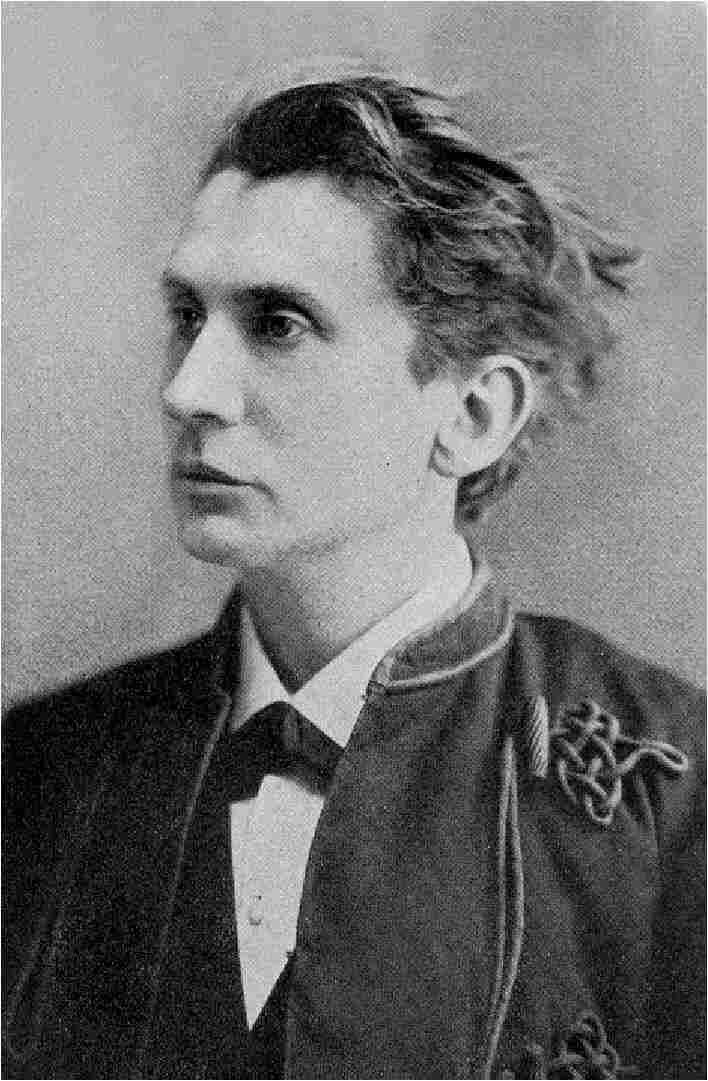
Leopold Ritter von Sacher-Masoch was born on 27 January 1836 and died on 9 March 1895. The Austrian nobleman, novelist, and journalist is remembered for erotic fantasies that outlasted his reputation as a regional storyteller. The psychiatric term masochism was coined from his name by his contemporary Richard von Krafft-Ebing. Masoch rejected the “honor.” In his own time he was better known as a utopian humanist and a chronicler of Galician life. Most of his books still have no English translation. For kink readers he is a literary root of consensual submission, fur fetish, and the contract fantasy that still structures a great deal of D/s fiction. There are two Masochs to hold at once. One is the public man of letters who wrote ethnic short-story cycles and social-humanist essays. The other is the private erotic architect who tried to live out Venus in Furs with mistresses and wives. Modern SM culture inherited the second figure through psychiatry’s naming habit and through the novella itself. The book still reads like a protocol manual dressed as Romantic literature. It is adult literature and private experiment, not a how-to.
Lemberg, and a border childhood
He was born in Lemberg, capital of the Kingdom of Galicia and Lodomeria, today Lviv, Ukraine, then a province of the Austrian Empire. The family was Roman Catholic. His father, Leopold Johann Nepomuk Ritter von Sacher, was an Austrian civil servant and an Imperial Police commissioner. His mother, Charlotte Josepha von Masoch, was a Ukrainian noblewoman and the last of her line. At the mother’s family’s request the father combined the surnames, and the Emperor recognized the new title Sacher-Masoch. Young Leopold studied law, history, and mathematics at Graz University and earned a doctorate in history in 1856. After a short time lecturing he left academia and wrote full time. The border childhood fed the ethnographic appetite of the later fiction: several languages, empire, Jewish and Slavic neighbors, a police-bureaucrat father, a maternal noble line on the way out. Galicia was not a postcard. It was a laboratory of types, costumes, and power relations. He eroticized those elements, and he sentimentalized them.
Legacy of Cain
Early non-fiction focused on Austrian history, then turned quickly to the folklore and multiethnic culture of Galicia. Within a decade the stories and novels outpaced the scholarship, but historical texture stayed in the fiction. Panslavist ideas run through much of the work. From the 1860s through the 1880s he published cycles of Jewish stories, Polish stories, Galician stories, German court stories, and Russian court stories, mining picturesque types among the peoples of his homeland. Socialist and humanist ideals show up in both the fiction and the essays. He argued for better societies, and he wrote contracts of submission and staged fur, cruelty, and waiting. Both strands belong to the same man.
In 1869 he planned a vast cycle, Legacy of Cain, meant to stage his whole aesthetic worldview. It opened with the manifesto The Wanderer, which already shows the misogynist tension in some of the erotic work: an idealized cold, dominating woman, and bitterness about women’s power. Six volumes were planned. He abandoned the project in the mid-1880s after finishing only the first two. Those two still hold his best-known tales. The method was to line up moral and erotic “types” like a philosophical exhibition. Cain’s legacy is biblical guilt, and it is also the inheritance of desire, violence, property, and love treated as systems. The unfinished cycle frames Venus in Furs as a keystone sample of a larger program, not as an isolated dirty book.
Venus in Furs, and the household
The work he is known for now is the 1870 novella Venus in Furs (Venus im Pelz). A man submits by contract to a dominant woman in fur. The story maps closely onto Masoch’s own fantasies and private experiments. What has lasted is the formalization of desire: written terms, staged roles, aestheticized cruelty, fur as a specific material of power, and the submissive’s active work of building his own humiliation. It is not just a plot about a man who likes pain. Later BDSM culture rebuilt those pieces as negotiation, protocol, and scene design. Masoch wrote them as Romantic psychology.
In 1873 he married Angelika Aurora von Rümelin. One model for the Venus figure was Fanny Pistor, an emerging writer who contacted him under the invented title Baroness Bogdanoff, asking for publication advice, and who became a living model for the dominant-woman-in-fur scenario. Rumor and memoir later mixed up which scenes were literature and which were household theater. The lesson is older than modern SSC language. Masoch tried to script power exchange inside real relationships. The literature generates fantasy, and it warns how messy that experiment becomes without the mutual, stable consent later communities treat as standard.
The public moralist, the diagnosis, the memoirs
He was also a prolific public moralist. In 1874 he published Die Ideale unserer Zeit (The Ideals of Our Time), a social portrait of Germany’s Gründerzeit. Court-story cycles, love stories set across centuries, Jewish and Polish ghetto stories, and late titles such as Die Gottesmutter (1883), Eternal Youth (1886), and The Serpent in Paradise (1890) show a working writer with a wide catalog. In his fifties his mental health declined, and his last years were spent under psychiatric care. Official reports place his death in Lindheim in 1895, a place later absorbed into Altenstadt. Another claim puts his death in a Mannheim asylum in 1905. The blur fits a life that was already being mythologized. The English rock star and actress Marianne Faithfull is his great-great-niece. Her mother was the Austrian-born Eva von Sacher-Masoch, Baroness Erisso. Eva was not Masoch’s own mother.
In 1886 Krafft-Ebing’s Psychopathia Sexualis defended the coinage. He felt justified in calling the “anomaly” masochism because Sacher-Masoch had made it the substratum of his writing, and because science already named conditions after people, as with Daltonism. Krafft-Ebing claimed private proof that Masoch himself “was afflicted,” and he did not publish that proof. He insisted that as a man the author lost nothing in cultured estimation, and that as a writer the “perversion” kept him from greatness whenever it entered the work. Masoch disliked the frame. Details of the private life stayed murky until Aurora von Rümelin’s memoir Meine Lebensbeichte (1906) appeared in Berlin under the pseudonym Wanda v. Dunajew, the name of a central character in Venus in Furs. A French edition, Confession de ma vie (1907), signed Wanda von Sacher-Masoch, was issued by Mercure de France. In 1991 RE/Search published an English translation from the French, The Confessions of Wanda von Sacher-Masoch. The memoirs are filtered through revenge, love, and self-fashioning. They are necessary, and they are not fully reliable.
What English readers usually miss
Points that keep coming up in the bibliography include A Galician Story 1846 (1858), Don Juan of Kolomiya (1866), Legacy of Cain volume 1, Love (1870), which includes Venus in Furs, Russian and Viennese court-story cycles (1873–77), Die Ideale unserer Zeit (1874), Legacy of Cain volume 2, Property (1877), Jewish, Polish, and related collections (1878–87), Die Gottesmutter (1883), Eternal Youth and stories from the Polish ghetto (1886), and The Serpent in Paradise (1890). A great deal remains untranslated. English readers often know the Venus novella and the psychiatric afterlife, and little else. A polyglot regional realist reduced to one erotic keyword is part of the cultural story.
Gilles Deleuze’s essay Coldness and Cruelty uncouples masochism from a simple “opposite of sadism” and takes Masoch’s contracts, waiting, and aesthetic cruelty seriously as their own erotic logic. John K. Noyes’s The Mastery of Submission, and studies of utopian peripheries, philosemitism, and modern sexual myth, including work by Alison Moore and others, keep reopening the file. Set him beside the Marquis de Sade and later Story of O and you have a European literary spine for sadomasochistic imagination. The man who lent his name to half of the BDSM acronym never asked for the diagnostic honor. For adult readers today he is more useful as an ancestor of the negotiated contract, the fur-clad dominant, the eroticizing of rules, delay, and humiliation, and the dangerous experiment of trying to live fiction inside a marriage, than as a clinical case. Read him as literature first. The name on the syndrome is a historical accident. The scenes he wrote are still load-bearing in kink culture’s shared imagination.
![CN-328 Forced Enema The Schoolgirl Next Door Midori Asuka [Exclusive]](https://bdsmwild.com/wp-content/uploads/2026/07/CN-328-Exclusive.jpg)