
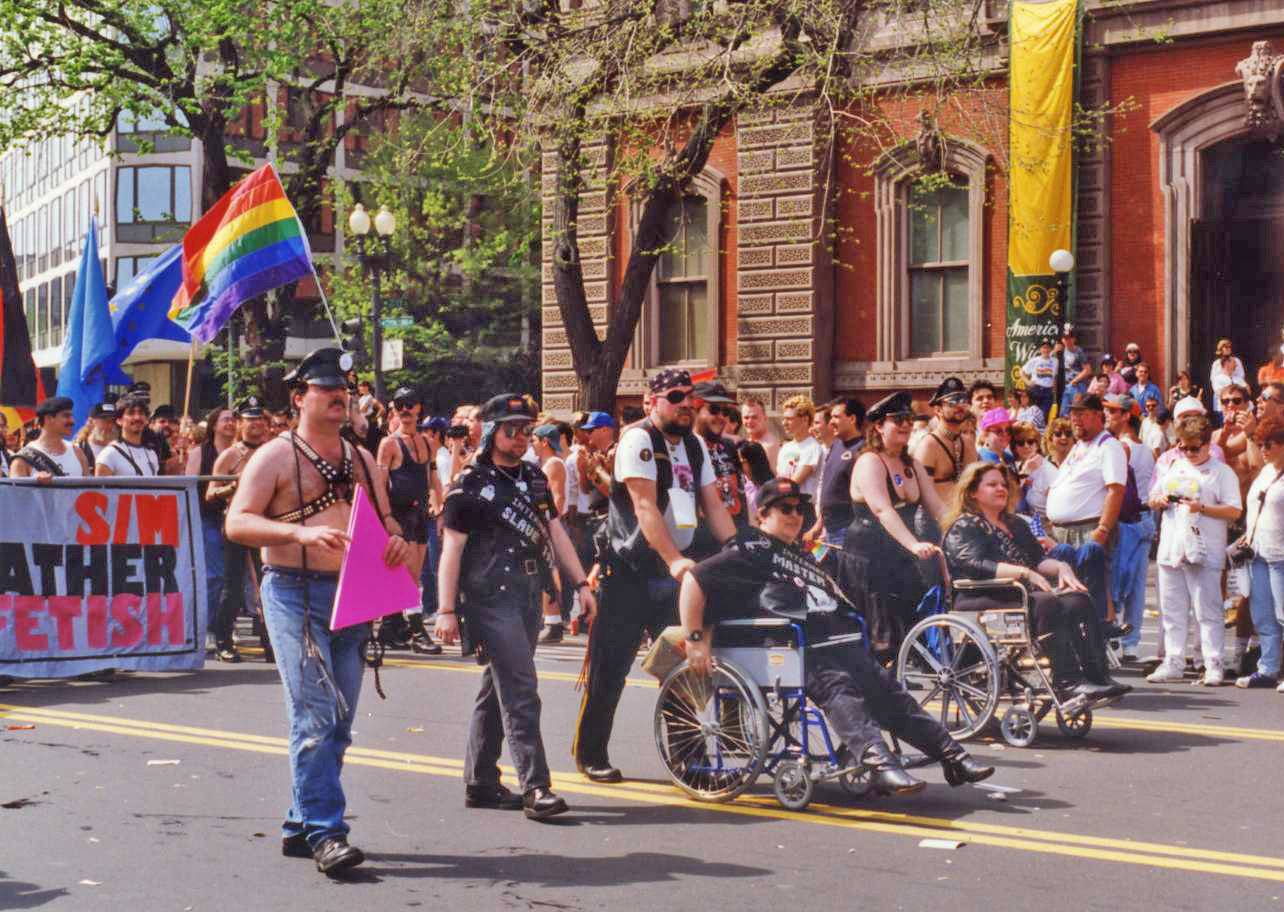
Leather subculture is not just a fabric. It is a way of dressing, a bar ecology, and a sexual style built around leather jackets, chaps, harnesses, and boots. Black leather marks people off from mainstream sexual culture, and it ties together gay and lesbian public sexual life. The charge in it mixes outlaw independence, heightened masculinity, and borrowed sexual power. Inside BDSM and fetish communities, leather is a visual language, an argument about Old Guard tradition, and one of the main ways kink announced itself to the twentieth century.
Gay leather took shape in major U.S. cities in the late 1940s and the 1950s, about twenty years after heterosexual fetish circles in Europe and the United States. It drew on two groups: postwar motorcycle riders in Los Angeles, and “pre-leather” butch BDSM players in New York. Queer service members clustering in big American cities in 1945 and 1946 brought military drill, male homosocial life, and a refusal of civilian softness into the early style. Sensational coverage of the 1947 Hollister “riot” turned biker notoriety into glamour. In the 1953 film The Wild One, Marlon Brando wears jeans, a T-shirt, and a leather jacket. The movie did not invent the symbolism. It standardized a masculine, sexual, radical look and distributed it nationally. Artists such as Tom of Finland drew exaggerated leather musclemen for physique magazines and carried outlaw-biker eroticism into gay visual culture. Early styles were already more than one thing: strict formal SM built on military models; the informal “rough sex” or “buddy sexuality” of bike clubs; leather fetishism as a taste for the material itself; and mixtures of those. Regional differences were wide, which is why later fights over the “original” tradition run so hot. Some historians doubt that the most romantic single system ever existed.
Bars were the container and the door. Through the 1950s and 1960s, leather bars appeared slowly in New York, Chicago, San Francisco, and elsewhere, then exploded in the 1970s. Lucas Hilderbrand has argued that bars gave the scene its coherence. Early rooms include the Golden Pheasant and Shaw’s on Third Avenue in New York, and Chicago’s Gold Coast, which Chuck Renslow reopened in 1960. In San Francisco’s South of Market, the Tool Box and later the Stud and Febe’s were hubs. Back rooms, dark corners, and basements were illegal sexual spaces that were mostly tolerated, and they were how newcomers got in. In New York, Frank Olson ran introductions by telephone. If you knew him, you could meet other people who were into S&M. The promise was a heavy sex night, and a reasonable hope that if you got tied up you would not get killed. In the 1970s golden age, bootblack stands and the color hanky code showed up. The Leatherman’s Handbook and the magazine Drummer taught people in smaller cities how to dress and how to signal. Drummer also sold overseas.
Gay men were not the whole story. In the late 1970s Cynthia Slater persuaded the Catacombs, San Francisco’s famous fisting club, to admit lesbians, and women got into a gay men’s leather space that had kept them out. In 1978 Pat Califia, Gayle Rubin, and others founded Samois, the first lesbian BDSM group in the United States. International Ms. Leather was first held in 1987. Dykes on Bikes led what was then the Gay Freedom Day Parade for the first time in 1979. Gay men are still the most visible leather demographic. These women had their own titles and their own place at the front of a parade, and during the 1980s AIDS crisis they cared for gay leathermen who were sick. BLADeaf, the Baltimore Leather Association of the Deaf, founded in 1986, was the first deaf leather club in the United States.
HIV/AIDS in the mid-1980s hit leather communities hard and also pushed organization and education. Sex clubs and bathhouses were shut. Hostility came from the mainstream and from parts of vanilla queer culture. The slogan “safe, sane, consensual” comes out of GMSMA in New York in 1981. It did not appear only after the baths closed. The National Leather Association was founded in 1986 to do education and activism for leather, SM, and fetish communities. The Leather Archives & Museum was founded in Chicago in 1991, while objects and histories were being lost. Mark Leno served in the California Assembly from 2002 to 2008 and was the first out leatherman to sit as a U.S. state legislator. San Francisco later created an LGBTQ and Leather Cultural District.
Argument about the Old Guard is still going. The phrase usually means a closed community from the end of the Second World War into the late 1960s, often using motorcycle clubs as cover, with military uniform, rank, and strict protocol. Historians have pointed out that this “pure form” may never have existed as a single system. The looseness later called New Guard and the strictness called Old Guard were both there from the start. Today Old Guard is more often a tradition people narrate than a single doctrine. Protocol is a way of teaching, not a costume-shop uniform. Tony DeBlase designed the leather pride flag and first showed it at International Mr. Leather in Chicago on 28 May 1989. He treated it as a first draft. Most people took the original as it was, and it has not been substantially redesigned.
Leather keeps moving through large events such as the Folsom Street Fair, international title contests, and leather bars around the world. Dating apps changed how people meet. Dress codes in physical bars still decide who is in the room, and a mentor still matters more than merchandise. The line runs from Tom of Finland’s drawings to a park at Natoma named for a leather leader. The test is the same one the scene has used for decades: when the cuffs close, is there someone who will vouch for you.