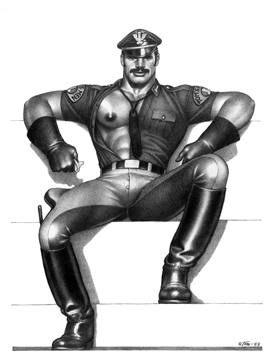
Kake (Finnish pronunciation roughly KAH-keh, [ˈkɑke]) is the best-known gay leather character drawn by the Finnish artist Touko Laaksonen, who worked as Tom of Finland. He headlines a twenty-six-issue erotic comic published from 1968 to 1986. Exaggerated muscle, an extravagant cock, cheerful promiscuity, and that friendly mustache helped set the visual default of gay leather culture worldwide. For readers who live in leather, gear, and power exchange, Kake is proof that hypermasculine SM style does not have to read only as a threat. It can be joyful propaganda.
The body is an ideal of masculinity: mustache, biker leather, jacket, breeches, knee-high riding boots, peaked cap. He also shows up as a cop, a mechanic, and in other fetish uniforms that put authority, grease, and street toughness in the same frame. Unlike the “dangerous” leatherman of straight media, he is friendly and easy to talk to. The stories sit in the sexual-liberation mood of the 1960s and 1970s: bright sex, not a grim hunt. When the comics touch BDSM or rape fetish, the sadism is often read as “innocent fun,” and the men can switch who is active and who is passive. That switchability is the point. The series does not freeze Kake in one power slot. A typical issue is about twenty full-page panels, mostly without dialogue. Sparse English shouts, or writing in the scene, keep the attention on bodies, gear, and how the meeting is staged.
Editor Dian Hanson has called Kake a “Johnny Appleseed” of liberated, mutually satisfying, explicitly drawn sex between men. On a motorcycle, he spreads the fantasy that men can fuck proudly, kiss and caress as well as penetrate, and still look like masculine strength. Laaksonen’s stated aim was simple and, for the time, radical: proud men who were happy having sex.
He started drawing multi-panel stories in 1946, as private pieces and gifts for friends. Leathermen were already in the drawings in the 1950s. He did not send comics out for publication until the 1960s. The first published comic, The Tattooed Sailor, appeared in the August 1961 issue of Physique Pictorial. Early published work suggested homoeroticism more than it showed it. Late in the 1960s, as censorship loosened, the sex on the page became overt. In 1965 he tried recurring characters: first a man named Mike, then a Tarzan-inspired Jack. A Danish commission then locked Kake in as an ongoing series.
Before that, the magazine usually ran part of a story and sold the rest by mail, a set of five to fifteen printed panels at about $1.50 a page. Kake broke the pattern. A reader could buy the comic book and keep it. Michael Holm, who handled the publishing, commissioned the series in the late 1960s. Interiors were black line, cheap to print. Covers were detailed pencil drawings, and Laaksonen kept using photo reference. The look came from a northern Finnish man named Eero, whom he met in Stockholm. Through the 1960s and 1970s Eero regularly traveled to Helsinki to pose for the character. The name Kake carries the force of a butch Finnish nickname, comparable to English “Butch,” and it was also the name of one of the artist’s friends. Slang toughness plus someone from his own circle made a figure who feels both archetypal and approachable.
Kake: The Intruder, published by DFT in 1968, opened the run. Laaksonen thought the pay was low and disliked losing ownership of the original art. In 1970 he accepted an offer from Revolt Press, which Holm had founded in Sweden, with a higher page rate and full ownership of the originals. In 1971 Kake moved to Revolt Press. That same year the Danish house Coq printed issues too. Parallel and overlapping underground printings make the edition history a mess, and exact sales are hard to pin down.
In 1979 Laaksonen and Durk Dehner founded the Tom of Finland Company, a mail-order business that later became the sole publisher of Kake and of the related merchandise and art books. Kake in the Wild West (1982), the company’s first book, sold out its first printing. A premium second edition, on better paper and with larger pages, sold out as well, and the company then issued deluxe reprints of earlier stories that had reverted to Laaksonen. The last comic was Oversexed Office in 1986. Emphysema, diagnosed in 1988, left his hands trembling and limited the drawing. He died in 1991. In 2008 Taschen published The Complete Kake Comics. Most of the original art is now in the archive of the Tom of Finland Foundation.
Unauthorized reprints and photocopies flooded the market for decades, so global sales stay muddy. Hooven estimated that twenty percent or more of Tom-related books produced between 1950 and 1979 were made without the artist’s consent. Some came from original art publishers never returned. Some were straight photocopy piracy. Those same pirated copies also put Kake’s face all through pre-internet leather networks.
Structurally, an issue is a short film in ink. The opening is often a place that already carried a sexual charge in gay male culture: a restroom, a park after dark, a worksite, a roadside. The men Kake meets are types — sailor, cop, cowboy, lumberjack — because the comics are as interested in the erotics of the role as in psychology. Gear and setting do the work dialogue would do in prose. When BDSM shows up, as restraint, rough handling, or rank, it sits inside the general cheer. The point is not trauma theater. It is mutual heat, without trapping either man forever as the victim. Leather readers claim him partly because the intensity comes without shame, and the role-play does not treat permanent degradation as the only script.
Edward Lucie-Smith argued that the masculine gay men Tom drew changed the way gay men think about themselves, building a dress-and-body type against the effeminate stereotype. Leather bikers already existed in both gay and straight culture. Laaksonen took Marlon Brando in The Wild One (1953) as a direct influence. Hooven’s view is that the leatherman as Tom drew him became the gay community’s gold standard. Kake, recurring for decades, fixed that standard in a run of comics, where a single pin-up could not. Susanna Paasonen has called him Laaksonen’s most iconic character. Hooven called him the gay world’s most familiar pin-up. Hanson’s Johnny Appleseed figure is about circulation: comics passed hand to hand, photocopied, taped to locker doors and bedroom walls. Piracy hurt the artist’s income and spread the look. Affection on the page is a political aesthetic. Kissing, caressing, switching active and passive, and looking happy while fucking pushed against mainstream homophobia and against the script that treated sex between men as tragic or furtive. For BDSM and leather history, Kake is not a rope manual. He is the mass-image engine that made peaked caps, boots, and chest harnesses read as an erotic home.
The character also reached audiences who never held a 1970s underground comic. Niklas Hogner plays him in the 2017 biopic Tom of Finland. Turku City Theatre premiered Tom of Finland, The Musical the same year. Those adaptations fold him into Finnish national memory and into international queer film circuits.
Nostalgia aside, the comics still do three things kink culture cares about. They treat gear — leather, uniforms, boots — as the main event, not an accessory to ordinary sex. They treat power play as compatible with warmth, humor, and switching. And they show that underground sequential art can invent a body ideal that real people then dress themselves into, at bars, contests, and pride marches. The line is clean, the bodies impossible, the acts wild, the mood often sunny. Hyperbole plus friendliness is the Kake formula. From The Intruder in 1968 to Oversexed Office in 1986, across DFT, Revolt, Coq, and the Tom of Finland Company, the series built a mythology you can carry: a gay leatherman you might want to meet, fuck, switch with, and wave to from a motorcycle afterward. Pirated copies, the foundation archive, Taschen’s thick books, the film, and the musical have kept the mustache in circulation. Collectors still work through original underground issues, later company reissues, and the complete edition. Scholars of gay visual culture use the series as evidence of how desire after Stonewall — and in the underground before it — taught itself a look. Men who have been in the scene simply recognize him. The man in the drawing looks like the man at the bar, and the man at the bar looks like the drawing. Tom of Finland and Kake closed that loop. The men in the comics are adults.
![[Art Video] 1945 Holy Woman Who Yearns for Bondage Drunken Angel of Riotous Abuse Hijiri Morishita](https://bdsmwild.com/wp-content/uploads/2026/08/Art-Video-1945.jpg)