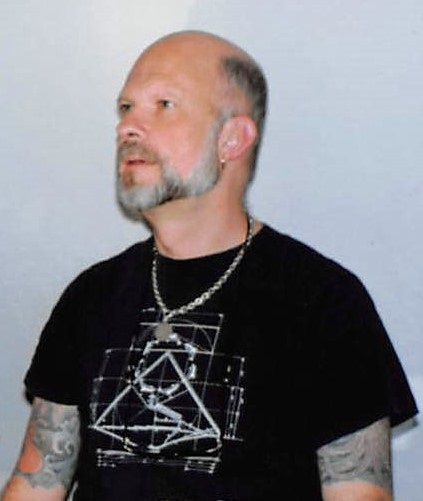
James Mark Ward was born on 28 June 1941 in western Oklahoma and moved to Colorado at eleven. In the 2004 MTV documentary The Social History of Piercing he is called “the granddaddy of the modern body piercing movement.” His shop, the Gauntlet, is widely treated as the starting gun of the commercial piercing business in the West. The career runs through leather culture, gay SM motorcycle clubs, and jewelry craft: private erotic ritual turned into a service with a public door. This is that history, not a set of piercing instructions.
In 1967, in New York, he joined the New York Motorbike Club, a gay S&M group. He studied jewelry making and, in that club, experimented with nipple piercing. Piercing as an erotic practice and piercing as a trade start in the same place. He later returned to Colorado, joined the gay Rocky Mountaineer Motorcycle Club, and went further into genital piercing.
In 1973 he moved to West Hollywood, a gay neighborhood of Los Angeles, and met Doug Malloy. Club experimentation started to look like a repeatable craft. The Frankfurt tattooist and piercer Horst Streckenbach, known as Tattoo Samy, and his student Manfred “Tattoo” Kohrs of Hanover, introduced him to barbell-style jewelry. Ward recalled that Samy came to Los Angeles through Malloy and showed him internally threaded studs. “They were internally threaded, a feature that made so much sense that I immediately set out to recreate them for my own customers.” The forms Ward pioneered include the fixed bead ring and internally threaded barbells. That generation moved piercing jewelry from improvised wire toward cleaner hardware built for a busy practice. Those two forms are now so common that newcomers rarely know they had makers.
A living room, then a storefront
Malloy’s money, tied to his work at the Muzak corporation, funded the start. In 1975 Ward used his home as a private piercing studio under the Gauntlet name. Early clients came from a mailing list Malloy supplied and from classified ads in local gay and fetish papers. After three years of refining tools and methods, he opened a commercial storefront in West Hollywood on 17 November 1978. The shop is commonly cited as the first of its kind in the United States: set hours, a jewelry case, and a door for the public. Body piercing left sailors’ lore and underground SM ritual and became a service business.
In 1977, with help from Malloy and Fakir Musafar, he started Piercing Fans International Quarterly, PFIQ. The magazine was an early print center for technique talk, jewelry, photography, and community argument, in the same way fetish clothing needed catalogues and leather bars needed newsletters. Tools, a shop model, and a magazine are the three layers of the influence.
In 2020 Ward entered the Leather Hall of Fame. He is also an inductee of the Society of Janus Hall of Fame. Those honors put him in leather and BDSM institutional memory, past tattoo-magazine celebrity. Consent forms, autoclaves, implant-grade steel, and menus that run from the lobe to the genitals, the ordinary equipment of a Western piercing studio, sit on work done by SM motorcyclists who treated the body as modifiable erotic territory and then professionalized the practice. “Granddaddy” is a publicity shorthand. The citation is the first shop, the magazine, and the jewelry.